
By Michael Nagler
Elon Musk, the world’s richest man, spent nearly half a billion dollars on the 2026 midterm elections, with much of the money going to Republicans in Texas—where Democrats had not won a statewide election in more than three decades.
It’s enough to restore your faith in human nature. I know I shouldn’t be writing this quite yet, as I’m buzzing from the Democratic victories that just gave repudiation—overdue, but overwhelming—to the wave of small-minded cruelty and destructiveness that has—no, had—threatened to wreck the hopes of democracy in America. There’s reason to hope this backswing of the pendulum is a worldwide, unstoppable event.
At the same time, it is a pendulum, and if we can stay calm (which I am not, at the moment), avoid triumphalism, as Martin Luther King would warn us, and take measured steps forward, we can lock in this victory of the human spirit. For so I regard it.
Flashback to 1956, the historic, successful conclusion of the Montgomery Bus Boycott. Reflecting on that victory in Stride Toward Freedom, King wrote, “We must avoid the temptation to take on the psychology of victors.” Indeed, earlier, one of the members of the White Citizens’ Council had said that if they allowed a certain concession, “The Negroes would say that they had won . . .” And that, of course, was intolerable. That same temptation we are well advised to avoid right now. Celebrate, of course, but celebrate a victory for democracy—even for human dignity itself, as I mentioned—but not a victory over people and parties who, in our considered opinion, were opposing it.
When Danilo Dolci, “the Sicilian Gandhi,” got a dam built that was vital for the local farmers but adamantly opposed both by the government, out of inertia, and, more importantly, by the mafia, who would lose a way to keep the people in subjection, a mafioso said to him, “Well, Danilo, congratulations; now you have all the water.”
“No!” Danilo quickly corrected him. “Now we have all the water. This water will benefit all of us.” That’s the nonviolent way of seeing.
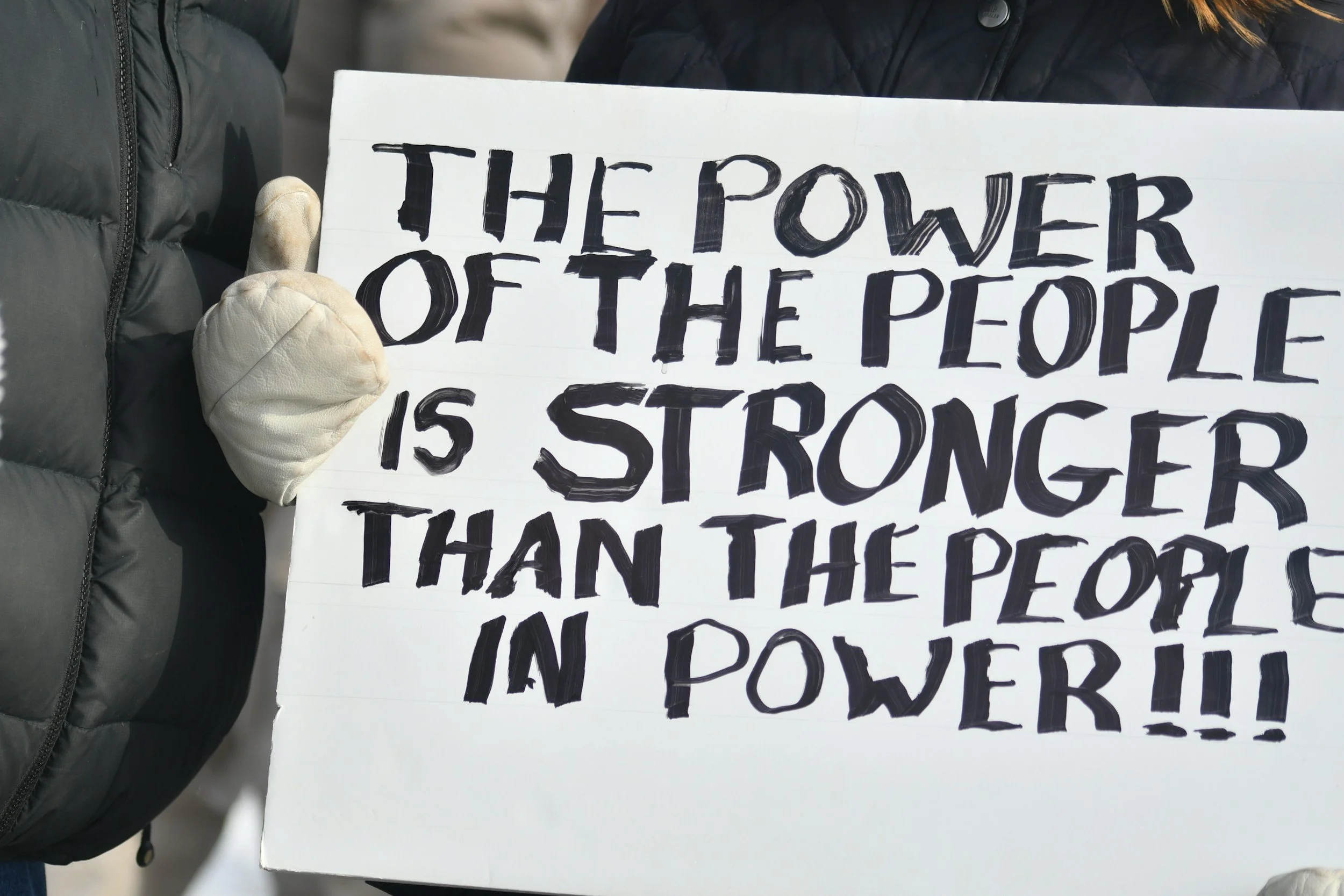
There is an aspect of the “blue tsunami” as it’s called, that’s particularly important and should be appreciated along with the electoral win itself, namely that even the world’s richest man could not buy it. While overturning Citizens United is among the several vital adjustments needed to lock in the November 4 victory, here is the first step that makes that possible: we may not need to “get money out of politics”—we can make it irrelevant.
Three other things need to happen to build on this remarkable success: break the stranglehold of the current Supreme Court—getting Alito and Thomas to step down, expanding the Court to fifteen, and taking other measures; abolish the Electoral College—an unneeded anachronism that has badly cheated us at least twice in recent memory; and loosen the grip of the two-party system, which makes elections a fight. Congress can change the size of the Court; abolishing the Electoral College requires a constitutional amendment. The third may be more elusive.
The system we are in will not solve our problems, so we have to keep our eyes on transitioning out of it into a higher order of democracy—beyond two parties and deeply humanized. We don’t have to burn it down. These expressions of progress give us something to build upon.
Along with avoiding triumphalism, i.e., construing the public awakening as a victory over others, we want to hold it as a great opportunity and responsibility. We want to build on it for the long term in many ways—every way possible—and understand its significance not just as the prevailing of one political faction over another but, as mentioned, as a victory for the principle of democracy and everything that principle implies about our human capacities.
Another flashback: during the Vietnam War, I was visiting my brother in Canada (yes, he was there because of the war) and stopped in to the Toronto Folklore Centre. Both he and I had spent time at the Greenwich Village version years earlier. Looking at the notices on the bulletin board to get a feel for the place, I suddenly gasped and sobbed. Someone had put up a note: “God, don’t ever let beautiful Canada go to war.” What a relief: even to imagine being proud of the country you live in. I had not realized up to then how damaging the—well, shame I had been harboring for the land of so much violence had been; how deeply we—not just me but a big swath of my generation—were carrying violence within ourselves.
The relief that so many of us are feeling now is of that kind.