
The Meaning Beneath the Monsters: Homer and Human Dignity
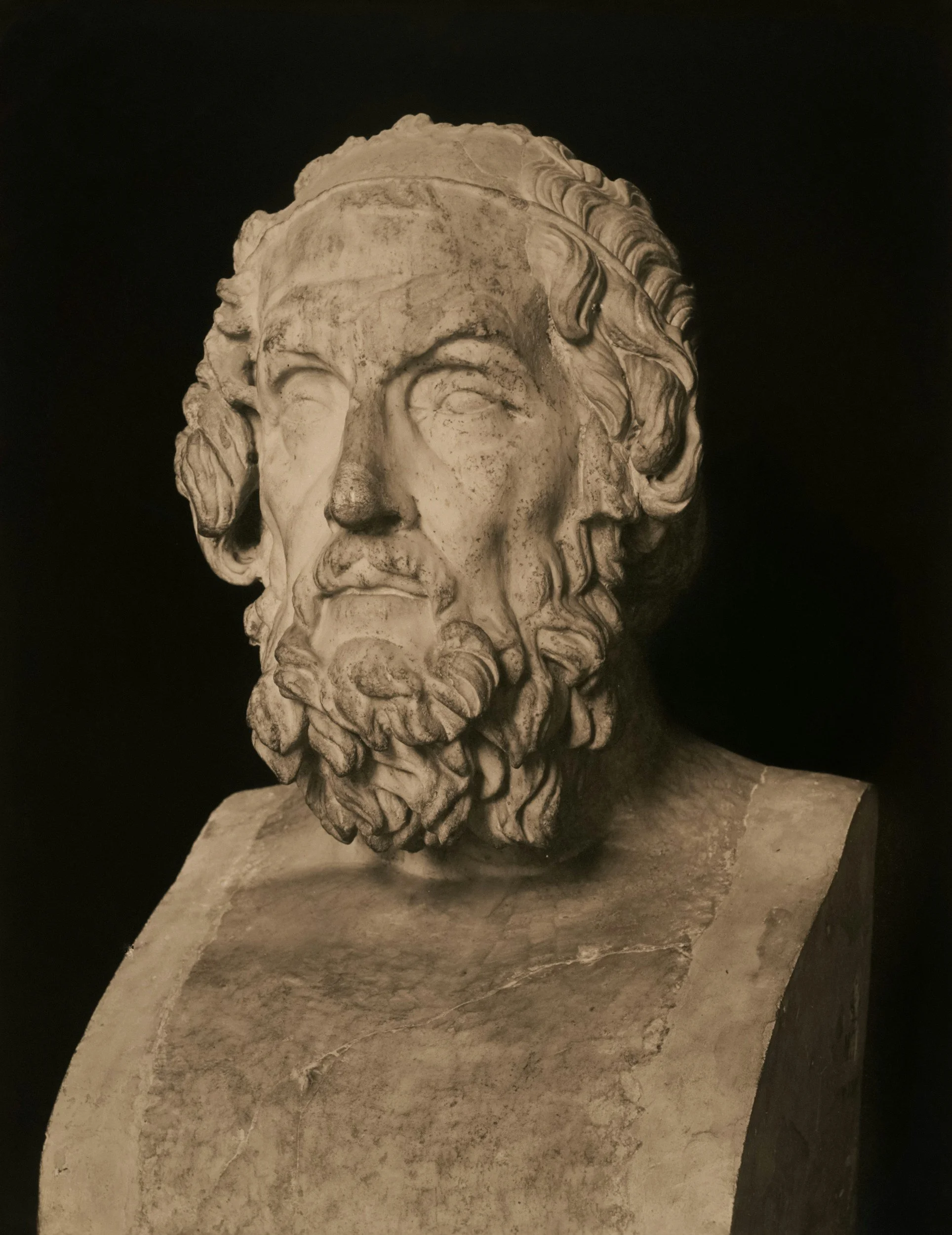
WHEN I WAS TEACHING HOMER at Berkeley (a career to die for) I did my best work, I think, on The Odyssey; so I knew immediately when Christopher Nolan’s “epic” film came out that I wouldn’t see it. In fact, I winced when I heard about it, and from what I can tell from the trailer and the reviews, I was right. We can’t redo Homeric poetry today because we’ve lost the one thing that made him such a classic 𑁋 the sense of human dignity.
Of course, there are monster fights and massacres in the ancient poem, but they are there because Homeric poetry was performed, at least in Classical times, before a wide audience, the entire city of Athens, in fact, and you needed to offer something for everyone. The monsters and the massacres were not only there because they were part of the traditional story, they served to get your attention, which could then be taken to the deeper message; in McLuhanesque terms they were the medium for that message. In Nolan’s film they’re the whole point. Think of the Bhagavad Gita in the Mahabharata, or closer to home, Shakespeare: his plays had elements of derring-do to keep the ‘groundlings’ in the theater, while for those who had the habit of looking under the surface of things there was profundity and gripping, often poignant depiction of what it means to be human. It was important for these poets to keep the whole range of audience goers engaged, because these genres were the voice of their respective civilizations. Homer’s poetic craft and the stories it worked with had evolved in a tradition that went back centuries where the singers and audiences (this is long before writing was used for literary creations) shared a deep treasury of beauty and meaning for which the song of the moment furnished a window. It wasn’t too different for Shakespeare.
When Milman Parry and Albert Lord were recording epic-length performances of bards in what was then still Yugoslavia they came to know that tradition pretty well, and on one occasion they complained to a singer that he had neglected a scene, I think the death of a hero who wasn’t yet introduced. “Of course I sang that part!” rejoined Avdo Međedovič. What he meant was that he and his listeners knew the tradition so well that he didn’t have to sing it out loud; they would ‘hear’ it in their minds.
Which is to say that the travesty of Nolan’s film speaks volumes about who we are now and what we’ve lost when a great epic becomes, in the words of Guardian film editor Catherine Shoard, ‘like a computer game.’ Or an action movie.
A couple of weeks ago, by coincidence, I had pulled down the Oxford edition of the text by my bedside and opened it randomly to the reunion of Odysseus and Penelope. It left me in tears. For bringing the richness of humanity to our hearts and minds, Homer was past master 𑁋 Homer, and the long line of singers 𑁋 and hearers 𑁋 who’d gone before him.
But let’s not fail to point out that the sense of human dignity that we all carry can never be extinguished; it can only be buried, in our case under the deluge of advertising, commercial and political. Nolan’s film will not exhume it, of course; on the contrary some will be convinced by it that humanity had no more dignity 3,000 years ago than we imagine it does today. The widely hyped film will stand in the way of learning from Homer the great lesson he has to offer, that life is rich with subtlety and poignant with meaning. But some, I feel sure, will be prompted to go back to the poem, itself. May it uplift their spirit and give them a glimpse of what we can still become.
Michael Nagler is Professor emeritus of Classics and Comparative Literature at UC, Berkeley, and author of the book and film The Third Harmony: Nonviolence and the New Story of Human Nature. He lives amid foxes, deer, and human friends near Tomales, CA.