
Hope or Terror?
"Satyagraha is a force that has come to stay. No force in the world can kill it."
~Mahatma Gandhi
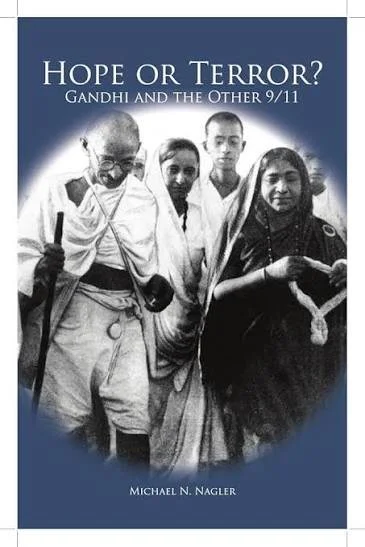
Twenty five years on from September 11, 2001, we, with countless others, continue to ask ourselves what might be different today if we had taken a path of trauma healing and reconciliation instead of retribution and violence. We should be able to see clearly now that our trauma was manipulated to sell war, weapons, nationalism, surveillance technology, and “homeland security.” And what about the spree of hate crimes against Muslims and Sikhs (among many others) that followed? We were handed bitterness and hatred instead of a path toward growth, transformation, and healing. Our grief, sacred and fragile, was harnessed into a violent rage as a nation, and it still hurts. Memorials tell us "never forget,” where’s the memorial encouraging and teaching us how to heal and forgive and grow?
It is a strange coincidence that on the exact same day, but almost a century prior, in 1906, Mahatma Gandhi stood before a crowd at the Jewish Empire Theatre in Johannesburg, South Africa, and launched Satyagraha for the first time. Satyagraha means a coordinated and strategic struggle rooted in determination and love, with the aim to overcome and transform—not perpetuate—violence.
Even 25 years on, it’s still not too late to choose a nonviolent path, if we have the will and courage.
~Stephanie Van Hook, Executive Director
PS: Please find our pamphlet about Satyagraha at the link below.
We are taught to believe that terrorism can only be countered with more violence, more “security.” In this short animation, we explore how terrorism must be understood from a structural issue if it is to be addressed without increasing violence; and that security to be true to its name must have a human face.
Michael Nagler’s first edition of The Search for a Nonviolent Future was published in 2001 under the title, Is There No Other Way? The Search for a Nonviolent Future, and went on to win an American Book Award. We republished this classic (under its second title, The Search for a Nonviolent Future: A Promise of Peace for Ourselves, Our Families, and Our World) in 2025 and it remains as important today as it was then, exploring deep questions about nonviolence, how it works, and offers a toolkit of concepts helping us better understand how to apply it in our world today. Find a copy at our bookstore.

A Message from Michael Nagler
IT IS CERTAINLY SOBERING to reflect that today, 25 years after the shock of the 9/11 attacks, we are still waging war to bring peace, in the Middle East and elsewhere. Here at Metta, we are in the growing camp of those who consider this worse than an exercise in futility 𑁋 it is an exercise in what Sigmund Freud called the “repetition compulsion,” not just in individuals but nations. That syndrome happens when you (or your nation) try to solve a problem with the wrong means, and since it doesn’t work, but you’re not aware that there’s an alternative, you just keep on doing it, irrationally and, as in this case, destructively. An article in the recent New Yorker cites the staggering figure of 28,000 who have committed suicide since that dreadful event.
A cousin of mine and a dear friend worked in those towers. They both survived, in my friend’s case because her alarm hadn’t gone off that morning (!); as for my cousin, Sylvita, she survived all right, only to see her husband Chick die of a heart attack 𑁋 as there had been no way to communicate to him that she was alright 𑁋 when she walked in the door.
My anti-war mind had been formed long before, but if there was any doubt I should devote my life to awakening the only alternative, nonviolence, it certainly fled then. We 𑁋 the American people, the world at large 𑁋 are waking to the destructive and needless burden of war. Whereas the Iraq War began with 70 percent public approval, Trump’s war in Iran has been widely opposed from the beginning, with only around a third of Americans currently in support. But the troika of money, power, and violence is to date still able to ride roughshod over our awareness. It will stop; it will have to stop. It will stop when the alternative grows large enough in our minds and our institutions. Gandhi said, “Nonviolence has come among men.* It will live.” And so shall we the people.
~Michael Nagler