
When madness becomes policy
To address the present crisis, we need to go beyond politics and transform our modern culture that degrades us.
By Michael Nagler
“Those whom the gods would destroy, they first drive mad.” This bit of folk wisdom has been kicking around for about 400 years now and even been (falsely) attributed to much earlier Greek and Latin sources. Whatever may be its origin, it rings disturbingly true to now. Looking at the erratic and dangerous decisions of President Trump, renowned economist Jeffrey Sachs, one of the most astute analysts of international affairs recently said, “this is madness.” And he added that it’s the precursor to self-destruction. When you consider how we could have used our financial strength to eliminate poverty and our power to eliminate war, the waste of opportunity is a tragedy of world-historical proportions.
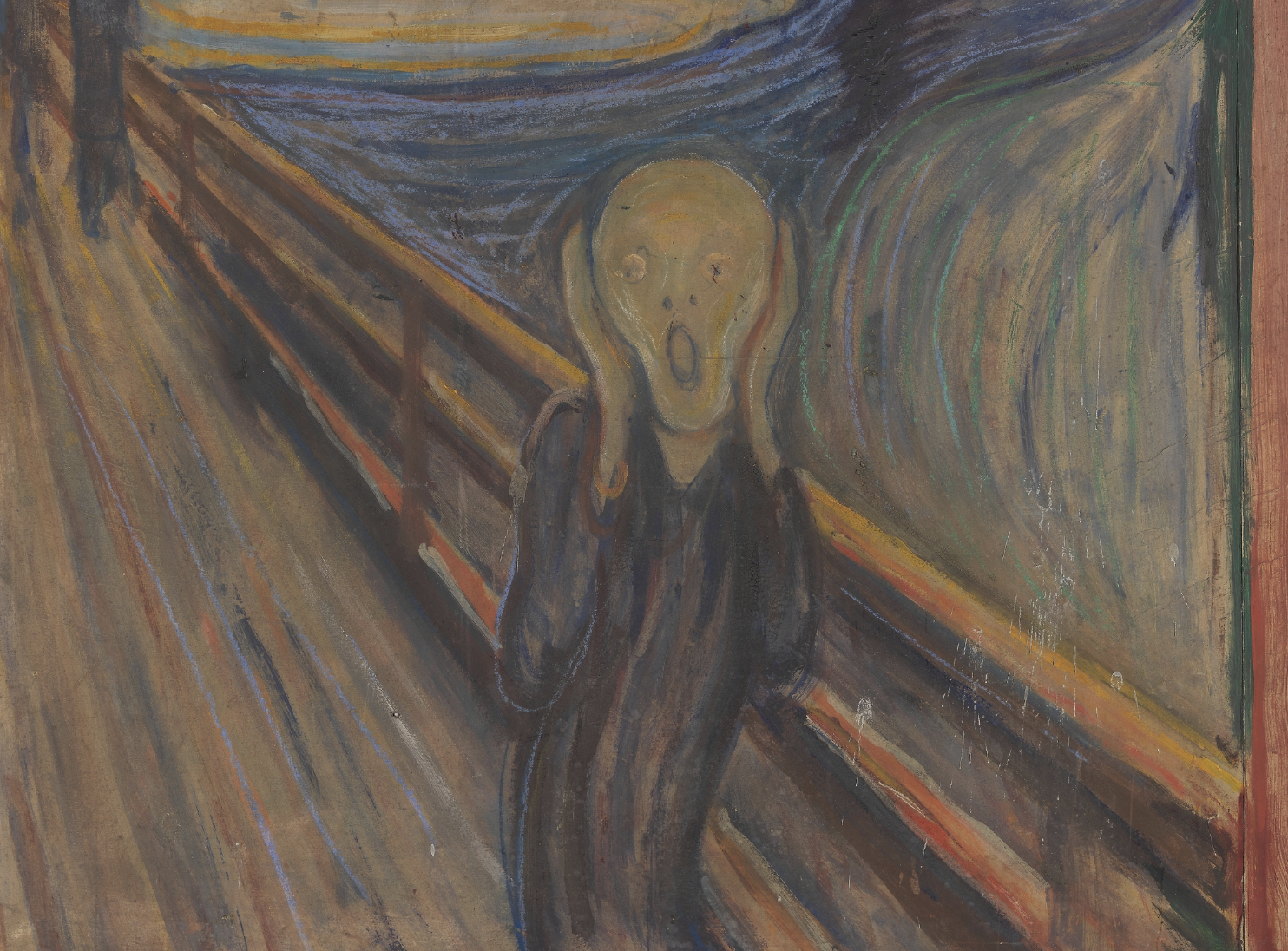
The Scream by Edvard Munch
Of course, there have been protests. We have seen many of them come and go, often with no discernible results, but if there’s reason to hope this protest will be different it’s not because of its size —12 million protested across the globe against the looming war on Iraq, but the American president launched it anyway. The ray of hope is rather the growing awareness that protest is not enough. The current president, that self-declared “very stable genius” with a very big ego (yes, he declared that, too) will still show no trace of recognition that he is leading civilization over a cliff. There must be more we can do.
What might it be? I hold that we need to aim high; to go beyond disestablishing a rogue regime, beyond any political change — though some restructuring of our political system is clearly and desperately called for. We must get down into the roots of modern culture. Who were the 77 million people who voted for this administration? What were they thinking? It reminds me of a TV producer who was asked what he was thinking to promote such violent programming. He replied almost indignantly, “There was no thinking whatever behind it!” In his case, there was only a mindless concern for profit; in the present case, it’s an equally mindless drive for global hegemony. You can’t have one without the other; the former madness enables the latter. You have to degrade the human image to produce a population manipulated by shallow, inflammatory language they never think to examine.
In other words, behind the 77 million voters lies the entire cultural infrastructure of America, and to one degree or another of all the Western industrialized civilizations. It’s a culture that predisposes people to want a politics that regards the human being as incompetent, needing to be led and controlled; in other words, the modern Republican party. I once watched a contest on television between two candidates for office. As soon as each had spoken his piece the announcer assured us, “We’ll have the results for you in a moment.” The results? For us? I thought the whole point was to allow us to decide. But of course, that would have been democracy.
The connection I’m making between commercial and political propaganda is not a new discovery; it was brought out devastatingly by a 2002 BBC documentary, “The Century of the Self,” that’s available now on Netflix. It should be watched by anyone who wants to understand — and we must, repugnant as it is — the devious “method” behind the fatal “madness.”
Always assuming we don’t actually blunder our way into World War III, aka Armageddon — for which our warmonger-in-chief, Pete Hegseth, can barely contain his enthusiasm — we would still be stuck with the related setback of the present collapse of reason: a worldwide loss of faith in democracy itself. But it’s important to recognize that democracy has not failed us; what we’ve really had here for some time is the shell of democracy, the empty structure, because we don’t have a culture that would empower people to use it. And that was before the deep fakes and general collapse of truth enabled by more powerful media recently.
Before there was the intoxication of war there was the lie of consumerism. According to James Douglass’ thorough research, the man who is in prison for the assassination of Bobby Kennedy, Sirhan Sirhan, was hypnotized into performing his role as patsy for the real killers (who have never been identified in public). That was not the first or the last time the CIA used that diabolical method to strangle in its cradle any possibility of peace. But I am proposing there is a sinister, largely unrecognized relationship between the use of this weapon to stifle consciousness in individual cases and the mass hypnosis to which we are all subjected daily by advertising.
I’m not proposing that advertisers do this deliberately, by the way; I’m not a conspiracy theorist. My interest (and very probably yours as well) is, what do we do now? How do we get a good number of people to recollect their minds from this culture of falsity and advertising and relearn how to think for themselves?
I am not the first to compare advertising to a mass hypnosis; since it is, what is its subliminal message? That we are helpless, separate from one another and the nature around us, confined to the narrow confines of what we are made to believe is our self-interest in a world with no other meaning. As a Western person, I have been exposed to, without exaggeration, a million messages selling a thousand different things — but with one underlying theme: “serve yourself, get yours, be better than the unfortunates around you, and emulate the rich (who are often the most unfortunate of all).”
Advertising drives overconsumption, which itself is a major cause of war and violence; but on a deeper level its massive propaganda prepares us to “buy” the message of vulgar selfishness represented by our worst politicians, who by no coincidence are now the ones in the highest offices and most powerful positions.
Again, what protection do we have against this pressure? What kind of resistance can we offer? How can we turn such a huge ship around?
A clue comes to us from one of the greats of American intellectual history, Ralph Waldo Emerson, when he stood gazing at the Concord Armory and pondered, “Timber, brick, lime and stone have flown into convenient shape, obedient to the master idea reigning in the minds of many persons … It is really a thought that built this portentous war establishment, and a thought shall also melt it away.” Human beings influence one another not just by their votes but by their thoughts; in fact, their thoughts come before their votes. Otherwise, advertising wouldn’t work. We even know something of the neural pathways for this well-known effect, the “mirror neurons” discovered in 1988 and studied by UCLA neuroscientist Marco Iacoboni and others. Consciousness is powerful, subtle and widely misused; but it could be used just as powerfully for good.
This is our most promising secret weapon. Consciousness is not material; it has no limits in space or time. Inherently, even one person’s consciousness can sway millions, indeed it has: 77 million in the matter at hand. And a raised consciousness can sway them back. As far as voting is concerned, it wouldn’t have to push very hard; the political margins are very slim. But we need to do much more than push the pendulum back across the aisle. We are talking about changing a culture, which is the same process as political change, only on a deeper level. And that change, if we could pull it off, would be more permanent.
And to do this we can take a second clue, from Gandhi, specifically from his economics, where he made a critical discovery: trusteeship. The idea was not to forcibly dispossess the wealthy (which would only lead to violent resistance) but to encourage them to use their immense resources for the well-being of the whole community. It enables them to feel good about their capacities and feel some sense of connection with the less financially fortunate, who are in a sense their victims. (Practically everything Gandhi did had greater unity as the goal).
On the grand, policy level we’re considering here it would mean using our great wealth and influence to alleviate suffering and bring the rest of the world economy along — the opposite of what the administration is doing. We would outgrow the childish boasting about “numero uno”and instead find our purpose as a primum inter pares, or first among equals. It would dramatically reverse the damage being done to American prestige and reestablish American leadership as a benefit to humanity. And of all humanity we would ourselves benefit most of all. There is a lot of science to show that we are made to serve, that the human individual comes into her or his own by helping others; can it be different for a nation which, as Gandhi pointed out, is made up of individuals?
The big changes we want on the political level — abolishing the electoral college, revoking Citizens United — depend on even deeper changes on the cultural level. That will require a media culture that is democratic — not corporate-owned — and nonviolence-aware.
These are tectonic, paradigm-shifting changes which will ground us in a more realistic vision of the world and our place in it. It’s not clear how to make them happen; but it is clear that naming them is a first step. And widespread education is the next.
There is a Buddhist story about a monastery in Thailand; a monk runs in breathlessly to tell his abbot that an entire teak forest nearby has burned to the ground. “Then we must replant it,” responds the abbot calmly. “But it takes a hundred years to grow a forest!”
“Then we must start right away.”