
Weaving Lawyers and Judges into the Pro-Democracy Movement
Justice in Motion organizers Danny Miller and Steve Silverman on building public trust and defending the rule of law
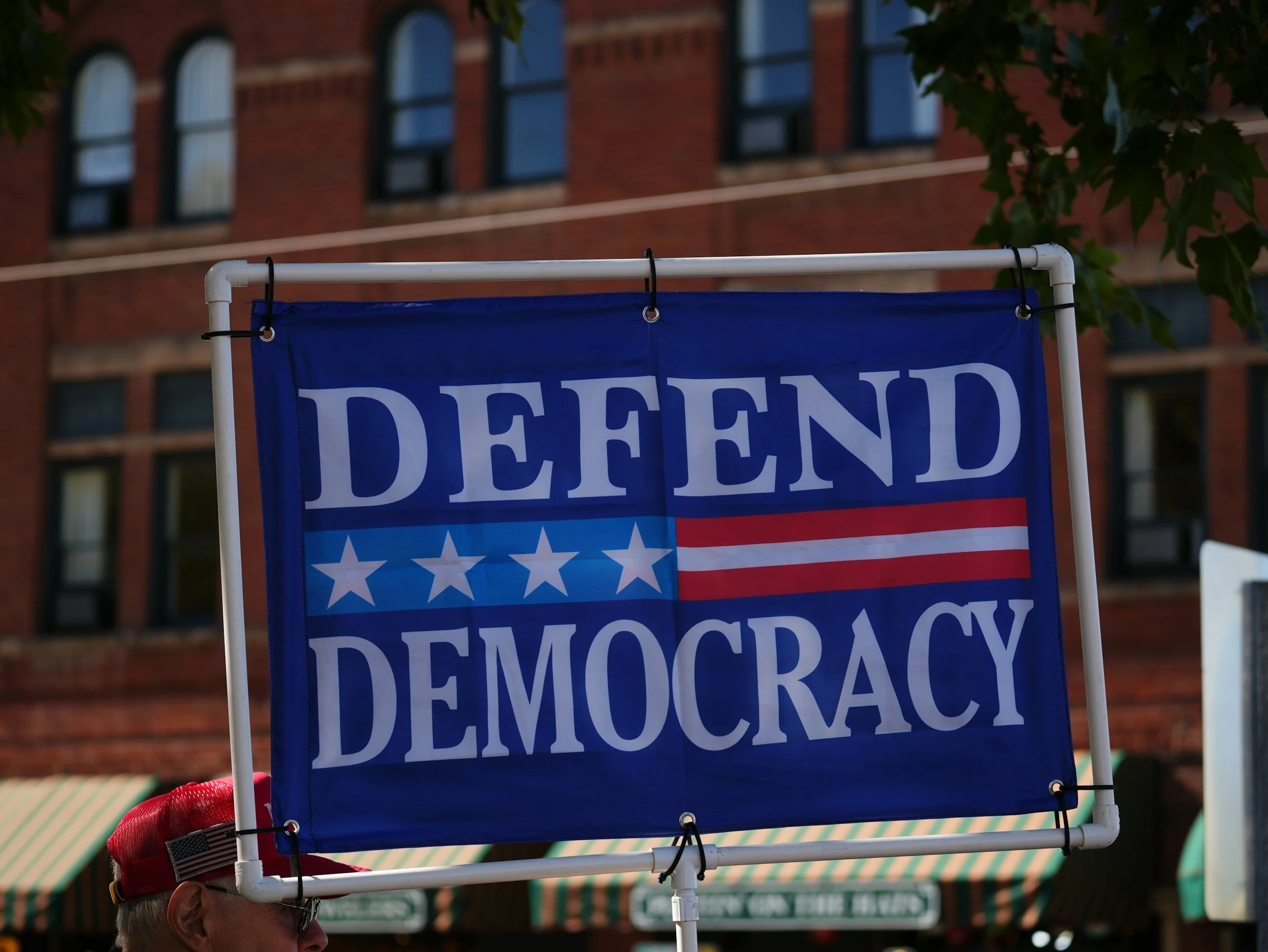
What happens when judges leave the courthouse to meet people in donut shops, community centers, and town squares? Danny Miller and Steve Silverman, organizers of Justice in Motion from the Democracy Rising Collaborative, share what they learned from taking judges on the road to connect with the communities they serve. Their conversation explores how public trust grows through personal encounters, how one person’s willingness to act can inspire others, and why protecting democracy requires participation beyond the courtroom. In the Nonviolence Report, Michael Nagler highlights cooperatives, constructive program, and the power of human connection to break cycles of violence.
Transcript, with gratitude to Elizabeth High
Stephanie Van Hook: Well, greetings and good morning, everybody. Welcome to another episode of Nonviolence Radio. I'm your host, Stephanie Van Hook, and I'm here in the studio with my co-host and news anchor of the Nonviolence Report, Michael Nagler, and we are from the Metta Center for Nonviolence in Petaluma, California.
And on today's show, we are going to be thinking about the rule of law, the role of judges and lawyers in this Great Turning, in this shift from violence to nonviolence in our world. And people may not know this about Gandhi, but he actually began his career as a nonviolent resistor, as a lawyer. And he had a lot of interaction, obviously, with the legal system, stirring up a lot of trouble for the British government in India, and was on trial many times. Michael, you wanted...
Michael Nagler: Yes, Stephanie, thank you. I did want to mention something. This is kind of a poignant contrast. After working in the field of law for some years, Gandhi said, "I have discovered the purpose of the law. The purpose is to unite parties that have been riven asunder." And just contrast that, sorry to do this, but contrast that with the billboards that we see alongside our freeways and highways and roads in California, where it advertises Law Tigers.
Stephanie: Mm-hmm. "Get as much as you can."
Michael: It's the exact opposite. "We're going to savage the opposition for you." Thanks. I had to get that off my chest.
Stephanie: You got it off your chest. Well, I wanted to add, so at his 1922 sedition trial, Gandhi asked the judge to resign rather than enforce the law that he believed to be unjust, or impose the severest penalty if he believed that law served the people. So that's a tricky space that he put the judge in.
Michael: Typical Gandhi.
Stephanie: It raises the question that remains with us today: How do we defend the rule of law while retaining the courage to challenge unjust laws? Our guests today are Danny Miller and Steve Silverman. They're co-founders of Democracy Rising Collaborative, which mobilizes lawyers, retired judges, and civic leaders to defend democracy and the rule of law.
And in our interview, they share stories from Justice in Motion. It's a bus tour that brought judges into communities to talk about why an independent judiciary matters in everyday life. And we discuss with them organizing across political differences, the role of people power alongside legal action, and how we can help one another find the courage to act. Let's turn to Steve and Danny.
Steve Silverman: Danny and I started Democracy Rising Collaborative last November to educate, organize, and mobilize lawyers, retired judges, and civic leaders for democracy, to stand up for democracy, and utilize the collective action to get people involved and to push back on democratic backsliding here in the United States.
We had both been part of organizations. I was the communications advisor to the ABA Task Force for American Democracy, which was a really wonderful group co-chaired by Secretary Jeh Johnson and Judge Michael Luttig, and a wonderful cross-section of American leaders from Dick Gephardt to Carly Fiorina, and so on and so forth. And when that was ongoing, I was part of a number of different coalitions and collaborations, which is so critical in this space. And during that time, Danny and I met, and we realized we had quite a lot in common. One of the things we had in common was that while the collaborations we were part of were outstanding, sometimes for want of money or somebody to really focus on it, we couldn't get as much done as we wanted to get done. And that's, I think, common in the sector.
But we said, all right, once the task force was sunsetting, we said, and Danny was thinking about how can we make more of an impact? And we decided, let's form this organization that will be action-focused, thoughtful action, but action-focused. We're going to be cross-partisan. We're going to be big believers in the pillar strategy, which is most recently articulated by Horizons, and we love that, and I would say we're acolytes of the Horizons method of Maria Stephan and Julia Roig and others, and Hardy Merriman. And we also believe it's really important to be in the States, so we try to really avoid… I am in New York and Danny is in the suburbs of Washington, but we do our best to spend as much time as possible in places like Ohio and Pennsylvania, North Carolina, and we'll talk more about that with our bus trip and other things. But we are thrilled to be part of the collaborating environment in this space at this critical time.
Stephanie: And so one of the projects that came out of this is Justice in Motion. So for somebody who hasn't heard of it yet, bring us up to speed. What is it and what did you hope to accomplish with it?
Danny Miller: We took judges, retired and sitting, on the road for a better part of a week through the Great Lakes states, through Pennsylvania, West Virginia a little bit, Ohio, and Michigan. It all stemmed from a trip to Warsaw sponsored by the Carter Center, and Steve can go into this a little more depth because he was the lawyer leader in the United States who went. But if you aren't familiar or your listeners aren't, in 2020 and 2021, sitting judges in Poland left their courtrooms and courthouses. There were a moment there, Poland was autocratizing. There were threats on the independent judiciary, and sitting Polish judges left their courtrooms to meet their fellow citizens where they are, to talk about why the rule of law and an independent judiciary is an important part of the way of life in Poland. They got into minivans, they traveled the countryside from small town to small town, and before they got in the minivans, they actually marched through the streets of Warsaw in what's now the iconic March of a Thousand Robes alongside thousands of hundreds of other judges and jurists from across Europe.
And so Steve saw that. He wasn't there when it happened, but he learned from the Polish advocates and judges firsthand. We both understood the power of judges talking about the rule of law. Judges are folks who have spent their careers within the four corners or walls of a courthouse standing up and living and breathing the rule of law. But they do that through written opinion. But what they did in Poland was going out in the countryside and cities to actually make the rule of law come alive in people's lives, and that's what we wanted to do in the United States. Something completely nonpartisan that lowers the temperature, that brings people together around our shared values, and the best people that know how to advocate and articulate this fundamental foundational principle to the American experiment, to our republic, are judges.
And so we did this bus trip, we can go into more details, but it was a huge success. I don't think anyone really understood what would happen if you put judges, both retired and sitting, on a bus and went to a donut shop in Toledo or West Virginia. They didn't know what would happen if you got on a bus and went to Wooster, Ohio in the middle of the summer on a Wednesday and it was like 95 degrees outside.
Steve: It's safe to say a lot of people were skeptical.
Danny: Yeah, a lot of people were skeptical.
Steve: But Danny and I don't like to be told no. If we're confident that we're doing something smart and thoughtful and it makes sense and all that, we're going to keep going. And I think there were times where, Danny had an experience with a sitting federal judge, said something like, "You're never going to get this done. You're never going to do this." And for us, that's a bit of a challenge, and we know that it's very difficult for sitting federal judges.
They are under threat and as you may have seen with the two associate Supreme Court justices spoke up for more funds a month or so ago. The Brennan Center just issued a report about the incredible increase in the number of threats to the judges, to their families, to their staffs, which is terrible not only for the judges, but in many ways those kind of threats are threats to the whole system, the judicial system. It's one of the things that's driving, as you've seen, there's been a terrible decrease in the trust that American people have for the judiciary. So it's really important for us to be able to speak up for judges, and that's one of the big issues that we addressed on the road as we went from Pennsylvania, West Virginia, Ohio, and Michigan.
And I think another big thing that we loved about it was, so many people just wonder what is the rule of law? We hear that question all the time. Most people who are sitting around their kitchen table, they're trying to get their kids out to school, they're trying to pay their bills, and they're like, "What is the rule of law? Why does it really matter?" And one of the things we saw up close, and the judges were really thoughtful as they explained it, was that rule of law affects all of us every day. And that sort of stuck with me, that things like when you go to the bank and your money's there, that's the rule of law in action. You don't think of it that way. When you go to the pharmacy and you get medicine and it's safe, that's the rule of law in action. So things like that started to make a lot of sense to me as I heard it.
And then I think just the, frankly, the excitement that people had for us to come in there on buses and see judges. Danny reminds me sometimes, I tell a story. When I was about 10, I grew up in New Rochelle, New York, just north of New York City, and my dad introduced me to a judge, the New Rochelle City Municipal Judge, Preston Sandy Scher. And I'm 64 now, so that's a long time ago, and I still remember meeting him. So I think when people meet judges, sitting or retired, it's very powerful. A lot of the folks we talked to were younger people, even some really little kids at a community center. And I think it's very powerful to see folks, judges coming out from behind their bench to the communities.
Danny: It was remarkable, the different contexts and environments we found ourselves, whether it was a donut shop, Toledo, and I think I had disembarked the bus at that point. I have two small kids and I had to get home. I couldn't keep staying on the bus. Steve went the whole way through. Whether it was a small donut shop in Toledo or it was a community center in Pennsylvania where you saw kids ranging from 5 to 12 talking to both retired and sitting judges about the rule of law. You had five-year-olds being read to by a sitting federal judge, asking and entertaining any number of unique conversations. And can you imagine being 12 years old or 10 years old, and one of your experiences is that you're learning about these foundational American principles from jurists who have spent their whole lives protecting the rule of law, and they're not doing so waving their arms and screaming into the TV or anything like that. It's just civics, and you're bringing it to them in their community, and it was really touching to see.
Steve: You are both experts, so we are always learning. One of the things we learned along the way was that the lawyers in the Philippines used purple roses as a symbol of judicial independence. And so we took a page from there actually, and the judges who did this march in Columbus, Ohio on July 8th carried purple roses as a symbol of judicial independence. And it was unique. You haven't seen marches like that in America. It's just not really done.
And I think what's interesting is, Danny sometimes talks about the permission structure, and showing other judges and leaders that they can do this. And I think we had some interesting examples along the way whereby doing that walk, and then other judges along the way, some of whom were going to host us in their chambers, or one of them in particular in Cleveland, was going to host us in chambers or in their courtroom, after seeing some of this, decided "I will come out and stand by you at the press conference." Didn't speak, but I think that judge saw what was happening and was inspired. And I think having Judge Leo Gordon, who's a sitting United States judge, having him along was really important because it showed other sitting judges that they could do it too. And frankly, we had the sitting chief judge of the Eastern District of Michigan, Judge Stephen Murphy III, we had the sitting chief judge of the Michigan Supreme Court, and others, a whole range of judges, and that was really special.
We also brought along, there was a couple of folks who really wanted to be there to support judges as allies. We all have an obligation to stand up for judges. They don't have to do it all themselves. And so we were lucky to have with us Rachel Cohen and Brenna Frey, who both left their very prestigious law firm, Skadden Arps, last March and April when Skadden Arps was about to be one of the nine law firms that capitulated to the administration, and these were two women in the earlier parts of their career, basically, early to middle, and said, "Our values really matter, and we're going to stand up for what is right here and leave the firm." And they both were on the trip, and it was really fantastic.
Michael: I'll tell you why this is of such great importance to us who are a nonviolent outfit. Anthropologists basically agreed that the system of law was developed in many societies in order to control the Hatfield-McCoy kind of violence, which could destroy a culture, a community, very effectively. And in creating law, and I'm speaking as a classicist myself, in creating law, they created an institution to which they could appeal that would negate this kind of violence which could just wipe out a community, and it did serve that purpose. And from my point of view, it's almost even more than democracy that's at stake. What's at stake is being able to survive, to live in a culture that does not tear itself apart. So that's not a real question, but I'll tag an interrogative onto- What do you guys think about that?
Steve: It's a great point. Danny, you go ahead.
Danny: I just got to say, Michael, can we just reserve a time every day to talk? Because I think I've said something like that a thousand times. This is about figuring out a way to share land with other people peacefully. That is what politics is. That is what democracy is in some sense and what you just said really illustrates the stakes. I think a lot of people think that this is a game, there aren't consequences to what's happening, but it's not a game. The results of societal fracture are violence. You tear at the threads that bind us, and before you know it, you're in a much darker place. I think a lot of us grew up in a time when we were post-history. At least, no, I did. I grew up in the 1980s, I guess the early 1980s, mid-1980s weren't post-history, but 1990s were in some sense. The whole end of history. And I think we are falling back into history. We're falling back into what defined most time periods. And it's up to us to marshal all the hope and inspiration, all the things we've learned in the last 250 years of our nation, which has both stood for bad but also really great things, to marshal all the good and virtuous to maintain those cords and ties between us. And in some sense, that's what we're all trying to do and what the bus tour's about. It's about trying to unite people around basic foundational principles. It's about teaching civics to five-year-olds. It's about showing people a better path, a more righteous path. Anyway, so I just wanted to say, thank you for saying that.
Steve: Yeah, I appreciate that. And I would just say over these next couple of months we're really keeping that in mind, and we've come out of the bus tour with really some good momentum and it's been a question of how do we follow up and where we follow up and all that. And we are in October going to set out on a van tour through parts of the Midwest and potentially other places. And a lot of it is reminding people what's happening. I think there's been a little bit of an apathy about the potential real challenges. People are entitled to live their lives. We don't judge that. In fact, our toolkit, which we put out a few months ago, is just no judgment. We'd like more people to be involved.
And in the case of lawyers, there's about 1.3 million lawyers, some of whom are doing amazing work. The Mark Eliases and the Norm Eisens and the great organizations that they're part of and others. But there's a whole lot of lawyers, almost 1.3 million, who are not doing enough. They're living their lives, and that's great. But we need them on the field. I should also say there's incredible lawyers doing work with those who are in detention and involved with immigration issues. They're remarkable people and it's nonstop and I just wanted to note that. But for all the folks who are general counsel somewhere or are practicing tort law or environmental law or whatever, it is good and we need you involved. We want people involved, and it's not just lawyers. I said earlier, we love working and need to work cross pillar. We love working with faith leaders. We love working with labor leaders. We love working with veterans. One of our favorite projects is with the veterans community and some faith leaders. It's called Project HALO, which Danny helps lead, so he may want to say a little bit more about it.
But in that bus tour, we're trying to raise the alarm and just remind people. We hope nothing bad happens around the elections. We really hope nothing bad happens, and it would be great if we can all just take some time off. But we can't put our head in the sand either. We need to be thinking about it. What are our community red lines? Whatever community you're in, and that's why the states and local people are so important, because you don't really have national red lines per se, but you do want to be thinking about, what would happen in Cleveland, what would happen in Columbus if ballot election machines were taken or ballot boxes or other potential eventualities.
And we hope, again, they don't happen, but it's important to think about what community engagement would look like. And we do know, the research, and I'm sure you're very familiar with it, is that when you add collective action, community engagement, people power to litigation, litigation is necessary, but not always sufficient, and so that's where the people power really comes into play, and that's why part of our trip will be some training in each place for people to at least be aware of the kinds of things they can be thinking about, and should be planning, frankly, for elections and other times. We can't just sleepwalk our way through this. We know this from history, so I'll just put it that way. But Danny, I don't know if you want to mention HALO, but you're one of the experts.
Danny: Yeah, and Steve also was referencing a trip we were going to be doing in October, which we can talk a little bit about. I can talk about HALO, but first just I read the study or the book, maybe not the whole book, some version, some part of the book by Erica Chenoweth and Maria Stephan years ago. And when I read it, I'm just thinking to myself, it was just clear to me, if things go sideways in this country, this is the only thing that will save us.
Michael: Amen.
Danny: And it was so apparent that this is about power. It's about power, and institutions when they break down, they just don't have power. Elections even, people try to undermine elections. They defy court orders. They ignore Congress. In that situation, the only way forward is people power, and of course, peaceful, lawful people power. And so just wanted to put that in. I think that's been motivating both of us for the last year, far more than that, and it's part and parcel of our work, and it's part of Project HALO.
Steve: I wanted to say, one of the things we've seen, we know that the labor folks, and in some ways faith community and veterans, are much better at this than lawyers. They're just more used to it, and they've done it. Lawyers have spent most of their career, and Danny and I are both attorneys, you spend most of your time working on a case or working on a deal, and maybe you have one or two colleagues, but no one has ever gone, "Hey, have you thought about reaching out to the faith community or the veterans?" It just, it's not part of the mindset. So part of this, what we're doing is a whole mind shift change. Takes some time, takes a lot of hard work, but that's why one of the lessons we learned from Poland, and we put this in a recent article we did for Waging Nonviolence, it's the organizing. You really have got to get in there. It's not something you can do from blasting out emails or whatnot. You've got to be in there.
Danny: Yeah. So Project HALO also dovetails with people power. Lawyers typically don't protect elections by using their... I'll just describe Project HALO. They typically, they protect the integrity of elections by suing against their anti-democratic actions. They sue to stop them. They do election protection work. Project HALO is an initiative that's led by The Chamberlain Network, National Security Leaders for America, Evangelical Lutheran Church of America, Democracy Renewal Group, Democracy International, our organization, Democracy Rising Collaborative, and others, that basically places community leaders, veterans, faith leaders, lawyers, business people, coaches, teachers near and around polling places where law will allow, so that if you're a voter in this moment and you're scared of anything. The climate in this country, no matter what side you're on, is so hot. If you don't feel reassured or you don't feel confident, or if you have specific fears about ICE or the military, basically what your community is saying to you is that we've got your back. And so by placing these cohorts near and around polling places, celebrating the right to vote, not fear-mongering, not guarding anyone, saying, "We're going to protect you from this or that person," but just passing out Constitutions or American flags or doing a prayer circle or quilting.
Steve: Well, that's one of my favorite things about this, is that in our pilots in the spring, Chris Purdy, the amazing head of The Chamberlain Network, when he was at the event that they were doing, he went to early vote led by a bagpiper, and it was just really cool. This notion, and this is something that we learned in Europe, but the Romanians have something called Funky Citizens, and it's worth for your listeners and viewers to know about. And the woman who was there in Warsaw just explained we need to be a little more creative. We need to do things a little bit differently, and I think the bus tour was an example. The van tour also. Project HALO, it's pretty new, and that's important that we try new things to engage people and connect, so that's another kind of lesson that we're trying to build upon.
But the other one related is we all saw the awful situation in Minneapolis, tragic, and also the amazing community response, so both. But the whole... I think I'm a drummer, so I think of the drum circle. I used to see drum circles, and I was like, "That's awesome." And then Danny mentioned the quilting. Our favorite organization, I hate to play favorites, but the Mormon Women for Ethical Government are amazing, and one of the things a lot of women, Mormon women like to do, apparently, is to quilt. And last year they made quilts, big quilts about the Constitution and freedom, and they shipped them to Washington to bring to their senators and congresspeople. But they allowed some of us not very capable artisans to spend a few minutes with it, and so it was a great community project. I just think they're the best. Anyway, Danny, yes, we're trying to get people to bring their whole self to this. You don't have to be a litigator to make a difference.
Danny: No. And there aren't enough litigators. That's good. We need more than the number of litigators in this country.
Stephanie: So I've heard you both use terms. I think, Danny, you used nonpartisan, and Steve, you said cross-partisan. And so I'm interested in what these terms mean in practice, because there's real threats to democratic institutions, and can you be nonpartisan, cross-partisan without being neutral to those threats? Anything that's decided that seems to rule against the Trump administration, "oh, they're activist judges." I could imagine that being a very difficult space to navigate.
Danny: I think what we mean when we say cross-partisan is if you believe in the Declaration of Independence, then we'll hold hands with you in this moment. There's going to be another time to talk about, there's a lot of important policies and even rights, frankly, that I might disagree with a lot of people across the political spectrum, both on the left and the right. And I'm not even sure where I personally stand anymore. The point is that it's got to be a big tent of people who care about...It can't be too big where you sacrifice principles, but I think we have to put a lot of disagreements aside.
We have to put a lot of judgment aside. We have to stop thinking, when we look at certain people and say, "Why did you just realize there's a problem?" We have to stop saying that. The only way that we're going to overcome this and figure out a way through this is if we give everyone a home in the pro-democracy space; and no one's going to want a home in the pro-democracy space if it's a hostile place where we're constantly judging people for what they've done or what they've said. I think this is a time for coming together around fundamental American values. I also, just as even a broader statement, I fundamentally believe in the goodness in the vast majority of the American people. And I mean that in a way which, you know, a lot of people would call me naive because of how many Americans have traveled down a dark path. And I still would say those same Americans can travel down a light one. And it's for us to shine light and to help other people find their way back. So anyway, hope that it was a reasonable answer, Michael.
Michael: Oh, more than, Danny, more than reasonable.
Steve: I'm going to leave it there. I have more to say, but I think Danny did a great job there. I'm going to leave it right there.
Danny: Thanks, Steve. I appreciate it.
Michael:That's exactly what we're about, Danny. By upholding nonviolence, the Erica Chenoweth, Maria Stephan kind of approach, among others, we're trying to remind people and reawaken their goodness and their desire for connection and community with one another. And we feel if we can awaken that in any way we can to any degree, things will automatically right themselves after that.
Steve: That is why your work, Michael and Stephanie, is so important. I will just say one quick example. When we arrived in Wooster, Ohio, it's a small town. We didn't really know, we didn't know what to expect the whole way. It was pretty much we were confident, but we just didn't... Who knew exactly what was going to happen? But it was a hot Wednesday afternoon in the early part of July, and there was about 150 people in the pavilion across from the old courthouse. And this was not a liberal part of the world, it's a conservative part of the world, let me just put it that way. And that's great, but there was 150 people there, and we had conversations, we had dialogue, that no one mentioned anybody who is president, who was president, who might have been president. No one talked about red, blue, whatever. It was just great, and I think people were inspired by that. And I think there are a lot of good folks doing work around these how do people communicate more effectively and disagree better, folks like that. But we found along the way people of good faith and good spirit to have these conversations.
And I'll just add, when you're talking to younger people, and I'm talking some of the kids were four and five or six, some of them were sort of middle school, and some were like seniors in high school, and then there were some college folks around at various programs. They're not really yet thinking about some of these difficult, awful partisan or things that draw us apart. There's a bit of a tabula rasa. It's a bit blank slate of we're just learning, and when Judge Gordon was reading his book and he was explaining to five and six-year-olds that what a judge does is just if you're on a playground and you can't figure out when something happens, and you go to your teacher, that's what a judge is. Taking it to its most basic, you realize that's really special. That's how you learn.
And so that's why we're happy to be part of hopefully the solution, part of people coming together, people standing up for what is right, not remaining silent during these difficult times, trying to engage people. And I think we're all agreeing here, American people are good people, and I think we're finding that, and we just got to keep raising this up and making sure people are aware, and don't walk down a path that is hard to come back from. One of the things we learned, we had the amazing privilege to have Javier Saldivia who was exiled, became an exile from Venezuela in 2014 or so. He was a judge there. You may know his remarkable story. And he stood up as a judge for his values, and when he told stories along the bus trip, you've got to be alert, right? In Venezuela, you didn't have a revolution via violence or military. You had, it was elected, right? And so we've got to be careful. He was sharing a reminder. One of the things and the reason I told the story was that he said, "Once you go down a path, there's certain parts that it's hard to return from." And he was reminding us that now's a pretty good time to pay attention if people haven't already. So I know your listeners pay attention to this a lot.
Stephanie: Well, we really appreciate the work that you're doing. What's next for you, and how can people get involved?
Danny: In terms of how they can get involved, they should go to Democracy Rising Collaborative, and they should reach out. Danny@democracyrisingcollaborative.org or steve@democracyrisingcollaborative.org.
Stephanie: And you're willing to talk to classrooms, and you're basically willing to talk to anybody who will listen.
Danny: Yeah.
Steve: If you can tell from this, we do like to talk. We do enjoy talking to people about these issues.
Danny: One thing I would just say, Steve said and I said the vast majority are good people, but the vast majority of people everywhere are ordinary people. It takes extraordinary kind of person to stand up against the way things are going. And frankly, I'm not prepared to say, like, we, Steve and myself, have not experienced a moment that's called us to act with great courage. We don't know what we're made of yet. In fact, most people do not. When people say we would behave differently in 1930s, you don't really know that until stuff really goes sideways. I think some of what we're trying to do is give people enough positive, inspiring hope and courage, and hopefully we can also live those messages ourselves so that if things go really sideways, then we'll have the courage to do the right thing.
What's next? We will be going throughout the Midwest. We are going to be bringing to select numbers of people in different cities the kinds of threats to election integrity that we think are possible, and also training them or giving them the tools that they might need to use if those threats come to fruition. As Steve, I think, talked about earlier, if you're a law firm partner in Cleveland and you look outside your window November 3rd and the military's there to confiscate ballots, not something that I think is going to happen, but it could. That can't be the first time you've considered the possibility.
Steve: We talk about building a muscle, and you got to be thinking about things. You got to be taking certain steps to at least be ready. You just can't go from zero to 60 on November 3rd or 4th.
Danny: We are trying to get as many people as possible to understand what red lines exist, what their own red lines are, and then what they can do about it to uphold our free and fair elections.
Steve: And to have those community conversations, what would happen? We did this in Ohio with some wonderful leaders, Maureen O'Connor, former Chief Justice of Ohio, Mike Donnelly, former Justice of Ohio Supreme Court, Ron Adrine, former municipal judge, and they created a letter that was to the community saying, "What are our red lines?" And they saw what was happening in Minneapolis, and they said, "What would we do here in Cleveland?" And that was followed by a call, it's an action call three or four days later where people could have real things to do. But then funny enough, places like Columbus and Cincinnati and other places were like, "Hey, we can do that. We're starting to do that." And then in North Carolina. So again, it's this whole concept of a permission structure or one at a time, but then you build a lot of momentum. And by the way, there's other amazing organizations out there doing all kinds of great civic leadership in various states. We are proud to be among a group of people who are trying really hard to make an impact, and that's why we put "collaborative" in our name, because this is all about collaboration.
Stephanie: That was Steve Silverman and Danny Miller of the Democracy Rising Collaborative, and we were talking to them about their Justice in Motion Tour and the importance of the rule of law. And you're here at Nonviolence Radio.
Well, Michael, today is the International Day of Nonviolence, and that makes it also a very important day. It's Gandhiji's birthday. Happy birthday, Gandhi. But he didn't want it to be celebrated as his birthday, did it? He wanted it to be celebrated as a remembrance of the work that is required in nonviolence.
So it's really interesting when our radio show aligns with this day because we are celebrating the charkha, the spinning wheel, the spinning wheel birthday, and continuing this work together. So, for everybody out there, and you didn't have a reason to celebrate before, you do now. It's a day to celebrate nonviolence. So Michael, yeah, I'd love to hear what you have to say about this International Day of Nonviolence and, and what's on your mind.
Michael: Well, what's on my active little mind here, it is Charkha Jayanti, the celebration of a constructive program, is how I would render it. And it's an important day. And when there are "days" celebrating certain things, I always think of that as being somewhat ambivalent because on the one hand, yes, it's good to uplift things that would otherwise fall into obscurity, but on the other hand, there's a tendency among people to say, "Okay, we did it. That was its day." And not to really realize that every day has to be Nonviolence Day, in order for people to thrive. So, you know, that's my guarded enthusiasm about the day.
But I will also point out an amazing synchronicity that this month, October, is the 800th October after the passing of St. Francis. And so sure enough, today, down in the big city, San Francisco, there is a major celebration going on, particularly at the Portiuncula, the little replica of St. Francis' little church. And I understand that relics, I don't know exactly what they are, have been brought in from Rome for this celebration.
Stephanie: From Assisi
Michael: From Assisi? Well, yeah. Actually they were being kept, originally from Assisi, yes, but they were being housed in the Vatican. That's where they were shipped from. But yeah, be that as it may, again, to remind ourselves of St. Francis on Gandhi's birthday is so apposite because the two of them had so very much in common, the way they divested themselves of material goods, and the way they created an enormous spiritual uplift in their respective worlds So it feels very good to be able to celebrate them.
But let me talk about some of the things that are going on, because we recently, in our year-long course at the Metta Center, we did our big unit on constructive program, and so these items have really stood out for me.
Public Citizen is a group that I like very much. They have a newsletter, newspaper that comes out regularly, and they recently pointed out that the United States has had a really bad trade policy for the last 40 years, which was just benefiting the billionaires. Surprise, surprise. It reminded me of this sarcastic take on the golden rule: the golden rule is those who have the gold make the rules. And what they did, instead of just protesting, they have drafted, in collaboration with five or six other groups, which is the style of the day, they have drafted a better policy. And so it's wonderful to have something to move towards and not just something to move against.
And I'd like to mention a couple of new books. I have talked recently about the War Resisters International volume called New Worlds in Old Shells, which is a handbook and exploration of constructive programs. But there's also a book out now called Beautiful Solutions. Actually, it's not that new. It's a companion to Beautiful Trouble. So that lined up so well for us at the Metta Center because Beautiful Trouble or nonviolent resistance is what we call obstructive program, and Beautiful Solutions are a constructive program. And once you start looking into the beautiful solutions going on around the world, it is, in a very positive sense, overwhelming.
I just want to mention about five examples here from that book. One-- the first one is from Zimbabwe. In 1982, there were 28 demobilized combatants, didn't know what to do. They got together and started a farming co-op called, hold on now, Chitsva chiri murutsoka. Hope I got that right. Don't know what it means. I think the language is Xhosa, I'm not sure. Anyway, they started this co-op, a farming co-op, and it led to hundreds of co-ops around the country and possibly in surrounding countries.
So that starts to illustrate how these good ideas can take off, and I've got an even more dramatic one. But this one goes way back to the 1960s, where women in Japan who had otherwise been somewhat pretty much marginalized. But they founded something in the 1960s called the Seikatsu Club Consumers’ Co-operative Union. And as of five years ago, that is 2021, that union had 140,000 members. That's just wonderful to see how truth can catch on and go viral in the social consciousness. So they have three goals. They wanted to create health, and in fact, they do food production and distribution. They wanted to uplift what they called participatory democracy at scale. So that's the issue of governance. And sure enough, they have gotten laws passed at the national level. And thirdly, they want to support the environment, and they have built solar and wind farms.
And here in the US, we have a big, long program called GreenWave, which does ocean farming, which, okay, it kind of irks me as a vegetarian, but what are you going to do? And there's a long tradition for people, that started actually among Black farmers, where they had a lot of agricultural co-ops going on in the South, and that provided a kind of organizational infrastructure for the civil rights movement. So that's what we're seeing again and again, this, starting something constructive, leading to confrontation with the authorities and the permission structures, as Steve and Danny were just saying, which would block it. Anyway, sure enough, they have these three goals: create jobs, feed the planet, and fight climate change. They're very similar to the Seikatsu union.
And then a couple of concepts I'd like to share with you. I always like it when I learn new words, right? So this is a term called recuperation, and what recuperation means is when workers take over factories or concerns that either have gone bankrupt, they have been abandoned, or in some cases they haven't been, and they just take them, and they run them as worker cooperative, which is, of course, a vastly healthier model than the kind of capitalist top-down structure that we've all grown up with. And in particular, there was a movement in Thessaloniki. We have a friend from Thessaloniki, so I'm happy to mention this. So this is in northeast of the Greek mainland. This goes way back to 2013, but one of the workers who was part of a factory that they had taken over was asked, "Okay, what does your factory now produce?" Because there's often a very big shift. I mean, Mondragon, for example, they don't produce weapons, and that's happened elsewhere where they've become worker cooperatives. But this person said, and this is a quote, "This factory mainly produces dignity." So I like that a lot. I've been thinking about how you say that in Greek, and I haven't come up with it yet. But that's my problem.
So the second concept after recuperation that I wanted to share with you is a term from, again, back in that era, 2014, in this case, from Taiwan, from the Sunflower Movement. Now, you might remember that movement, young people occupied parliament in Taiwan for 22 days, got educational and other adjustments in policy. And they came up with the concept of listening at scale. This fascinated me because I'm always interested in how large groups can make decisions and take actions and move forward without stifling the consciousness, the desires, the ideas of the individual. And I've had a lot to say about that from time to time. Even going back in the mode of biomimicry to how birds do their murmuration. But listening at scale and things like this also came up for us here in the Black movements recently; how small groups of people who have given space for each individual in the group can then sum up to very large scale movements which are not anti-democratic. So I see that as the model for the world that we have to move forward into. And so I am happy to share it with you.
Now, I want to also give you a sense of the scope of nonviolent actions that are taking place here in this, what I think 137th year since Mahatma Gandhi's birth, I'm not sure. But from our friend Rivera Sun, she recently looked back over her work, which started eight years ago in 2019, and that was her origins when she started the short format of Nonviolence News, where we get a lot of our material. And at that point, 2019, they promised to deliver 12 stories a week. But they quickly realized, or she quickly realized, that they could confidently find 30 or 50 stories. And in the past two years, the scale has gone up to 60 to 90 stories. And Rivera says, "Sometimes that sheer volume is inspiring." And of course, sometimes it's overwhelming. And here's a quote from her: "Most of the time it lifts my heart to know that humanity is boldly using nonviolent action all over the world." This growth from 12 stories to almost 90 poses an interesting question for me. Does that mean that there were more events happening, or does it mean that we're now becoming aware of them, that we're tuning our radar to see nonviolence when it happens? Both are very positive developments, and I actually end up not caring which it is. It's probably a combination of both. But let's leave it at that. There's a lot more happening. It's a vibe and a ideology and a modality that is catching on and spreading, and that's perfectly understandable given what we believe about human nature.
But along with it is a greater awareness. And for example, as we've sometimes mentioned here, and Danny and Steve talked about Erica and Maria, that in the academic world, there's been this awakening, this awareness that nonviolence is a meme, a thing to look at in history. In a funny way, I'm glad that didn't happen earlier, because then if it did, I would've stayed in the university, and that wasn't where my svadharma, as they'd say in India, was taking me.
Anyway, I'd also like to mention a film that is coming out. The trailer is available now, but it'll be streaming soon in various communities. The name of the film is Nothing to See Here: Watts, and I'm sure most of you recognize that when there's a violent episode or an accident, and as a citizen, you're just walking by, the police will say, "Nothing to see here, folks," you know, "Keep moving," otherwise you get in the way of their work. This film talks about a remarkable event, which was a meeting that was called between the two gangs in LA that were involved in this Hatfield and McCoy type of retaliatory violence, and it was getting out of hand. I mean, even one death is too many, but this was threatening the social fabric. And so all the stakeholders: a police officer, some citizens, and a representative of each of the two major conflicting groups, the Crips and the Bloods, they met together for the better part of the day. They realized that they had more in common than they had separating them, and, it actually led to, this is the astonishing and inspiring statistic, it led to a 90% reduction in homicides in that city, just that one meeting. And as I watched the film, there were two themes that stood out for me. One that I've already mentioned, namely retaliation. You think that you're just carrying out an act of violence, and it will stop there. You know, you will attack people, and they'll get the message and stop making trouble. But it never, never works that way because of what one of the speakers said of this principle of retaliation, that if someone kills one of your homeboys, you have to kill at least one of their homeboys.
And while this is happening on individual gang level here, let's remind ourselves that this is going on today in Gaza. There was an attack, a dreadful attack, on a couple of kibbutzim, and a festival going on in the south of Israel, and now, of course, the retaliation is many, many times worse than the original offense. And that is what we call the violent spiral that just goes on and on and gets worse and worse. And the good thing is that you can intervene and change the mode completely, diametrically opposed to, from violence to nonviolence, really at any time in the cycle. So that was one thing that came out for me in my watching the trailer of Nothing to See. The other really landed for me, and that is, what was the motivating force that motivated these people to reach out to their sworn enemies and put a stop to this retaliatory violence? And this is a direct quote, "We wanted our kids to have something to dream about. We wanted them to be able to walk to school safe." So it's love for, I'm going to say, love for children, because it's more than just their own children, love for children was the only force that was strong enough to overcome that hate that they were growing up with. I think that's a good thing to bear in mind.
While mentioning talking about youth, I want to talk about one other phenomenon. In Japan, there's a group called Tattsu where young activists are reshaping protests into something accessible, individual, and non-hierarchical. That's the future for you. The trend of people being able to participate with their own free will was evident recently August 15th at an anti-war rally at the Shinjuku South Gate. They had, you know, instead of purple roses, they had idol pen lights and pop style placards borrowed from popular fandom culture. And again, this is youth taking lead and being open and accessible, and for me, one of the most important things, chalking out new modes of governance. So this is remarkable creativity, very hopeful, and I guess I will hold the line there and carry over hopefully next two weeks some of the events that are going on now. Thank you, Stephanie.
Stephanie: Thank you, Michael. That was a very thorough Nonviolence Report. We really appreciate it. We also want to thank our mother station, KWMR, for making this show possible. And, to our friends at the Democracy Rising Collaborative, to our friends who help syndicate the show, including Elizabeth High, who does the transcript, and our friends over at Waging Nonviolence and Pacifica Network, and everybody that helps along the way, thank you so much. To you, all of our listeners, you can find the show at mettacenter.org, nonviolenceradio.org, and until the next time, everybody, Happy International Day of Nonviolence, and we'll be back in two weeks. Please take care of one another.