
Real Revolution is a Change of Consciousness: Safoora Arbab on Recovering the Transformative Story of the Khudai Khidmatgar
What does it mean for a revolution to transform not only political structures, but our understanding of ourselves?
On this episode of Nonviolence Radio, we speak with independent scholar and educator Safoora Arbab about the Khudai Khidmatgar, the remarkable nonviolent movement that emerged among the Pashtun people in the Northwest Frontier of British India.
Arbab challenges familiar accounts that portray the movement as the achievement of a single leader, Abdul Ghaffar Khan, or as an example of Gandhi bringing nonviolence to an otherwise violent culture. Drawing especially on the movement’s vernacular literature and women’s poetry, she shows how the Khudai Khidmatgar drew upon Islam, Sufi traditions, and existing Pashtun practices to transform ideas about violence, honor, gender, and resistance.
Their struggle against colonial rule was also a constructive effort to create something new: schools, systems of conflict resolution, political participation, and ultimately a different way of imagining society itself.
Michael follows the conversation with the Nonviolence Report.
Transcript
with gratitude to Elizabeth High
Stephanie Van Hook: Welcome to another episode of Nonviolence Radio. I'm your host, Stephanie Van Hook, and I'm here in the studio with my co-host and news anchor of the Nonviolence Report, Michael Nagler. And we are from the Metta Center for Nonviolence in Petaluma, California.
On today's show, we're going to have a conversation with independent scholar and educator, and also board member of the Metta Center for Nonviolence, Safoora Arbab. Her book that she's currently submitted, it's in manuscript form still, The Ecstasy and the Anarchy of Nonviolence: The Intersectionality of the Khudai Khidmatgar Resistance in the Northwest Frontier of British India. The book focuses on the vernacular literature of a very popular Muslim nonviolent movement of the 1930s British India. Safoora's work looks at women's resistance literature, and she uses an intersectional feminist and decolonial lens to illustrate how they articulated the key factors for nonviolent transformation.
And now, this is an important movement for us to study today, first of all, because its story is getting lost in the pages of history. And when nonviolent movements get lost, we no longer are able to learn from them, and that's how nonviolence builds. That's how we grow nonviolence, is by learning what happened in the past, what direction did it go, what strategies, techniques did they use, what was the commitment, and we build on it because this is a long-term movement, it's not one-off. There are so many different campaigns, and so it's so important not to lose our nonviolent history.
But it's also extremely important because this is an example of nonviolence in the Muslim world. This was in a decolonial context, but we're still in this place where the countries that hold so much power today are villainizing Arab countries and Muslim people, saying that they're violent. And yet this movement shows something different, doesn't it? It shows that within Islam, there's a tradition of nonviolence. And I think that's really what's special about Safoora's research about the Khudai Khidmatgar movement, is that she's going to show us that this is already in Islam. They're rediscovering parts of their culture.
There's this story that's being told about this movement in other literature. I think Eknath Easwaran, for example, has a book, Nonviolent Soldier of Islam, that did some good work by letting people know about this movement, but also falls into the same tropes that, oh the Pashtun people were violent, angry, revenge-centered people who had this leader, Badshah Khan, come along, who knew Gandhi, and this is all Gandhi's influence. Now, Safoora blows that argument apart, and very deservedly so, by showing that, no, these are stereotypes that were perpetuated by British colonialism about a people who even in some ways did internalize these stereotypes, but that was not who they were. And the movement was not just Badshah Khan. It was just not Khan Abdul Ghaffar Khan, who we'll be learning about in today's interview. It was a movement of people.
And the most important thing here, which I haven't even gotten to yet, is that they started a nonviolent army. That's why this is so interesting, that not only did they resist British colonialism through different institutions and changing the worldview, but they actually engaged in conflict without weapons. And there's an incredible story, Michael, I'd like to invite you to share it, about the Qissa Khwani Bazaar, which is extremely sad, but it really illustrates the paradox of repression in nonviolence. Why don't you tell us a little bit about that?
Michael Nagler: Yeah, this was a nonviolent, peaceful demonstration. I think we're talking about 1930, I'm not sure, in an area called the Qissa Khwani Bazaar. The British were very nervous. They were always terribly frightened and nervous about the Khudai Khidmatgars, by the Pathans in general, and that always leads to very, very bad outcomes. Anyway, they ordered the people to disperse. They didn't, and then they ordered firing, and it was the precursor to the Jallianwala Bagh massacre in India, so actually it must have been in late 1920s. And all day long, they fired and fired and fired into this crowd, and they killed a lot of people. There were heroic stories of a young fellow In his teens, standing in front of their contingent, baring his chest in front of a British rifle and saying, "Go ahead, shoot me." Which, they accommodated him. They did. But it leads to the paradox of repression, as you were saying, in the sense that this really stripped away the mask from the British Raj as the civilizing element in India. And of course, Abdul Ghaffar Khan then arises as a great leader and becomes, well, they called him the Frontier Gandhi. He himself said, "No, there's only one Gandhi."
Stephanie: Yeah, and they were definitely friends. But the paradox of repression was that it grew the movement from maybe 10,000 to swelling, at one point, up to 80,000 people unarmed in an army. I think that's incredible. And I did do a little fact-check while you were speaking. It was in 1930.
Michael: Oh, okay. Right the first time.
Stephanie: Thank you so much, Michael, for that. And when we've completed the interview, I'd love to get some more of your thoughts before we go into the Nonviolence Report. But for now, let's turn to this interview, really, really interesting, with Safoora Arbab.
Stephanie: Can you set the stage for us historically to better understand what was this movement called the Khudai Khidmatgars and what about the "leader" Khan Abdul Ghaffar Khan? Let's just start there.
Safoora Arbab: Okay. So Ghaffar Khan was part of a prior decolonial movement and he was more focused on social reformation of his own society. So it didn't start off as an anti-colonial resistance movement. It was more about, "how do we change our own society, educate a largely illiterate population, bring women out into the public sphere." And so there was a prior movement that he was part of with two other very famous resistance fighters also. And the Khudai Khidmatgar movement was initially... Khudai Khidmatgar means servants of God. So it's a bit hard to pronounce with a "kha" sound. In Pashto it's hard to pronounce for most people. So the Servants of God, and they were also called the Red Shirts because they wore brick red colored uniforms, the army itself. So this was initially a voluntary organization for older members who wanted to just come and help with the village sanitation and the educational institutions and conflict resolution and just taking care of the community, so to speak.
But Ghaffar Khan, he walked literally from village to village, and this was a village-oriented movement. Even though the Pashtuns are mainly an agrarian society, the city people and the educated people were not attracted to this. It was the people in the villages, the ordinary sort of people who really were attracted to the idea of education and the idea of changing their society and unifying Pashtun society because there was so much tribal conflict and so much blood feuds and all of those things. That's what they were trying to overcome so that they could create a unified nation. And so Ghaffar Khan would walk from village to village telling people about his vision, and that's how the Khudai Khidmatgar movement actually grew: in the villages, from the villages. And then they became so popular that the other organizations merged into it.
And they had many different arms, you could say different branches. So the army was just one branch. The army with the training camps and drills and stuff. They would do physical training, but the main thing, the impetus, was to change the culture and change people's consciousness.
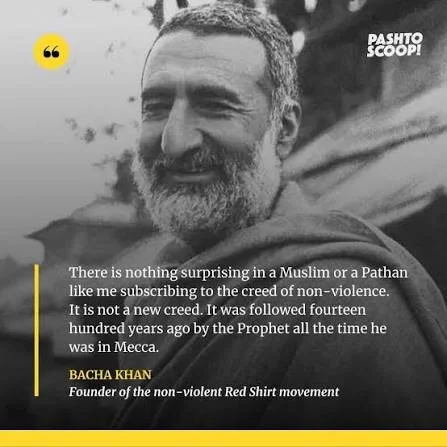
Abdul Ghaffar Khan is known as Badshah Khan in, in the vernacular. He says in his autobiography that real revolution is a change in consciousness, and that's why their focus was on education so much. And so the Khudai Khidmatgars set up schools in different areas, but they also had a journal which they published on a biweekly basis, very popular journal that was not just in the Northwest Frontier Province, it circulated there, but in the tribal areas in Afghanistan, in the diaspora, in Australia, in America and everywhere. So there's copies of it lying with people in all kinds of areas because it later got, most of it, the public copies, archival copies, were destroyed by the Pakistan government when they declared the Khudai Khidmatgar movement as traitors to the Pakistani state.
So it was this multifaceted multi-pronged approach to social reformation. And the Pashtun journal was where the women who were participating in it would contribute their poetry because it was conservative society, so they couldn't come out to join the army as such directly. Even though there is one account where they ask Ghaffar Khan, "Can we form our own army and can we wear uniforms and create our own jirgas so that we can be part of this system?" I don't know what happened to that request. That's the only mention of it that I read in their journal. So the journal, and then they would also, the Khudai Khidmatgars would also perform dramas and poetry recitals. What I'm trying to say is that they were trying to change not just their physical circumstances, but their imaginary and the ethos as well. That was the main focus. And especially the representations of Pashtuns as a violent people, this very racial profiling that the British colonial, it's especially very learned in British colonial literature. But it also got internalized by the Pashtuns themselves to a large degree. So yes, you can't just call it a peacekeeping force. It was much more than that, is what I'm trying to say. And they were building an alternative system to the colonial one. So I think that's where they were quite unique in that.
Stephanie: And so to clarify, Safoora, that this is a nonviolent army. The schools, they're based on new values, nonviolent worldview, what we would probably understand as decolonial ideas today.
Safoora: That was the main thrust was to decolonize, not just from British colonialism, but from their own kind of value system where violence is valorized as something that is an honorable way to exist. Because the violence that the Pashtun society engages in even now, especially the concept of badal. So there's a whole code of Pashtunwali. So there are codes of conduct, of normative codes of conduct on how you behave as a Pashtun. And one of the codes is called badal, and it's often translated as revenge or retribution And it's associated with people who are, if a member of your family is wronged or killed, then you are honor-bound to go and take revenge or retribution. Now this is misunderstood by people thinking that one person will just come and pick up a gun and shoot you, and then another person will come and pick up a gun and shoot you back, kind of thing. It's not that. It's more encoded than that. There's a whole process of why you would shoot a person in the first place. There has to be something very drastically wrong that they have done. And you have to also remember that this was a tribal society that governed themselves. It was governed later on through the nation state system and the colonial system, but they governed themselves. So these were ways of adjudication actually. So if somebody had done something very wrong, you were allowed to take them out, so to speak, right? And if you didn't, your honor was sullied. So honor and violence got associated.
What the Khudai Khidmatgars did was to disassociate honor from violence, and I think that was the huge shift that they did, and they reassociated honor with nonviolence. And the nonviolent way of fighting, they would say, is a much more braver way to fight against any wrong that has been done. So they would emphasize badal, which actually literally means reciprocity. It does not actually mean revenge. It means something, so you can do something good in exchange for something good that somebody else has done. That's all it means. Badal is an exchange. And so they emphasize the literal meaning of badal, that this is reciprocity in exchange, and let's come together and sit and discuss what the wrong was that has been done. So they set up these, jirga system is already part of the society, but they set up councils more often in an organized fashion than is normally done.
And what this did was two things. It not only brought people together to voice the wrongs that have been done to them and try to solve them in different ways than in violence, but it took away the colonial government's power, which was especially embedded in law and the courts and so on. And they said, "We're bringing law and order to a savage tribal peoples." So the colonial government, of course, couldn't abide that. So there were two things that they really knocked the pillar out. Actually more than two. But the law by setting up alternate systems of conflict resolution and passing judgments on things, and education, which also the colonial government wanted to be in charge of because they wanted to change subjectivity according to what they thought were norms. And so they started vernacular school system, which also knocked out, that was also the decolonial thrust of it. And then also the idea of a nonviolent Pashtun took out the representational aspect of colonial literature that Pashtuns are just violent, they only understand the language of the gun, they don't understand any other language. So it was on many levels that they were decolonizing themselves from their own customs as well as from colonial domination
Stephanie: There's a lot to unpack in all of this, isn't there? That's why you've done so much. It's also we're at a time where we're looking at past movements with new eyes, I'd say too. The way that colonialism or imperialism works is by saying these people are a violent threat, and we need to subdue them and to make ourselves safe, and to make their society safe, we need to help them. We see the same thing in the United States today, the way that we perpetuate retribution all over the world, right? So I see that also this movement is showing that there's a way out, that we can turn things around by looking at the way that the Pashtuns were able to discover their connection to a more nonviolent way of being. I think that's an amazing legacy to leave the modern world is that there's a way out. Not that these people are a violent people, and they had this nonviolent army for some time, and isn't that great? But rather, look how violent our world is today, and what are some of the things that this movement did that we can learn from? And why was the movement repressed? Why was Khan thrown into prison? Like, why was this movement itself a threat?
Safoora: So I'll answer your question in two parts. First, the part about learning from our own societies. I think what is very powerful about them was that they tapped into the local ethos, not just to change it, like the concept of badal, but they also tapped into different Pashtunwali codes such as Nanawatai, which literally means to enter into. And it was one of the traditional ways in which blood feuds were ended, when the mother of one of the feuding families would go into the house of another feuding family. And generally she would do it with a Quran on her head to signify that she's coming in sincerity. And the other family was obliged to let her enter into the house. They had to. It was part of the hospitality codes and all of that. So once she enters into the house, obviously, you cannot engage in violence. You now have to be hospitable and engage in dialogue and so forth. So that code got emphasized. And the code of hospitality, the code of forgiveness.
But what was even more incredible, and you see this especially through the women's poetry, is that they emphasized Islam. They're saying nonviolence is an enlightened form of Islam, or it is Islam but you don't recognize its aspect of Islam. And everybody understood it because they articulated it through Sufi metaphors that people were already familiar with. So union with the sacred Beloved and going and destroying your ego in order to achieve this more beautiful union with the sacred. That was seen as a nonviolent war, the part on war. So there's so much poetry about how nonviolence really opened up the idea of Sufi enlightenment and the destruction of your ego. So then the ego got associated with violence. And violence then in turn got associated with collaboration with colonialism. So if you're engaging in violence, you're upholding that system which serves colonial domination.
So they were able to do all of that, but it was done so quickly within a few years because the movement started in 1929 and it was ended by Pakistan in the 1950s, and I'll get to that question about why it was a threat to them. So it was only just a span of 30 years, and all of this change, very dramatic change happened. But it's not so dramatic if you actually understand the literature and they were just tapping into the meanings that were already available to them. So this idea that Abdul Ghaffar Khan came and miraculously transformed a violent culture doesn't hold up when you look at how everybody understood what nonviolence was and understood it through the framework of Islam.
And women demanded their rights, especially for education and coming out in the public sphere, through the discourse of Islam, which is also very relevant today, I think. By saying that Islam has given us the rights, equal rights and Islam enjoins us to go and study, as far as China, that's sort of a very famous saying, that "go and study and find knowledge as far as China," because that is what each human being is duty bound to do. So I think it's significant on that level as well, that how they tapped into existing customs, existing imaginaries, existing narratives, existing practices. And so it was very much rooted in the land. But then their message can be translated into any society, especially societies that are extremely violent because these norms exist everywhere. And so I think that's why that was extremely relevant to understand on their own terms and not just as this, oh, unique movement that had a nonviolent army and that was, brought about through the leadership of Abdul Ghaffar Khan.
Now, the reason they were put into prison firstly by the British was because they were such a threat against colonial rule. This area is still a very precarious border territory. It was the northwest of British India. The border, they created the border. The British created that three-layered border. One was the nation state of Afghanistan, one was the tribal territories, and then one was the Northwest Frontier Province. And this used to be the open gateway to India. So they turned an open forest, what would it be called? Crossroads, or a thoroughfare, and they closed it up into three very heavily militarized border territories. And it's still one of the most heavily militarized border territories. So that was one, the threat of the unification of the Pashtuns on both sides of that, on two sides of the border. There were three aspects of the border. The Pashtuns in the province, in the tribal territories, and in Afghanistan. And so that was a threat. And also the idea of a nonviolent Pashtun didn't suit colonial representation because they recruited heavily for the British army, the Indian army from the Pashtuns. And so the idea of a warrior race serves that. So there were other places also, it wasn't just the Pashtuns. The Gurkhas in Nepal and the Punjabi Rajputs and these were all classified as warrior races and they were recruited into the Indian army. So for colonial and then education, the vernacular education was another threat to colonial domination.
So on many levels it was a very threatening force to colonial. So that's why Ghaffar Khan was imprisoned so many times. But the reason that the Pakistani government then were against the Khudai Khidmatgars were because they didn't want India to be partitioned into India and Pakistan because it was done in the name of religious difference, that Muslims cannot live with Hindus and Hindus are a different race from Muslims. And Ghaffar Khan was part of the All India National Congress Committee, which was the main anti-colonialist nationalist movement. He was very good friends with Gandhi and Nehru and close friends, but also on the Congress Working Committee. And when Pakistan was being created, they were saying, "No, India cannot be divided along religious lines because the Congress Party is representing all of India: Muslims as well as Hindus and Sikhs and so on." But there was a different party, the All India Muslim League that was created and they said, "No, we represent all of India's Muslims, and the Congress Party is just a Hindu party." The fact that the Northwest Frontier was one of the largest Muslim majority provinces was part of the Congress committee. And they didn't want the partition of India along religious lines. They didn't want the partition in India at all, actually. Disrupted that narrative of this "Pakistan's been created in the name of all Indian Muslims." And they were constantly refuting the idea that Hindus and Muslims are so different that they cannot live together in peace because they say "no, we've been living together in peace for a very long time." There are still actually Hindu and Sikhs in the tribal territories that are still living there. There's even a temple in Peshawar, a Hindu temple right next to a mosque. It's functional and still operating. So it's still one of those false narratives. So once Pakistan was created, then they were declared traitors. And they were a threat in different ways because they were not only undermining that narrative of Muslimness and Pakistan being conjoined. But the fact that they were criticizing the All India Muslim League that created Pakistan, that "you are just reproducing the colonial state structures and you're reproducing colonial narratives, and you're not doing anything different. You're just replacing the colonial government with this other elite government." So they were a threat on that level also, this whole critique of that government. And they were very much rooted in the subaltern population and not in the elites because the elites were not part of that movement really. Even though a lot of landowning Khans were part of it, Badshah Khan himself was a landowning Khan, but most of the population of the movement were from the subaltern classes
Stephanie: I want to go back to when you were talking about the revenge aspect and the violence. But then you talk about women's participation as the kind of redefining the ideas of violent badal because when I hear the idea of honor killing, it feels like a very masculine approach to resolving our disputes. So can you speak to uprooting a more patriarchal idea of who we are?
Safoora: Yes, absolutely. The women's poetry is amazing in that they do not speak about colonialism in any really significant way. They're just talking about their freedom from patriarchal tradition, and they say it directly in no uncertain terms. And they also very strikingly liken patriarchy to colonial domination. And they say, at that time this is a modern thing, like intersexual critiques and so on, but they say, they tell the Khudai Khidmatgar men "You are asking for your freedom from the British. But you are denying us our freedom. And what wrong have we committed that you cage us for life in our homes. and it's considered a shame or a dishonor if we come out of our homes or if we get educated?" So their whole poetry is aimed at upturning patriarchal tradition.
But very interestingly, they do it in the name of Islam. They say, "No, Islam has given us these rights," and they conjoin Pashtun patriarchy with pre-Islamic Arab tribalism, which was famous for killing their baby girls, infanticide, and not giving women their rights and no property rights and so on. So that pre-Islamic time is called jahiliyyah, or ignorance. And so they keep using that word, jahiliyyah, jahiliyat when they're talking about Pashtun traditions. So, in a sense they're saying that Pashtun patriarchy does not understand Islam, it's pre-Islamic. And nonviolence, which is giving us our rights and allowing us our freedom, is enlightened Islam come to liberate us.
So their poetry is just amazing with all of that stuff in it. When I read it the first time, I was like, "Wow, this is like feminism, with no reference to Western feminism," right? So there's no reference even to the women's movement that was going on in the larger Indian… I'm sure there was influences and they must have heard about it. But there's no direct sort of reference to that kind of feminism. And so it's, yeah, it's quite amazing.
And the fact that even in the very famous poem by Ghani Khan, which was Badshah Khan's eldest son and he's a very famous poet, and he writes a poem on nonviolence, which is absolutely brilliant. So the poem turns on the figure of the feminine, of the women going to the houses, the Nanawatai tradition to ask for reconciliation. So the whole poem, like it starts off by depicting the Khudai Khidmatgar as these enlightened warriors, mystical warriors that are going out to battle now unarmed. But the whole poem turns toward nonviolence on the figure of the women going and asking. So it's saying, "No, we're turning our codes because of this feminine aspect of reconciliation." And the poem ends with a very other, sort of resident metaphor of Layla and Majnun, which are two lovers. Like Romeo and Juliet. They're very famous in all of Asia and East Asia, West Asia, and everywhere, the story of Layla and Majnun. And the poem ends on the idea of love, of Layla as the figure of the beloved sacred beloved. And it asks, "Let's see if Layla can abandon herself to Majnun for love alone." So Ghani Khan is asking the question, so let's see if this politics of love can become a norm and can become part of the wider sphere, can be enduring, and so on. So it ends on the figure of the feminine as well, is what I'm trying to point to. So it was very significant that the whole movement was attached to the idea of emancipating women. It started off like that. Ghaffar Khan says he went he went to an All-Congress meeting and he saw how women, other Indian women were active in it, and he wanted to bring that kind of political awareness to Pashtun women and he was hoping that once women come out into the public sphere, we will know that we've achieved a unified and an enlightened new nation. So women became a signifier of that.
There's another poem, Badshah Khan's March to Mardan, which is also about this movement. He only writes two poems about this movement, very surprisingly. He has so many other poems, but he was a reluctant Khudai Khidmatgar. Let's put it that. I think because of his maybe a little bit of conflict with his father and the father trying to rein him into becoming a Khudai Khidmatgar and so on. So he's a very interesting figure, though. But the other poem, Badshah Khan's March on Mardan likens Ghaffar Khan to a Sufi, very famous Sufi mystic called Mansour al-Hallaj. And Mansour al-Hallaj is very famous in all Sufi tradition, in all poetry as an enlightened resistance fighter, in a way. Because he utters the word ... when he becomes enlightened, he utters, "Ana al-Haq: I am the Truth." Haq is one of the names of God, 99 names of God in the Quran. So when he says, "An al-Haq: I am the Truth," he's in a sense saying, "I am God." So it was taken as, I am Haq. It could be misunderstood that way. So he was executed for uttering blasphemy. So he became very famous for that reason. But the Sufi mystics point out that when he's saying, "An al-Haq: I am the Truth," it is referring to the oneness of God, right? That God is, the spirit of God is within me, it is within you, it is within everybody.
And there's a concept called Wahdat al-Wujud that is very prevalent. It starts with Ibn `Arabi's writings, even though he doesn't use this term. But the idea that God is in everything; everything is sacred, essentially because it is a manifestation of the divine. So if the world is understood that way, that even, there are Quranic injections against, even picking a leaf off a tree. You're not supposed to pick a leaf off a tree or cut a tree because that's considered sacrilegious. So what does that mean, essentially? So you can make further references. But if everything is sacred, then killing one human being is you know- killing. And then I think there is a verse in the Quran that says that: if you kill one person, it's like killing so many or I'm not sure of the exact verbiage of that. But so this concept of Wahdat al-Wujud runs through their Sufi understandings of what nonviolence is this sacred way of being in the world.
Stephanie: Have you met anybody who is part of this movement?
Safoora: Even though she's no longer alive, and it was a Khudai Khidmatgar woman, very famous, Alif Jana Khattaka. I actually have some photos I just remembered.
That is Alif Jana Khattaka when I saw her, which must have been 2016 or something. So she was a very famous poet. I think I have one of her poems as well here. Yeah, this is one of her poems.
"Come, Pashtun girls of the frontier. Let's talk about our sorrows, one with the other. You have accepted the life of hell. Why send your daughters there also? For God's sake, take care of their education if you want your daughters to have a taste of life. You've made necklaces, shackles, and handcuffs their music. God only knows what crime they are being caged for."
Alif Jana Khattaka was a very prolific contributor to the Pashtun Journal. And the Pashtun Journal held a contest about the best article or poem against why women should wear the veil. And she won that contest twice about why women should not be veiled and be inside the homes. But when I went to see her obviously she still had the chador on her head. So this is the traditional way that Pashtun women in the villages cover themselves. There's no full hijab or anything like that. They just cover their hair and wear a white chador like that. That's the traditional way that women cover themselves in villages. So I asked her, I said, "did your poems and did your activism have any effect on the veiling of women?" And she said, "No. Even at this age I wear a chador when I go out, and so do my nieces." Her nieces were sitting around with her. But she had married at a young age, but she left her husband, came back home and educated herself, and she had earned a double master's degree in Urdu and Pashto literature or English literature, I forget what it was. And then when she came back after she got divorced, she started teaching at schools in her area, and she taught all her life. And that area is a pretty remote part of the province, but it is one of the most highly educated. The levels of literacy are one of the highest in that whole region. And her nieces and her daughter, they all were educated also, and some of them were working outside the home as well. So I think even though she said she didn't make a difference, I think she really did make a difference at least in her household. So I think she was one of the last living Khudai Khidmatgars when I was doing my research.
But there is another great book by Mukulika Banerjee. It's called The Pathan Unarmed. And she went to the province and interviewed, I think she wrote, she was doing her dissertation in the 1990s. And she interviewed a lot of Khudai Khidmatgars at that time, and that book is based on that. So that's a really great resource for somebody who wants to look into it further because it is accounts, firsthand accounts of the Khudai Khidmatgars. Yeah, unfortunately they're all gone, and now it's just sort of memories. Their grandchildren left and memories of them left and...
But even though their literature was destroyed, their history was distorted by Pakistan; in 2008 the political party that is run by the grandson of Abdul Ghaffar Khan, they came into power. And they revived the history and took away that status of traitors and so the literature started coming back in the archives. So when I was doing my research, the literature was emerging at that time in the archives and libraries and stuff like that. So that status is now highly improved. People don't regard the Khudai Khidmatgars as traitors or Abdul Ghaffar Khan, he's acknowledged as one of the great nationalist leaders of Indian independence now.
Stephanie: So your work is also in terms of keeping their story present and told so that it isn't erased in history as well?
Safoora: Especially the women. Because even people who know about the movement don't know about the number of women who participated in it, and the significance of what they were saying and why they were saying what they were saying. And the amazing sort of articulation of you saw Alif Jana Khattaka's poem. She likens the adornment of women, necklaces and what a woman is supposed to be, quietly staying at home and adorned and stuff. She's saying, "Those are our shackles. Why are you willingly wearing them?" And so that whole discourse is so significant, especially today, I think, where women think that this is a modern phenomena or a Western phenomena to ask for your liberation from being segregated and cloistered and so on. But this was very much part. So I think especially their articulations are so important to understand.
And the Khudai Khidmatgar's views of nonviolence, what, how they viewed nonviolence themselves, I think that's very important to understand because people just look at it from the outside. Here is an army, and they did this and this. But, their actual, how they internalized that whole phenomenon and how, what made them turn towards nonviolence so readily and in such large numbers. Like I mentioned before, everybody in the province was either part of this army, they were writing for the Pashtun Journal. And then they had a political branch called the Frontier Congress. It was in alliance with the All India National Congress, so they had the Frontier Congress committee, which was the provincial branch of that. And they won elections three times in the province once it was held. They didn't have complete power because the British government had vetoing power. So any time they had any legislation that would have really decolonized the province, that would get vetoed by the government. But they were so popular. And so there were people who were part of the political movement, part of literary movement, part of the educational circles, or just sympathetic to their anti-colonial nationalist kind of aims. And people still have stories about that time and who was in there. So everybody's family has some member that was part of this movement. Yeah.
Stephanie: And I can't help but think how is this relevant to politics today? And I know that you've been thinking a lot about enlightened anarchy, and I know that you've also, as so many of us have been particularly concerned about the genocide in Gaza and the the problem of nation states. So I wonder where do these areas align for you, this movement from history to what we're looking at today and I wonder if you see any connections there?
Safoora: I make the argument in my book that– enlightened anarchy is a term that Gandhi used. And it's a term for the ideal of what nonviolence is aspiring towards, the ideal kind of sociopolitical that the nonviolence is aspiring towards. And he makes the argument that once people become so morally evolved when they've embodied nonviolence, that they will not need political institutions or policing or armies or anything to enforce laws or legislation on them. They will do it themselves because sort of the Kantian kind of they will know what is morally correct, and they will do it, and they won't need enforcement from outside. And so the idea is that people will create societies that are very egalitarian, and they will all come together and decide in a consensus democracy kind of fashion. And so that was his vision.
When I make the argument in my book that was already what the Khudai Khidmatgars were doing because the anarchic ethos was part of Pashtun tribal culture anyway. They were always considered themselves not bound by state laws but by their own kind of codes of Pashtunwali, and they would come together and it was a consensus democracy thing. Everybody had to voice their concerns and then people would take account into. So that's how they came to different decision-making processes. And so when you add nonviolence to that, and if you think of nonviolence as this enlightened form of being in the world and, you're thinking of it not just in religious terms but even in secular terms because the Khudai Khidmatgar movement, even though they were using the vocabulary of Islam, was a secular movement. It included Muslims, Hindus, and Sikhs, and they didn't want partition on the basis of religious lines or anything. It was very much a secular movement. And so when you combine that idea of understanding nonviolence as an enlightened way of being in the world, and you have this anarchic ethos.
So my argument is that's what they were aiming for, to create a society. They were not aiming for a nation state society. And so when the idea of partition came along, when the India and Pakistan were being proposed as two separate states, Ghaffar Khan wanted a third alternative called Pakhtunistan. And so there's a hot debate around what Pakhtunistan means, and it's still considered a very seditious term by Pakistanis, that they are wanting to separate from Pakistan and create their own nation state. But my argument is, no, they wanted to preserve the way that they were doing politics already, their idea of consensus democracies and not being governed by one single ruler, by centralized authority. They don't want centralized authority. And so I'm saying that's what it represented, at least at that time. Then later on it got politically muddied and Afghanistan took it on and it, and there are many meanings to Pakhtunistan .
But at that time when he wanted, when he called for the idea of a third option I think that's what he meant, was to preserve this kind of enlightened anarchy or to bring it into being fully. So actually, it comes from the Khudai Khidmatgar literature itself.
And I feel that today I think it's imperative for us to think of different forms of political outside of the nation state structure because we can see how violent that is and how it profits off of death and destruction. So I do not feel there is a way to fix the problem from a system that's whole economy is geared towards death and destruction. It's just a contradiction in my view that that economy would change towards life and equality and justice when there is no profit for it in that. So it has to, the whole system has to shift, and that's my, hopefully my work moving forward is to emphasize that in some fashion or the other.
Stephanie: And so do you see that by focusing on different institutions within a society, from how we do justice to how we do conflict which I would say, an army, but also policing, what we teach in schools and also the way that we interpret religion, all need a more enlightened/mystical awareness as part of them. And what is that awareness?
Safoora: So I think the emphasis here that was really transformative for my own sort of growth or whatever you want to call it, change, is the fact that they viewed nonviolence, the Khudai Khidmatgars viewed nonviolence like you have to shift internally, your consciousness has to shift. That is the key aspect, the keystone to creating an alternate society. You cannot create an alternate society without this shift first, or at least alongside with creating another society. This is very imperative, and that, if it is grounded in a religious tradition or a spiritual tradition, will give you a lot of strength and it'll give you a lot of rootedness, because it is such a difficult process. Both sort of the internal letting go of your ego sort of attachments, which are what in Islam is called the inner jihad or the greater jihad. You have to let go of all of these things that are destroying you from within. The violence that you inflict upon yourself essentially. You have to let go of all of those things first before you can then tell others that this is how one should live. So you don't have really the moral authority to do that until you've done it for yourself kind of thing.
So I think the great takeaway for me is this idea of how do we bring about that shift in consciousness or the awareness that is the most important aspect of changing society and not just going out on the streets or just trying to create new laws or just fighting against governments to do different things. Can we build an alternative cosmology that makes that redundant in a sense? Is that possible to do? So that's a question out there still. I do not have an answer for that. But at the moment, I feel that it cannot be done from within a system that is so destructive, either through laws or through education or through doing away with the police. Or if you do it in bits and pieces I don't know if it'll work. Although, right now we've got great democratic leaders coming out in the US. But how much can they do within the system versus how do you do it, how do you even build another system, or maybe not a system, many smaller localized grassroots systems that are not based on centralized authority?
Stephanie: Thank you very much, Safoora. I think that all of this really brought that out. I think, in the end, that it's not going to work to just try to reform these systems that we have. We definitely need a consciousness that allows us to have the courage to build differently, and to participate in that, and not to put so much hope and faith in, oh maybe we'll fix this broken system because the system is like a nuclear weapon. It's a violent system. It shouldn't exist. It needs to shift.
Safoora: I think that the shift will come once we start building alternatives to it. It just, it has to crumble on its own contradictions, and I think it's already started. It's just not feasible. How far can you take, unless, the whole world gets destroyed by a nuclear, which is very likely also, by either through climate catastrophe or nuclear weapons or whatever. But I think if we start putting all this energy that we're putting in resisting and trying to change this system into creating an alternative or alternatives, I don't think there's one sort of right answer, I think each community and each place and peoples have to decide for themselves what is, what works for them. I think all that energy that we see right now is incredible, especially the young people are already seeing it, doing it and seeing it so clearly. What would happen then is the question that is pulling me now.
Stephanie: For those of you just tuning in, you're here at Nonviolence Radio, and we've been sharing an interview with Safoora Arbab. She's an independent scholar and educator. And we've been talking to her about her research on the movement of the Khudai Khidmatgars and their emphasis on nonviolence, building a nonviolent army, and also rediscovering nonviolence within their culture. Her book manuscript, which will be published sometime soon, is called The Ecstasy and the Anarchy of Nonviolence: The Intersectionality of the Khudai Khidmatgar Resistance in the Northwest Frontier of British India. Safoora, you can find her at safooraarbab.org, and she's also a member of the board of directors at the Metta Center for Nonviolence. You can also contact her at info@mettacenter.org. So Michael, this has been a lot. I'd like to turn to you now for your Nonviolence Report, as well as any comments that you might have that came up while listening to Safoora's interview
Michael: Thank you, Stephanie. Many, many comments did come up. I think I'll just select one. Safoora mentioned this famous line from the Quran that anyone who takes a life, it is as though he killed all of humankind, and anyone who saves one life, it is as though he saves all of humankind. Interestingly enough, that very same identical set of lines is found in the Torah. So I've always found that a kind of very hopeful, very suggestive little connection.
I'm going to reach way back into prehistory for a moment because it touches on the concept that Safoora was ending on actually, what kind of polity is ideal for reducing violence? Now, there's a site that was recently, excavated. It's really being worked on now. It has only a quarter done. It's in a area in Turkey called Göbekli Tepe, which I gather means Potbelly Mountain. And the amazing thing about this development, this site, is that it is 12,000 years old. So this is a time of prehistory when humans were supposed to be hunter-gatherers, you know, living at or near caves and, using stone tools. And what you see here is a massive establishment of beautiful stone pillars with beautiful carvings on them. Evidently, it was some kind of ritual site. They haven't found any human remains there, so there's not that kind of stuff to go on.
But here's why I want to bring it in here, and that is that this site was occupied for over 3,000 years, and it shows no sign of conflict. So it doesn't rule out the possibility 100%, but that length of time, you would expect, you know, a broken bone, an arrowhead, a smashed wall, something like that. But we don't see any of the signs that victory in battle would produce and has produced in countless other ancient and modern cultures.
Okay, so I'm going to turn now to our favorite peace institution, Unarmed Civilian Peacekeeping and the Nonviolent Peaceforce. Violent conflict and displacement take a great toll on mental health, which goes on to fuel further violence. So recently, we have become aware that by addressing trauma as an integral part of Unarmed Civilian Protection, UCP, Nonviolent Peaceforce has been interrupting this cycle. So from South Sudan to Ukraine to the United States, they are fostering long-term healing by addressing trauma, supporting communities in establishing their own care systems. And I cite this as an excellent example of when you do the right thing based on the right principle, it leads to all kinds of right results which you hadn't anticipated. You know, I was in at the beginning of the foundation of Nonviolent Peaceforce, and it was very far from our imagination at that point that we'd be addressing trauma and many other things. Another aspect of this work is, in South Sudan, since 2010, thousands of South Sudanese, mainly women, are now engaged in their own security. Whereas before, their attitude was always, well, when the militia attacks us, quote, "Somebody will come and protect us." So that's another big step forward in human understanding that's taking place because of this intervention of nonviolence.
Meanwhile, back here in the States, and Nonviolent Peaceforce has been showing New York City youth, these are young people between the ages of 14 and 18, showing them how to stay safe and take care of each other. In other words, building community at the most basic level. And across the river in Camden, New Jersey, the homicide rate has been lowered by 450%.
So these are just some of the many stories of nonviolent solutions that were discussed July 30th at the Solutions Circle, and part of their collaboration with Pace e Bane's program called 2026: The Year of Nonviolent Solutions.
One of these is happening in Atlanta, where they are creating sanctuary zones where people refuse to cooperate with ICE or the police. It's a coalition in Atlanta that is building the infrastructure to practice real community safety, kind of our domestic version of what we've been seeing in South Sudan.
And there are a couple of important principles that are pretty well known in the field that have become prominent here. I'd like to mention them. One is parallel institutions. People forced to do things for themselves that the regime won't do for them, and possibly even is taking away from them. And during the course of nonviolent resistance as a major part of what we call a constructive program, has been this phenomenon of building parallel institutions so that when the regime is dislodged, the authoritarian pressure is off, you don't just look around and say, "Well, we have to reinvent the wheel and start from scratch." And this has actually led to backsliding, very unfortunately, in many cases.
So this is a part of nonviolent learning that you touched on, Stephanie, early on in your talk, and I wanted to mention that it has also been formalized way back in 1990s when a young fellow named Srdja Popovic, who was kind of a very prominent figure in the resistance against Slobodan Milosevic (who is in prison in The Hague right now for his many crimes), that they started an organization called CANVAS, the Center for Advanced Nonviolence Actions and Strategies. So that became a formal institutional teaching tool, so it's not just person to person, and that's very good.
Now, this next comment I want to share with you, this next item, or several of them, are on the general question, "Would it really be so difficult?" In 2021, New Mexico became the first state in the United States to offer universal free childcare. Horrors. Obviously a form of creeping socialism. But what was the result? They saved $12,000 per year per family, and the policy has now helped to lift 120,000 people out of poverty. The system helps parents stay in school, pursue careers, build financial stability, and it's paid for through, get this, taxes on fossil fuel companies.
So the program has even raised the wages for childcare providers. And this reminded me of a phenomenon that was noticed in Colombia when, the US was bombing coca farms to destroy the supply chain of cocaine, and it was pointed out that it would be 20 times cheaper to support the farmers so they didn't have to grow coca, which they hated anyway. They just wanted to grow food crops. But, you know, people reach for the solution that they understand, even though it is very much not the favorable one, not an advantageous one.
One other item. In Boston, housing providers have been building more than 7,000 apartments, and they went from having highest eviction rate to zero evictions in 2021. Again, just by supporting people to work out manageable repayment plans, for example, so they could get their rent paid. So this is a great example of change making its way up from the bottom, and I guess I will have to end there.
Stephanie: Thank you so much, Michael, for that Nonviolence Report. And we want to thank our mother station, KWMR, for making this show possible. To our guest today, Safoora Arbab, find her at safooraarbab.org or at the Metta Center. And, to our syndicators at the Pacifica Network Waging Nonviolence, thank you very much. And to you, all of our listeners, until the next time, please take care of one another. We'll be back in two weeks.