
We Keep Us Safe: Meet Roz Lee, Head of US Mission at Nonviolent Peaceforce
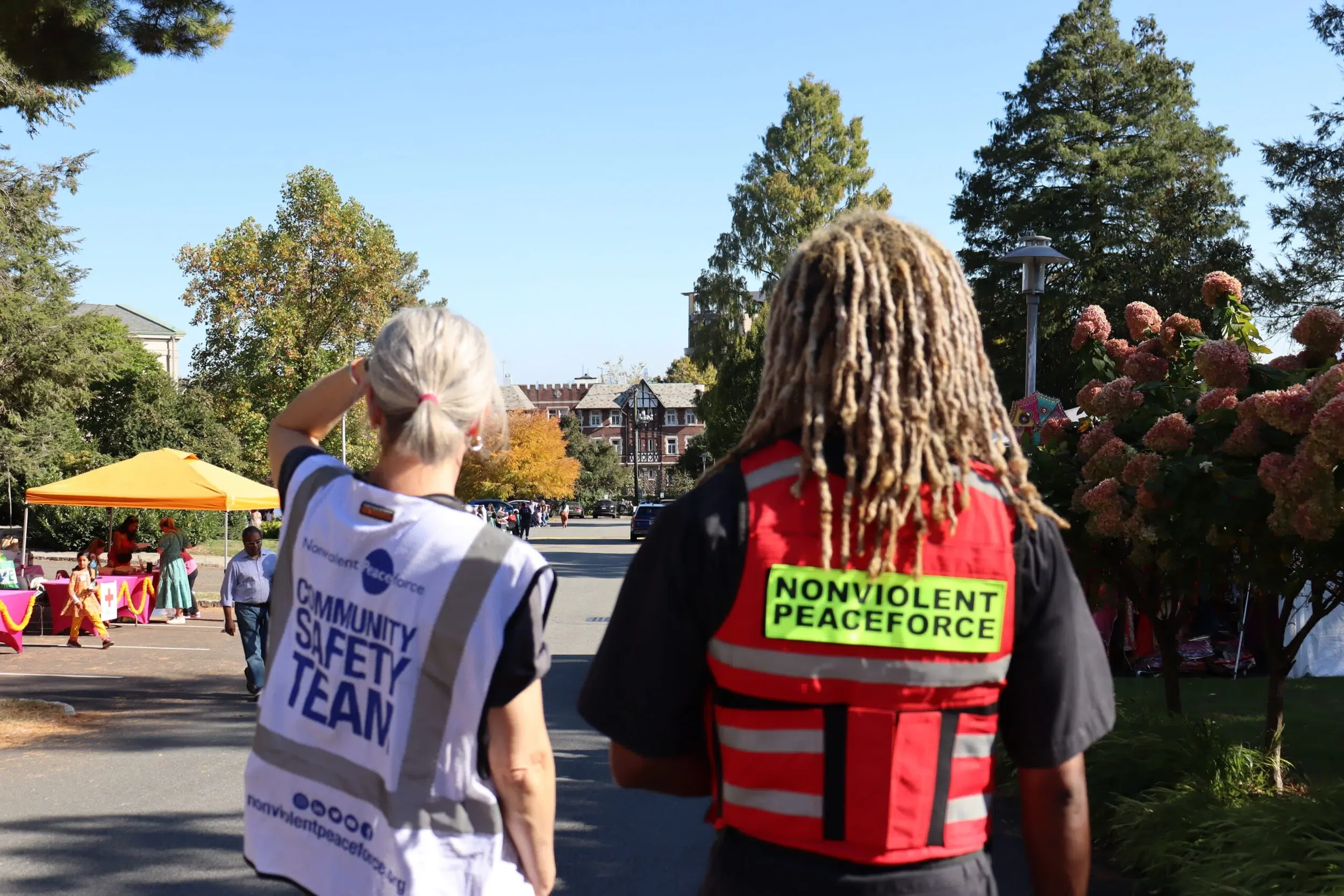
What does it look like when communities become active participants in their own safety rather than waiting for someone else to protect them? In this episode, we speak with Roz Lee, Head of the U.S. Mission for Nonviolent Peaceforce, about the growth of unarmed civilian protection (UCP) in the United States.
Although Nonviolent Peaceforce has long worked in places experiencing war and violent conflict, the murder of George Floyd in Minneapolis—the city where the organization was founded—made it increasingly difficult to think of violent conflict as something happening only elsewhere. Since then, its U.S. work has grown to include partnerships with communities responding to hate, violence and, more recently, harsh immigration enforcement and ICE activity. In Minneapolis, for example, NP has worked alongside interfaith leaders, grassroots organizers and neighbors to help keep people safe.
Lee emphasizes a difficult truth: there are social conditions that make it easier to recognize violence elsewhere in the world than to see the violence taking place within our own communities. Part of changing those conditions means talking to one another—and being willing to believe one another about the violence we experience.
Transcript (with gratitude to Elizabeth High for support)
Stephanie Van Hook: Well, greetings and good morning everybody.
Welcome to another episode of Nonviolence Radio. I'm your host, Stephanie Van Hook, and I’m here in the studio with my cohost and news anchor of the Nonviolence Report, Michael Nagler, and we are from the Metta Center for Nonviolence in Petaluma, California. And with this show, we try to share as much as we know about nonviolence and to inspire people to know that there is another story happening right under our noses, sometimes right in front of our eyes.
On today’s show, we’re joined by Roz Lee, head of the US Mission for Nonviolent Peaceforce. Roz has spent decades working at the intersections of racial justice, gender justice, philanthropy, and movement building. At Nonviolent Peaceforce she helps advance unarmed civilian protection or UCP, an approach to protecting people from violence without the use or threat of violence.
UCP works through relationships, presence, accompaniment, and other nonviolent strategies drawing on the knowledge and capacity of communities themselves to create safety. We’ll talk with Roz about what that work looks like here in the United States, what we can learn from communities already practicing new approaches to safety, and what it means to build a culture of protection rooted in relationship rather than force.
Let’s turn to Roz Lee
Stephanie: We're not looking at Nonviolent Peaceforce or unarmed civilian protection work to come in and be the new police force for us, where they solve our problems for us. So what is the vision here, for this work?
Roz Lee: Well, I think we need all the things. Nonviolent Peaceforce is not anti-police, but we are in favor of making sure that what is happening is that people are being kept safe. I believe that organizations like Nonviolent Peaceforce, that center nonviolence and peace and different strategies that don't involve arms to keep people safe, that those are also effective strategies. And when we're working together as actors, then nobody is suddenly a victim of violence. We're not seeing people go first for force when we're working collectively, when our cooperative collective goal is to keep everyone safe. And so I don't know any kind of approach to solving social problems that can only rely on one strategy. So I think I'm leaving out strategies in this conversation with you as we're talking about, the in-between, right? And I think that there is still yet to be discovered some of those in-between strategies that are the bridge that will also help dissolve some of those fault lines, and as a result, keep us all safe.
Stephanie: How do you look at a community and then decide, how to participate, with this work in a community?
Roz: Well, that's an easy question to answer, because I think everything begins with relationships. One is being very respectful that, you know, if these are communities that we don't directly belong to, then we are hopefully invited in for conversations, in for dialogue, in for increased and better understanding. And then finding a pathway to "are there things that we can do for each other?" I'm very Freirian. Paulo Freire is, like, I'm a huge, huge fan and follower. And so coming in with relationships, seeking relationships, coming in with a tremendous amount of humility, is, you know, just also a part of how I've been trained as a community organizer and as a community advocate. So kind of starting there, but then recognizing that even if there's something that I have to give, or Nonviolent Peaceforce has to give, that we are ready to receive what we can learn and we can also get from those communities.
I had this conversation earlier today, talking with some consultants that we're working with at Nonviolent Peaceforce, and I was talking about nonviolent and peace-building organizations. And I said, you know, there are global organizations, there are some national groups, and there are groups who are working at the regional level at the US, who are in the US, who are, you know, intermediary organizations working with various communities. Then locally, we have organizations who are working deeply and directly in their communities.
If you only stop with nonviolence and peace building, then you're not looking at the entire ecosystem. There are organizations and projects that are focused on interrupting violence, preventing violence. There, in the US, is a whole movement around restorative justice, right? There are community safety interventions that show up in many, many different ways. And so even when I don't, it's kind of what I'm describing in terms of the in between. So I think that there are lots of different ways to look at safety and security. It's the dream, which is that we have peace, and we have an absence of violence, right? That's the world that I want, my Eden, basically. But at the same time, it's a journey. That's always going to be a journey. And so there have to be different roads to go down. And so when I think about engaging with communities, I'm looking for what are the variety of approaches that communities are taking to increase safety and security, to increase a sense of belonging and connectedness. Because I think that those are the ultimate bridges to what is our pathway to getting rid of violence and only having room for peace.
Michael: I'm really getting enthusiastic about the possibility, and this didn't dawn on me back in the earlier days, that what we're seeing here is not just a technique of intervention after something has gotten rolling, but rather in the longer, longer term, a way to reorganize the world, or a way to reconceptualize how people are related to one another. So, you know, in one way we used to say we look forward to a day when we're not needed anymore, but I'm actually thinking of looking forward to a day when nobody else is needed anymore. If you know what I mean.
Roz: Well, I think some of the advancements that we've had as a society, there are some challenges to it. So we have, for example, the internet, social media, that brings people in closer proximity to each other, where that was a much harder thing to do in the past. So you can forge a relationship with somebody in South Sudan, without being physically in the same place as them, if you have some shared interest and the desire to have that friendship. And I think that that's something that even before we had the kind of access that we do to social media platforms and the internet, that's something that I know that I always had a desire to be: a global citizen, somebody who was a part of something bigger than myself. And now I see that being true for the generations that are following us, where they're starting from the place of they have a connection to people outside of their neighborhood, not only on their block or their particular community. And there is the real possibility, because it's actually what they're living, that many people can travel to places.
I was in New York City for the World Cup, and I was struck by the diversity of people who had made their way to New York and other US cities for the World Cup, from all over the world. Now, not all of these people could be so wealthy that they can just easily go anywhere they want. So in some cases, I have to imagine that they saved up their money, because they knew, "This is my dream, to go to this World Cup." They could've been doing that for a really long time. They found creative ways to come here, and many times I was encountering families, and I was constantly amazed. I'm like, "How could it be that these thousands upon thousands of people have made their way to the US, to New York City, which is incredibly expensive as we know, and for their love of a sport, for their love of soccer, football, for their love of the beautiful game, right?" And automatically in community with each other. There was harmony, there was community, there was love, there was pride. For folks whose countries weren't making it all the way through, there was respect. Just even through a sport, if this could be possible, that these people from different backgrounds, nationalities, religions, could find themselves in harmony. I'm using the word harmony because it was what I saw. I was swept up in it. I was just totally swept up in it. And I thought, "Well, this is actually where the world is going," right? This is where things are moving to. And I think I'm not in a minority of people who believe that my wellness, my survival, my happiness is connected to other people's ability to survive, to be well, to experience joy. I'm really loving this conversation. It was a busy day, and then I'm like, suddenly I have this gift of this conversation with you.
Stephanie: Well, let's get into the work in the US in particular. I think, can you situate us within the UCP movement? In the United States, there already were groups that were doing unarmed civilian protection work or work like that in the US. But Nonviolent Peaceforce seemed to have always been working out of the US, but internationally. And I think more and more people started asking questions, "Well, what are you doing here? What are you doing here in the US?" This is, we're going around helping conflicts around the world, but we're extremely violent here.
Roz: So I think I'll start by saying that Nonviolent Peaceforce, very central to our mission is protecting civilians in violent conflict. And it's always been easier to recognize in other places, particularly places where there are longstanding civil wars or an outbreak of violence. Places like South Sudan, Ukraine, Iraq. Just kind of easier to see that, and it's also in the news. Nonviolent Peaceforce's US program, the organization was founded in Minneapolis, in the US, but worked internationally in those places, again, where it was very, very easy to see that civilians were in violent conflict, and often in a civil war or war circumstances. We founded in Minneapolis, US, George Floyd was murdered in Minneapolis. And it was very, very hard for the organization to say that there was not violent conflict in the US, right? Like,suddenly it became very visible because George Floyd was murdered in the place where we were founded, but that there were many, many, unfortunately, many, many other examples of this kind of violent conflict, focused on communities that were already pushed to the margins in our country.
And so that, I think, was the impetus, that we couldn't keep doing business as usual without recognizing that the US was not an exception. And our work grew in the US by the circumstances that emerged. So for example, we began working with Asian and Pacific Islander communities in New York City at their invitation as they began to experience hate violence around the COVID pandemic, with our president essentially blaming those communities for causing the COVID pandemic.
And so addressing hate, addressing violence, addressing harm. Again, with nonviolent strategies, and helping communities center what safety and security look like for them. We've seen recently, and we talked earlier in this conversation about the harsh immigration enforcement in places like Minneapolis, and perfectly aligned with NP's tools and strategies, unarmed civilian protection. How could people be kept safe? How could we respond to the harsh immigration enforcement while also respecting the laws of the country? And so here we were able to partner with interfaith leaders, with grassroots community organizers, with people who were directly impacted by the enforcement, to help keep everybody safe. We were able to partner with neighbors who wanted their fellow neighbors' children to be able to go to school safely, to be able to walk to school. We partnered with people who were not targeted for their immigration status who were also experiencing harm. And we worked completely with people who believed that this country deserved to be free of violence.
That I will say was true of everyone, that I talked to people who said, "I never imagined that we would be inflicting violence on ourselves as a country, and that we would be condoning that. And so I want to be a part of mitigating that and ultimately stopping it from happening." And so the unarmed civilian protection became, many tools on the tree of unarmed civilian protection, from helping communities deescalate violence, helping folks regulate themselves so that they would not themselves cause harm, helping communities have systems where they could warn their neighbors to take care, to control rumors, which were just all over the place, and again, escalating fear for folks, to find ways to negotiate where we could, and in partnership with the communities, so that the best could happen for those communities.
Those are all branches of the tree of unarmed civilian protection, and there are others, but I'm mentioning the ones that were most proximate to how we've been able to work in a US context. And if we can have the long line that we need in the US, because it does take years to build that kind of trust, to deepen those relationships so that you're not just reacting to these situations, but you're proactively building responses that keep everyone safe. We're about six years in with our US program. A lot of our early work has found us necessarily supporting communities who are reacting to violence. Our dream and our vision is to work with communities and community members to proactively build nonviolence in their communities, and that is, you know, I was talking about the beautiful game of soccer, but that's NP's beautiful vision for the world.
But in the US, our goal is to popularize nonviolence, not just for short-term situational actions, but something that we can rely on permanently. We've seen historically, from decades ago to present-day moments, where nonviolent interventions have saved lives, have stabilized situations. But that's only a part of what is possible, and it doesn't have to be short term, and it doesn't only have to be a tactic. It can be a destination, and it can be a permanence. As somebody who teaches about social justice movements and globally, we often talk about the social change levers and the tools in the toolbox, with nonviolence being one of the tools in the toolbox. And I talked about nonviolence being a verb. And I don't want to give up, because as a English major and a grammar lover, I don't want to give up also nonviolence as the noun, right? So I feel like I want it to be, like, every single thing, you know. The verb, the noun, the adverb, you know. Let it have all the functions, but also be a place where we get to, rather than just only a tool. It's a very, very critical tool, but it can also be much more than that.
Stephanie: So with the US work, it must be then the same as in other places. If there's a community that is needing support, how does that work?
Roz: So, we're definitely available for folks to reach out to us. Giving you maybe a little bit more information about our US program. So we are a small but mighty team in a very, very big country, right? And so we can't be all places at once. And so some of what our new programmatic approaches are is to really deepen our capacity to be able to work with a lot of people at once. So we are developing, for example, a national training program where we can work with community safety leaders through a cohort model, where we're able to build networks of community safety leaders that are skilled and trained in unarmed civilian protection, that are able to then go back and take those skills into their communities. Also, to network them so that they are not isolated from each other. And ultimately, to be able to activate and mobilize UCP practitioners, so that when there are moments when we do need community safety teams, community peace building teams, that we are able to activate those teams. And that will be a new and strengthened capacity. So yes, working at the local level, we have limitations because we can't be everywhere. We often work with organizations, and so we work with community organizations who seek us out, around not only training and technical support, but building safety plans and mechanisms for their communities and/or the issues that they're seeking to address.
There are other organizations who are doing nonviolence and peacebuilding work, and it's very important for us that we are connected, that we are maximizing all of our potential. And so Nonviolent Peaceforce is stepping into a place of determining, is there a convening or collaborator role that we can play with nonviolent and peacebuilding organizations in the US, to maximize all of our ability to be effective and support building peace and promoting nonviolence?
Another area for us, Stephanie and Michael, is being able to work with organizations like your organization, where our goal is not to just hold unarmed civilian protection close to us and it only belongs to NP, but to really offer it to everyone. And so, really building and strengthening our tools and resources so that they can be shared with other organizations, that we can partner and collaborate with other organizations so that we are not, as a small but mighty team, the only ones who are promoting and bringing people to the practice of unarmed civilian protection.
Michael Nagler: Roz, I'm thrilled to hear the ways that UCP is branching out, and kind of sending tendrils, if you will, out into the wider community, which is going to make it real and make it, not just small and mighty, but widespread and taken for granted. And one thing that struck me about these branches that you mentioned is that this is the clearest proof that with UCP, we have touched upon something that is a basic truth, and is a basic feature of human nature. Because if it were artificial, if it didn't fit with the nature of things and the nature of people, those branches would never show up. They would shrivel.
Roz: Yes.
Michael: So, I'd love to get your thoughts about that, but I also want to mention that I was very struck by something else you said. It struck me as, has to be true, the minute I heard it, that it's easier to see violence somewhere else than it is in our own society. And so here's another dimension, that UCP is helping the US understand itself.
Roz: Yes. And you know, Michael, you know, I want to answer both of your questions, about the branches and this question. My family and I, we have dear friends who live in Colorado. And when there was more public information around Black Lives Matter and there was a series of killings of Black men and women by law enforcement. I remember having a conversation with one of my friends about one of those cases, and he said to me, he said, "You know, everywhere around me is being described as fake news." Right? "to the point that I don't know if it's true or not." Speaking to someone, you know, who, you know, we love each other. We're friends and we love each other, and to me it was an absolute truth that these folks had been killed by law enforcement. And for him, it was an absolute question as to whether or not it had happened at all. And so that's where I do think that there is evidence that in our society we question whether or not these levels of violence are happening, right? How much it took for people to understand what was happening in some of our cities with the harsh immigration enforcement, right? And it wasn't enough for people to see footage. They could question whether or not that footage was real, doctored, or fake. And so I think that that adds to this problem around whether or not we believe that there's the kind of violence that is happening in other places. And added to that is that there is not a lot of information about what's happening in other places, right? So that just kind of adds a layer to it.
And when we talk about dialogue, when we talk about bringing it down to these conversations with communities, with people, the missing part of it is people having to be in conversation with each other. Because my talking to my friend helped him understand and empathize with my pain. With the realities that my community was facing. With the reality that this could happen to his friend, and it could become a story of did it even happen to his friend, right? And that can't happen unless we're actually talking to each other about these things.
And on both sides, when we talk about, you know, being on polar opposite sides, on both sides, there's a tendency not to engage in dialogue with anybody that you believe might respond differently than you. And unless we break that down, then we are not going to be able to break down these walls, and we're not going to be able to break through to where we want to get to with not having to be subject to these levels of violence, that we are only seeing increase in our society when we see less of an understanding and sense of compassion and connection to each other.
And to answer your question about, well, to ponder your question about the branches. So I remember going through my own training in unarmed civilian protection early in my tenure of joining the Nonviolent Peaceforce team, and learning about the branches of unarmed civilian protection. And one, I was drawn to the idea that it was a tree, right? Because I happen to love trees. But that it could have so many branches, and that you could access different branches, or you could have to climb a tree so that you're reaching for the branch that's most accessible with a vision for being able to climb to other parts of the tree. And that there were a whole bunch of different ways to get there. And so that really drew me.
And so an example that we use in other country contexts, but we're beginning to be able to understand how to apply in the US is early warning, early response. So that is a tool where you're helping communities when there's risk, when there's a security risk or the possibility of harm or violence; communities can create systems to warn each other so that they can seek shelter, they can avoid the violence, or they could avoid the conflict. And it's easier to see in a place where people are at war, right? So to get people to safety in Ukraine because there's going to be a bomb attack, there's going to be something devastating happening, and sometimes not as easy to see in the US.
But when we were working with communities in San Diego, for example, community members wanted to keep their community members safe from violence, so any kind of harmful interaction with ICE, to make sure that people were kept safe. But also at the heart for people was the violence of seeing families ripped apart. So if you detain someone, the ripple effect is often devastating to that family. So people didn't want to see that happen. So we were able to help people develop an early warning, early response system. So where community members, trusted community members could themselves keep each other safe, let people know there's about to be an ICE raid. We spotted ICE officers on their way to Home Depot, where day laborers go each day to try to get work so that they can feed their families. So those community members could spread the word, "Don't leave your house today." Right? "Don't go to Home Depot today." Those were tools that then the community could take care of itself. The community could keep itself safe. But being able to introduce that kind of tool to the community so that you also didn't create circumstances where more harm was caused, because what happens when a family is on the brink of being ripped apart? The emotions, the tensions will run high. People may themselves not be able to hold back from trying to react violently. And then what usually happens? Tragedy. Someone is shot, you know, someone is beaten up. And the family is still pulled apart. And so, that's an example of a tool that in a practical way can work in South Sudan and it can work in San Diego.
Stephanie: That was Roz Lee. She is head of mission in the US for Nonviolent Peaceforce. Find out more about Nonviolent Peaceforce and their work in unarmed civilian protection, UCP, at nonviolentpeaceforce.org. Let's turn now to our Nonviolence Report with Michael Nagler. Michael, take us away.
Michael: Well, thank you so very much, Stephanie. I'm not going to take you away, I'm going to take you further back in. I wanted to mention that another UCP organization, probably the second largest, I think, after Nonviolent Peaceforce and one which also does work both domestically and abroad is Peace Brigades International. I'm saluting them because this week PBI turned 45. So unarmed civilian protection is not something that just parachuted in. It's maturing now. It's been around for a while, and we're getting to understand the various branches that Roz was talking about. But yeah, 45 years ago, in 1981, 11 peace workers got together at the Quaker Peace Centre -- it always seems to start with the Quakers -- the Quaker Peace Centre on Grindstone Island in Canada, and in the course of a week they formed Peace Brigades International, which went on to do wonderful work in Central America.
And I think they probably formalized the technique or the tool that's today known as protective accompaniment, where a third party will simply, if nothing else, just show up where there is an oppressor and a victim and change the dynamic by their very presence, but can also do other things short of violence to protect threatened individuals. And what PBI did was to protect human rights workers in places like Guatemala and allow an entire movement to take place that was being oppressed by the government at that time. So we always seem to have a lot to say about UCP, and I think that's entirely appropriate.
But I'd like to send out a salute to three great ones who have passed recently, and no one will be surprised, the first I want to mention is the singer-songwriter Dolly Parton, who has recently passed away at age 80. And now how on earth is this relevant to nonviolence? Well, in various ways. One is she created an effort, an organization called Imagination Library. She did that in memory of her father, who had been illiterate. And what they do is they send books to kids. But that only gives you part of the idea. Imagination Library has confirmed it's going to continue doing this, sending books to millions of children around the world. In fact, they are sending out 3 million books a month. Well, how is this related to nonviolence? Chime in Stephanie, and I'll answer my own question.
Stephanie: Well, does it have something to do with what you were told in the locker room the other day? I think you should share that story, where the man looked at you and said one thing to you. You were talking. He told me this. You came out of the locker room, and you said a man looked at you, wasn't speaking, didn't say anything else but looked at you and said, "I guess Dolly's going to bring us all together."
Michael: Yeah. It felt true. Here I studied all this stuff for all these years, and I have no explanation for it, but it feels intuitively true. Well, I wanted to get back to the question of books, because not all books promote nonviolence, of course. But generally speaking, the act of reading books is something that gives people more dignity and more connection with one another. I'm remembering a young woman who was incarcerated, who was given the opportunity to take a Shakespeare course, it completely changed her life. And she said, "No one ever gave me an opportunity before." So to take a person seriously as a thinking being, as a person having some agency, that is something that books can do. That's why I'm proud to say that years ago when my son was quite young, someone asked him, "Is your father a doctor?" And he said, "Yes, he's a doctor of books." So that is my salute to Dolly Parton and to my unknown friend in the locker room.
The second person I want to salute is the agrarian Wendell Berry, who passed on at ninety two. Now, at various times I've had a demur about the amount of attention that we dedicate to the environment. Not that the planet doesn't need that attention, but it would be more efficient in my view to try to focus attention, and this is much more difficult, on what I call in our project at the Metta Center, "The Third Harmony." Okay? So if the first harmony is the one that Wendell Berry and Rachel Carson and Bill McKibben and now so many others are awakening us to; harmony with the non-human environment. The second harmony is harmony with one another, other human beings And the third harmony is inner coherence, harmony within ourselves, which can only happen when we are in a state of love and nonviolence. So that's great one, number two. And the third-
Stephanie: Wait before number two. I'm sorry. I missed- I think for Wendell Berry this poem called Questionnaire. I don't know if you've read it.
Michael: I have but you go ahead.
Stephanie: Oh well, I don't think I'll read the full thing, but it's just a-- It's a bit cynical. It's a bit of a cynical questionnaire, but it also hits pretty hard.
"Questionnaire"
1. How much poison are you willing
to eat for the success of the free
market and global trade? Please
name your preferred poisons.
2. For the sake of goodness, how much
evil are you willing to do?
Fill in the following blanks
with the names of your favorite
evils and acts of hatred.
3. What sacrifices are you prepared
to make for culture and civilization?
Please list the monuments, shrines,
and works of art you would
most willingly destroy.
4. In the name of patriotism and
the flag, how much of our beloved
land are you willing to desecrate?
List in the following spaces
the mountains, rivers, towns, farms
you could most readily do without.
5. State briefly the ideas, ideals, or hopes,
the energy sources, the kinds of security,
for which you would kill a child.
Name, please, the children whom
you would be willing to kill.
It's called Questionnaire from Leavings: Poems Yeah. Isn't that.... I mean it's so cynical but it's also-
Michael: It's hard hitting. And we needed it. So he has passed on at ninety-two, and I'm going to get back to my problem with environmentalism in just a minute. But the third great person I want to salute here is Gloria Steinem, the feminist who was also ninety-two at the time of her death.
Stephanie: And Gloria Steinem did good feminism in the way that understanding that everybody is interconnected, that you cannot raise up one group without raising up others.You have to work with everybody.
Michael: And that was critically important because there's also a well known tendency to raise up one's group at the expense of others, then you're just same old, same old.
Well, let me go on to two science items. The first is from the UK, and I just want to mention its existence. It's a podcast called "Survival of the Kindest." Well, you know, this is quite appropriate coming from the land of Darwin, with whom we associate the phrase "survival of the fittest," which has given, I'm going to use my language carefully here, has given a pseudo-scientific excuse for competition and violence. I have a bit of a problem with what Darwin did. I have a huge problem with what Einstein did, but the problem is not with them. It's what people made of them and how they took their work and basically perverted it to their own uses. It's less known about Einstein. Everybody knows he was the father of the atomic bomb. One letter he wrote to President Roosevelt. But very few people are aware that he was a Holocaust survivor and a pacifist. He was a passionate pacifist his whole life long, and it just... the tragedy of picking up the violent parts and ignoring the nonviolent parts. That's also true of Darwin. He went on to write that much more what we sometimes call today the better angels of our nature and the importance of cooperation, but we didn't quite pick up on that part.
So that's my first of two science items. The second one comes from the Rhône Valley in France, and particularly from a very, very rich paleoarcheological site that is called Grotte Mandrin, Mandrin Cave, where it seems the bones and the artifacts of the last Neanderthals are being examined, and it requires exquisitely painstaking and careful scientific work, and my hat is really off to the scientists who are doing that. But here's why I'm mentioning that as a part of the Nonviolence Report. It's because it has given us, again, confirmation of the most likely reason that Neanderthals went extinct. They died out about forty thousand years ago, and we didn't. So what enabled us to survive when they were not able to? And people thought, "Well, maybe Neanderthals were not that intelligent." That turned out to be wrong. That they weren't healthy. That turned out to be wrong. They even have exemplified social coherence and compassion. There's a famous cave today called the Shanidar Cave in what is now [sic:Iraq], where a Neanderthal who passed, I think if I remember right about 70,000 years ago. He was found to have a broken femur which healed. Now, this is very significant because you cannot survive a broken leg if you're a hunter-gatherer unless people are taking care of you. So that proves that within the clan, within the community, the extended family, whatever it was, people took care of their helpless ones. They also discovered pollen from flowers that some of which still exist in that region, so he was buried surrounded by flowers.
So they were nice folks, Neanderthals. Why did they die out? They died out because they weren't very communicative with one another. They didn't circulate around. They didn't trade ideas. They didn't trade goods. Whereas, our direct ancestors, Homo sapiens sapiens, as we name ourselves, perhaps not deservedly, that we were remarkably intercommunicative. You find a new way of chipping a stone tool, let's say, in a cave in what is now the Caucasus, and maybe a couple hundred years later, it will show up in what is now France or what is now Spain.
But Neanderthals, if they did innovate things, they didn't share those things So there are scientists now looking at this phenomenon and pointing to the fact that this trait of being able to intercommunicate with one another, which incidentally is the theme of The Odyssey, right? I don't want to get into that whole thing here, but this is exactly what Odysseus does. He goes around communicating with very different beings. This is the trait that saved us in evolution, and I am not the only one asking now: Will we live up to it? Will we learn how to communicate, appreciate, and share with one another? So those were my two science items. My dad would be very proud of me. He always wanted me to be a scientist. Well, I guess I sort of am.
But I'd like to mention a couple of 10,000s here before I go on to other parts of news. There is a wildlife crossing in Washington State which has recently celebrated 10,000 safe crossings without roadkill. This is the Snoqualmie Pass on I-90. It's been open for 12 years, and it's been so successful that the state is planning to build 15 more undercrossings and one more overcrossing. So 10,000 times fifteen will be the number of animals saved in the next few years. And I feel very good about that. Here's a different kind of 10,000, but in Seoul, South Korea, 10,000 people marched on Korean Independence Day to demand that the U.S. military close its bases, of which I think we still have 290, stop its military drills, and leave the country. This is part of a very, very significant development which we're seeing played out more dramatically even in Iran, where we are seeing the end of American military dominance in a violently organized one polar world. We will probably have to have a whole program on that at some point.
Well, let me move on now, to cite another very interesting program similar to what Roz Lee was talking about in the domestic application of unarmed civilian protection. And that is violence intervention programs. And once again, they're doing things that UCP has learned to do. They use trained local people, rather than parachuting in as a third party, who can draw on their skills, training, credibility and most importantly, their existing relationships in the community to stop violence in their neighborhoods. They have an impressive data-driven track record of lowering violence, including in cities like Richmond, Buffalo and Detroit, which was not known for being nonviolent in the past. And yet, here we go again, these programs are struggling to secure funding and support from public officials. There are other examples that we can bring up of, kind of community spontaneous capacities for organization and self-protection which, national governmental entities, really they can't do it, or in some cases they even mess it up.
I want to mention that the Global Sumud Flotilla, another example of making connections across borders, they are setting sail, I think as we speak, for Albania to support the Flamingo Revolution (revolutions in Eastern Europe have names and colors), in their ongoing campaign against the Trump family's corruption in that country.
And then coming back to the States for a second. There is, I'm happy to cite, an American Grameen Bank. You may or may not be aware of this bank which was begun in Bangladesh, which is not a highly capitalized, top-down kind of organization that charges high rates of interest, but a new phenomenon, which is called a ROSCA, a Rotating Credit And Savings Association. So it is an informal community savings circle pioneered often by minority groups, where each member contributes regular amounts of money each week or each month to a shared fund. And then on a rotating basis, those members will receive a lump sum that they can use for things like tuition, emergency healthcare, or a down payment on a house. It's such an obvious idea which has not been visible because of our ideological bias. And when I heard about this, I immediately thought of my son. Yeah, my son Josh, because when I was visiting him in Nicaragua, where he was doing the Peace Corps, I became aware that that was one of the projects that he was doing there. So I got in touch with Josh and he said yes, they have a number of these ROSCAs, though they didn't call them that, in Nicaragua, and the most successful one was in a town called Empalme de Boaco, where he lived for a while.
I guess I will just have to wrap it up here, but I want to share with you that there is a lot of nonviolence going around in the world. Training ourselves to see it and be aware of it would be a very useful thing, and maybe a tremendous difference. Thanks very much.
Stephanie: Thank you so much Michael for that. And I love how you also began your Nonviolence Report with UCP and ended on New Economics. And that’s really what we’ve been studying this month at Metta too, where we’ve moved from UCP Month in August to September being a study of Gandhian economics.
So we want to thank our guest today, Roz Lee, our mother station KWMR, to everyone who helps make the show possible, including syndicators at Waging Nonviolence and also Pacifica Network. And to you all of our listeners, until the next time please take care of one another. You’ll find us in two more weeks. And, special thanks also to Elizabeth High who helps with the transcript and archived at nonviolenceradio.org. Okay everyone. Bye