
Taking Risks for Animals: Zoe Rosenberg on nonviolent direct action, open rescue, and the criminalization of compassion
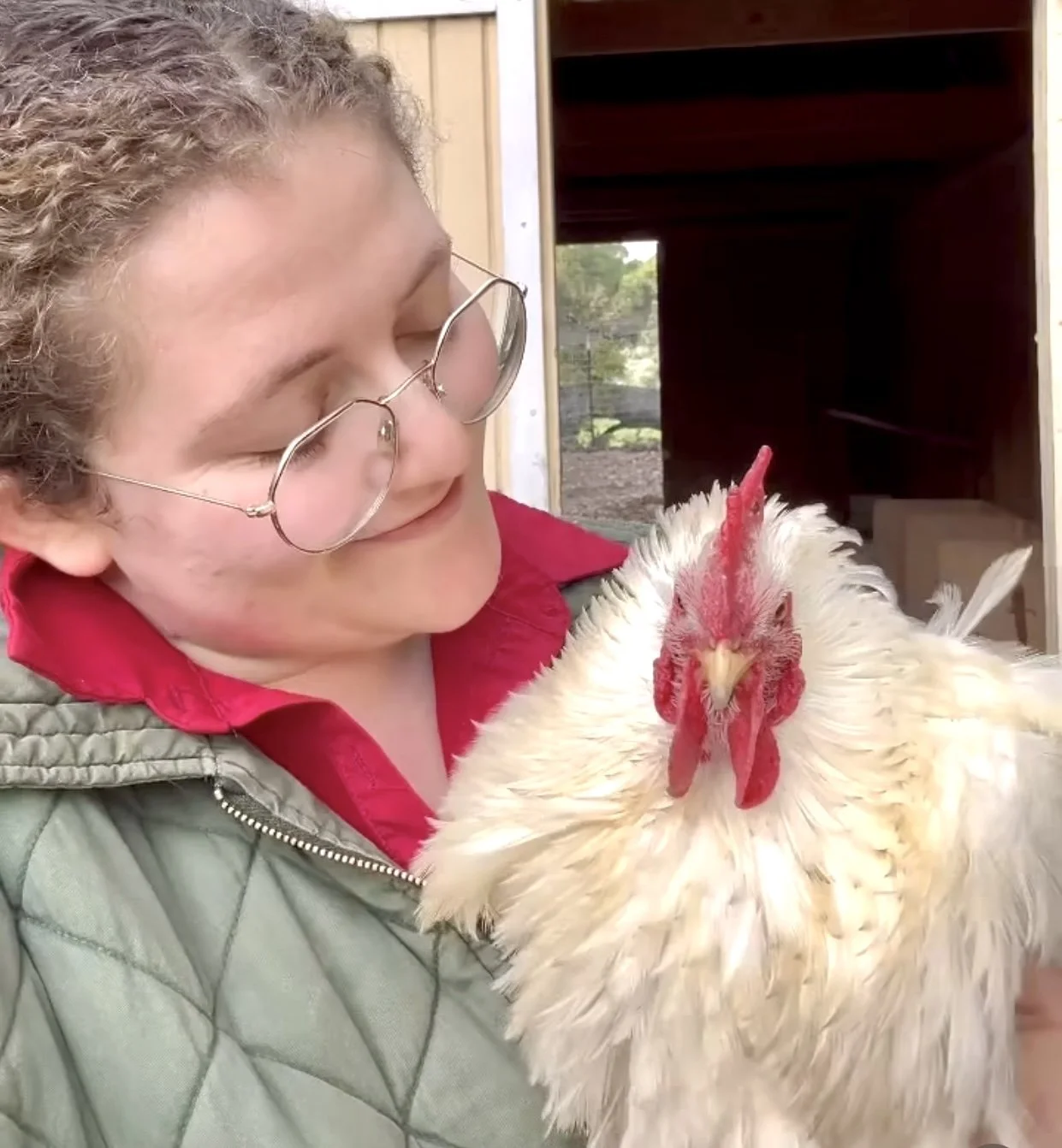
Photo credit, Zoe Rosenberg, Instagram @ZoeRooster
In this episode of Nonviolence Radio, we speak with animal rights activist Zoe Rosenberg about nonviolent direct action, open rescue, and the personal costs of standing up for animals. A recent graduate of UC Berkeley, where she designed her own major in social movement strategy, Zoe brings both practical experience and thoughtful analysis to the challenges facing today's animal rights movement. She shares her experience rescuing chickens from Perdue's Petaluma Poultry facilities, the legal consequences that followed—including a felony conviction, house arrest, and time in solitary confinement—and why those experiences only deepened her commitment to nonviolence.
The conversation explores the history of repression in the animal rights movement, the ongoing campaign to rescue beagles from Ridglan Farms, and the power of principled action to expose hidden suffering and inspire change. Zoe offers a compelling vision of what it means to extend our circle of care to all living beings and to build movements capable of transforming both hearts and institutions.
With gratitude to Elizabeth High for her transcript support.
Stephanie Van Hook: Well, greetings and good morning, everybody. Welcome to another episode of Nonviolence Radio. I'm your host, Stephanie Van Hook, and I'm here in the studio with my co-host and news anchor of the Nonviolence Report, Michael Nagler, and we are from the Metta Center for Nonviolence in Petaluma, California.
And on this show, we like to explore nonviolence in all of its forms through activism and scholarship and theory and science and practice, and all of it. And often we talk about, you know, political actions, but also the way that people transform their lives. And on today's show, we're going to talk about a space that kind of encompasses all of that, which is in the realm of animal rights and nonviolence.
Because, animal rights, it's a deeply political topic, but it's also a spiritual topic. What constitutes consciousness? What's alive? Who's alive? Who experiences harm? How do we treat non-human beings, not only animals, but plants and nature and our environment and climate and all of that?
As well as, how that impacts human beings, whether we think something is worthy of treating with respect, how that impacts us as human beings. It's like we have to respect all of life in all of its beauty, and all of its complexity, because that's what human beings are meant to do.
We're not meant to disrespect the Earth , and other species. So Michael, I want to bring you up here for a minute. I know that you've done a lot of thinking on these topics about consciousness , and the New Story, and I wonder if you might be able to summarize, in just a few words or a few sentences, what the New Story means to you and how it applies to all of life being sacred.
Michael Nagler: Thanks Stephanie, and I'm glad you said what it means to me because different people have slightly different takes on it. But in general, my position is a recognition that the human being and animals consist of, body, mind, and consciousness, and that's an ascending hierarchy, and one of the important criteria for that ascension is togetherness, unity. So at the level of body, which is where we have been forced by our advertising, we are most separate. And finally, if we could reach that pinnacle of consciousness, there would be no separateness at all. I was just thinking about the Buddha who said, "I reached an experience, the nirvana, which is unborn, unrivaled, secure from attachment, undecaying and unstained." Just a beautiful quote, which is where you are grounded in the unity of life.
Stephanie: Hmm. You know, speaking of the Buddha, that reminds me of a story that is very relevant to today's interview with animal rights activist Zoe Rosenberg from Direct Action Everywhere. I'll say more about that in a second. But the story is about the Buddha as a young boy, and he's with a friend who's a little bit more troublesome. and his friend shoots down a bird out of the sky, and the little boy, Siddhartha, who will later become the Buddha, he goes and he rescues the bird. And, his cousin, his friend, is like, "Hey, that's my bird. I shot it. I get to keep it." And, so the, the little Siddhartha Buddha takes it to the king and says, "You decide, whose bird is this?" And Siddhartha says something like, "Does the bird belong to the person who tried to harm it or the person who's trying to save it?" Meaning him. And so I think it's a beautiful illustration of the way that our role as human beings is to protect and to serve creatures, not to harm them, not to kill them.
Michael: Oh, might as well mention the judgment that the king, Siddhartha's father, renders, which is that it belongs to the one who tried to save it.
Stephanie: Yeah, that is true, yeah. So Zoe Rosenberg is actually a convicted felon for rescuing three chickens from Perdue's Petaluma poultry factory farm, and she's an organizer with Direct Action Everywhere. It's an organization whose goal is to end animal exploitation in one generation through nonviolent means.
And in this interview, Zoe shares her experiences with rescue and facing the legal consequences of her actions from the rescue to prison, and how those experiences only made her more sensitive to the well-being of other humans and animals. And she also introduces us to Chester, her beagle from the Ridglan Farm. It is an operation in Wisconsin that breeds and sells beagles for animal testing. You might have seen something about it on the news because it's gotten a lot of media coverage. So Ridglan Farms has been at the center of large-scale rescue actions, including the release of over fifteen hundred beagles in May, with more happening and planned.
And their actions have exposed the cruelty of these practices, resulting in the loss of the breeding license for Ridglan due to their inhumane treatment of the beagles. And I think that this interview will inspire you to take action for animals and to see an effective, principled, nonviolent movement at work.
So let's hear from Zoe Rosenberg.
Stephanie: Welcome to Nonviolence Radio, Zoe. We're really glad to have you here, and just been really impressed by the work that you've been doing for animals and for humanity with Direct Action Everywhere. I think I also saw that you just graduated college?
Zoe Rosenberg: Yeah, I just finished at UC Berkeley, where I had designed my own major on social movement strategy.
Stephanie: Cool. Yeah, can you say more about that?
Zoe: Yeah. UC Berkeley has a program where you can make your own major, which is really awesome, and I took classes on social movement history and the sociology of social movements throughout my time at Cal, and just finished my senior thesis, which is an analysis on the interaction between movement mobilization and repression in the animal rights movement between 1990 and 2010, and just trying to really look at why repression was able to have such a chilling effect on the movement in those years.
Stephanie: I definitely see that happening in Petaluma. When people say Direct Action Everywhere in this town where we're based, it's really kind of with a sneer. And with a lot of contention, I'd say.
Zoe: Yeah, definitely. It's become quite controversial, and I think it's interesting how in different places, people's reaction to the work we do is very drastically different.
In some places, it's almost entirely supportive. Like in most of the rest of the Bay Area, people stop me all of the time and they recognize me from my case, and they stop me and tell me how much they support me. And, in Sonoma County, the sentiment is often different to say the least.
Stephanie: Do people recognize you in Sonoma County too?
Zoe: Sometimes, yes. And sometimes people are sometimes supportive. Particularly, it's been really sweet, the other people who are going through the criminal justice system in Sonoma County as defendants have offered me a lot of support. I think probably just more understanding of what it's like to be on this side of our criminal justice system, and that the way things are framed are not always as they are.
Stephanie: You talked about your case, and I don't know if our listeners necessarily would know what your case is. So why are you a contentious figure in Sonoma County?
Zoe: Yeah, so in the spring of 2023, I was involved in a company-wide investigation of Perdue's Petaluma Poultry. Some people might also not know that Petaluma Poultry is actually owned by Perdue. They have several very large factory farms, both in Sonoma County and in the California Central Valley, where they confine, often, hundreds of thousands or more than half a million chickens in filthy sheds where they're crowded together. And throughout this investigation, we documented the conditions that those chickens were living in at various facilities. At one of their factories in Santa Rosa, we were able to see the company's own paperwork hung on the wall, and it showed that more than 10% of the baby birds had died by the time they reached just five weeks of age. That's how severe the abuse and neglect was at this facility. And there were just chickens who were dead and decomposing amongst the living birds, chickens who were collapsed and unable to get to food and water because they were suffering from illnesses and disabilities, and they were not getting the care that they needed.
And then also that spring, for the very first time, activists with Direct Action Everywhere were able to investigate the Petaluma Poultry slaughterhouse, which is Perdue's slaughterhouse in Petaluma. And, through a hidden camera, were able to uncover that chickens were being improperly stunned during the slaughter process, which was leading to them flailing in distress on the kill floor, being cut up on various parts of their bodies as they tried to avoid the automatic throat-slitting machine.
And the slaughterhouse had records that we were able to photograph that showed that chickens were sometimes being boiled alive and condemned, as what the industry calls cadavers, during the slaughter process, and this can happen just due to negligence that results from rapidly moving slaughter speeds.
We reported these things to Sonoma County law enforcement, and we have been reporting them to Sonoma County law enforcement for many years now concerning violations at Petaluma Poultry facilities, and all I received in response for my reports was a very dismissive email from Sonoma County's District Attorney's office.
Animal Services didn't even respond to me. And so in June of 2023, I ended up rescuing four chickens, Poppy, Ivy, Aster, and Azalea, from the Petaluma Poultry slaughterhouse. These four chickens were in pretty rough shape. They were covered in scratches and bruises and small wounds. Azalea and Aster had swollen, infected feet. Poppy had a really serious respiratory infection, and she was having a lot of trouble breathing. And I got them care. I shared their stories online, and I called on members of the public to join me in putting pressure on Sonoma County law enforcement to take action to prosecute Petaluma Poultry. And what ultimately ended up happening was that Petaluma Poultry was not prosecuted, but instead, months later, Sonoma County District Attorney's office filed several felonies and misdemeanors against me, and I ultimately was ordered to wear an ankle monitor as a pretrial release condition.
I wore an ankle monitor for two years almost leading up to my trial. I was under travel restrictions, a bunch of ridiculous conditions during my pretrial days. One of the orders that the prosecutors convinced the judge to issue was that I was not allowed to possess chickens, ducks, or other fowl, because they were that worried I might rescue more birds.
And yeah, I ultimately went on trial facing felony conspiracy to commit misdemeanor trespass and three misdemeanors. The misdemeanors were two different counts of misdemeanor trespass and then misdemeanor tampering with a vehicle, which sounds a lot more sinister than it is. It's just literally because the chickens were in cages that were sitting on a truck bed, and I opened cages on the truck bed, and so I guess that means I touched a vehicle.
I was ultimately convicted on all of those charges at trial and sentenced to serve 90 days in jail.
Stephanie: And this is while you're at school, so trying to do your homework in jail.
Zoe: Yeah, my trial ended up being seven weeks long too, and it was in the middle of the school year, so I had to take the semester off.
Stephanie: It's really crazy though, the way that you were able to document Petaluma Poultry, or let's say Perdue Petaluma Poultry. They're breaking the law. And law enforcement doesn't care, or they just don't feel like that's anything-- that's not their problem? Whose problem was it?
Zoe: Yeah. What's ended up happening, and, and we've seen this quite a bit in our work investigating factory farming, is we will report to an agency, and they'll send us to another agency. Every agency wants to put it on another agency because they don't want to deal with the problem.
The sheriff's office will say, "You have to go to the district attorney's office." And the district attorney's office will say, "You have to go to the sheriff's office." And then the sheriff's office will say, "Actually, maybe try animal services." And then the animal services says, "Try the police department." And we just are sent round and round in circles, and nobody will do anything.
Even the United States Department of Agriculture, which is, like, literally supposed to be monitoring the Petaluma Poultry slaughterhouse because it's a food processing facility; when we reported it to them, they ended up, months later, they, weirdly, they sent me an email, and it was bizarre, and they said that animal cruelty and disease is not in their area of expertise.
And-- but that's literally a huge portion of what you're supposed to be monitoring at their slaughterhouse. What do you mean it's not your area of expertise?
Stephanie: It's so strange, Zoe, because if we can trust that there's laws in place that keep systems as humane as possible, that's hopefully what the law in these spaces is for, and they don't care. And nobody's going to stop them.
Zoe: Yeah. And it's horrible. And then especially for birds, I think things are really bad because they're-- things are bad for all animals who are living in factory farms, but poultry don't have any federal protections. We're depending completely on state regulation, and the Humane Slaughter Act doesn't apply to poultry.
Their protections are honestly just limited in that regard. But there certainly are things that just should be blatantly illegal, like boiling birds alive. And California does have a good statute, Penal Code 597, which does make it illegal to cause any animal unnecessary suffering, and I think everyone can agree that boiling someone alive is certainly not necessary, and it is certainly suffering.
It's just really no excuse that our government is letting this happen.
Stephanie: Yeah, there is no excuse, yeah. And we can't be content in knowing that there are laws in place to stop them because nobody's enforcing those laws. I imagine they might get a fine, and they'll just pay it, because they're making so much profit.
Can you speak to the profit margins of Perdue?
Zoe: Yeah. Perdue makes over $9 billion in annual revenue, so they are a major company. They're the third-largest poultry producer in the United States.
Stephanie: Yeah. And what about their employees also in Petaluma? They must have hundreds of employees working there. And I can't imagine it's glamorous or even well-paid work.
Zoe: No. It's definitely not, and we have had Petaluma Poultry slaughterhouse employees reach out to us over the years and just kind of share stories about the conditions. And one woman reached out to me a few months before my trial, and she said that she and her husband briefly worked at the slaughterhouse, and they both had to quit pretty shortly after starting because it was just so awful working there. The conditions were so poor. And they said one of the hardest parts about working there was that they were expected to participate in pretty violent acts towards animals. And she said that her husband did observe chickens who he believes were boiled alive during the slaughter process. And yeah, they have a very high turnover rate at the slaughterhouse. I don't know the exact percentage, but they're constantly hiring. Nobody wants to work there. They're not paid well. Their work is really hard and really dangerous. And a lot of slaughterhouse workers, they get injured on the job. It's a dangerous job. One thing that's a double-edged sword a little bit is there's a measure that they're implementing at some slaughterhouses, which Petaluma Poultry has done, which is the live hang room. So that's when, the first room that chickens go into during the slaughter process, where they're hung upside down in the shackles, and some slaughterhouses have started turning the lights off in that room.
And the idea is that's maybe more humane if it keeps the animals calmer, which maybe is true, but the downside of that is that, one, it's, then becomes a lot more common for birds to be improperly hung because the workers can't see what they're doing, and also a lot more workers get injured because they can't see what they're doing. So it's just a bad situation.
Stephanie: What would you hope to see take place in these situations? Shut them down altogether or have fewer creatures there? What's the short-term and long-term goal about this?
Zoe: I believe Petaluma Poultry should be shut down, but at the very least, I think we want to see law enforcement take these violations seriously and hold these companies accountable to some extent, because right now they're doing, for the most part, nothing. Maybe every once in a while they'll do something, and when they do, they'll usually-- what we usually see in an enforcement action is very targeted to a specific worker. They might fire a worker or prosecute a worker, but they're not actually addressing the systemic problems at the company level. And I think we want to see companies: as a company, Perdue should be held accountable. They should be not allowed to continue operating in this way.
Stephanie: Okay. So then circling back, you're wearing an ankle bracelet for two years or a monitor for two years, and you have a seven-week trial in the middle of your school year. And I know-- were you just in Santa Rosa at the courthouse the other day?
Zoe: Yeah.
Stephanie: Okay, so can you bring us up to speed about how that all played out?
Zoe: Yes. One of the big things that we wanted leading up to my trial was for the court to allow us to argue necessity as one of my defenses, basically saying that what I did was legally justified because it was necessary to prevent the chickens' suffering. And by breaking the law, I was preventing a greater harm. And the judge ultimately ruled leading up to trial that I would not be allowed to argue the necessity defense. And part of his ruling in that regard was that the necessity defense in California does not apply to non-human animals. And I disagree with this, and a lot of attorneys disagree with this because the way that the California necessity law is worded is it says, "You may break the law to prevent greater evil towards someone." And so it does not specify that it must be a human being. And so we do believe it should apply to animals, to a dog or a chicken or a cow. But that was his ruling, and that greatly limited what animal cruelty evidence we were able to present at trial because the permitted evidence is based on the defenses that you're going to be allowed to present to the jury.
So we weren't allowed to present evidence to reinforce that it was necessary from the perspective of the birds. And some of the stuff that was excluded that was disappointing was we were not allowed to show photos of the paperwork that showed that chickens were being boiled alive at the slaughterhouse.
We also were not allowed to show any photos or videos from any of Petaluma Poultry's factory farms, which was highly relevant because the conditions on the factory farms were what determined the conditions of the chickens I rescued on the truck. And ultimately, like I said, I was convicted on all of those charges.
I had my sentencing hearing where I was sentenced to 90 days in Sonoma County Jail, and I was also ordered to pay over $100,000 in restitution to Perdue. And, it's ridiculous, but the argument for that was that after I rescued the four chickens, they decided to pause production at the slaughterhouse while they tried to figure out what happened.
So production was paused for three or four hours. And so they wanted me to pay for all of that worker downtime, and then they wanted me to pay the overtime for when they ultimately had to make up those hours. So that was their argument on the restitution. So while I was ordered at my sentencing hearing, every defendant has a right to a separate hearing to challenge their restitution amount. So that hearing was scheduled to be this past Tuesday, and so that's why I was at court in Santa Rosa. But last week, Perdue's attorney reached out to my attorney, and they were basically like, "If Direct Action Everywhere agrees to stop protesting at Petaluma Poultry executives' homes, then we will tell the court that to not worry about the restitution."
So we were able to get rid of the restitution, so my restitution was set at zero dollars on Tuesday. So that's good news. Won't be giving a penny to Petaluma Poultry. But yeah, it's been a ridiculous couple of years certainly, and I'm on probation still for the next year and a half.
Stephanie: And can you talk about your time in prison, when they put you in solitary confinement?
Zoe: Yeah. I was sentenced to 90 days. I ended up being approved to serve part of my sentence on house arrest. I got credit for the last 60 days through house arrest. In California, if you are on good behavior, you can get half-time credits, so then each day counts for two. And I'd already been in jail for a day when I was arrested, or I was in jail for half a day when I was arrested, so that counted towards a day. So I ended up serving two weeks in the Sonoma County Jail. I have multiple chronic illnesses that I live with, and one of our big concerns about me going to jail was how the jail would handle my medical situation.When I had been arrested initially on these charges a couple of years ago, the jail had threatened to remove my insulin pump that I need to survive. And when I asked, like, a nurse at the jail at that time what would happen if they removed my insulin pump, he said, "Things will be really bad for you if you stay here."
So I ended up having to bail out at that time because I was pretty concerned that I wasn't going to get the medical care I needed, and I could end up in the hospital or worse within a matter of hours without insulin. So I was worried about that going into jail, and my attorney was in touch with the head nurse of the jail, trying to really put pressure on them to take my medical condition seriously.
The Sonoma County Jail got rid of their medical wing a few years ago, and so they don't have a medical wing. They just have their normal units, and then they have what they call a mental health wing, which is a gross thing to call it because it's basically this wing of the jail where they house people in solitary confinement who have some sort of mental disability or who are suicidal or just going through something.
Because everyone knows that being in solitary confinement is really beneficial to your mental health. That's sarcastic, obviously. But anyway, the medical personnel of the jail are all stationed in the mental health wing. So now they, anybody who has a more serious physical medical issue also often gets housed in that wing in solitary confinement.
So basically, because of my chronic illnesses, they housed me in solitary confinement. And yeah, that was a very difficult experience. Basically I spent every single day, at least 23 hours a day, sometimes more, just in a very small cell by myself. All that was in the cell was a bed, which was just like a slab of cement with a very thin rubber mattress pad, and then there's a very small table, a toilet, and a sink, and you can take a few steps in each direction. Yeah, so I was in there for at least 23 hours each day. Some days all I got was 45 minutes, out of my cell. And when I would go out of my cell, I was still in solitary, so every person in solitary is alone during their out-of-cell time too.
And, so in those 45 minutes, I would get let out into, what the jail calls the day room, which is just like a kind of medium-sized room that just has a couple of chairs, a computer to place commissary orders, and like a payphone. So I was able to make a phone call during that time, and that was pretty much the extent of my social interaction most days.
But yeah, it was, it was really difficult, being in solitary and every moment felt much longer than it really was. Like, there would be times where I would think that two hours must have passed and it had only been 20 minutes. Like, time just passed really slowly and, I thought a lot about all of the animals who are living in, in confinement like that too during my time in jail.
And it did definitely make me feel like, an added sense of, of urgency, to want to get animals out of those situations too.
Stephanie: It just really makes me sad hearing about this.
Zoe: Yeah. I don't think anyone, even if somebody did commit a horrible crime, and I don't think anyone should be treated that way, and I do definitely think about the other inmates who are in that wing, and I had very little interaction with any other inmates while I was there because I was obviously in solitary.
But every so often, like I would have a brief interaction through my cell door with another inmate in that wing, and they were all kind and supportive of one another, and some of them had been in solitary for many months and that's just horrible.
Stephanie: And was this the first time that you've gone to jail?
Zoe: I had been in jail before just for the brief holding period after an arrest. But this is my first time serving an actual sentence.
Stephanie: And when you said you had to take bail in Direct Action Everywhere, is it don't take bail, take prison time if you can because it draws more attention to the cause? Is that it, or…?
Zoe: So when you're initially arrested, they can only hold you for 72 hours before a court appearance. And then at a court appearance, generally, if you are a nonviolent offender and you're not a flight risk, you'll be released from custody either on pretrial release or just on your own recognizance, which just means you're expected to show up to court. So, like, you can just wait those three days generally and get out of jail at the end of it without paying any money, is, like, most often what happens for activists. So, like, when possible, ideally we like to just wait out those three days and get out without having to put forward any cash. But yeah, given the circumstances, obviously made the decision to pay bail. And we do get that money back, once you show up to court, you get the money back. But yeah, it's still just a headache when you have to pull out $49,000 cash and hope you get it back.
Stephanie: It's just so crazy. They really threw you in jail to threaten you. It doesn't sound like there's any sense of justice or fairness in that at all, right? As we see with the flotillas and just this escalated state of tension that we're experiencing in the world, compassion is criminalized. And it's just insane. Who really understands that our legal system works to jail people who are trying to uphold the law?
Zoe: Yeah, it's just like the priorities of our legal system are completely backwards and they're focused on criminalizing the wrong things and the wrong people, and it's not oriented around rehabilitation for people who are struggling and resorting to crime for whatever reason. Those people need help, too. And it's just, yeah, it's not a good situation on many levels. And it's shocking to me how many people still have this perception that our legal system is just always right, that it's all working. It's working as it was designed perhaps, but it's certainly not working as it should.
Stephanie: Exactly. I like that. And I liked how you brought up the term nonviolent, as in nonviolent offenders in prison. But I mean, you are actually a nonviolent person, which is a different kind of nonviolence altogether. Because the organization DxE is deeply committed to nonviolence and using nonviolence as both a principle and a strategy, which I understand, so to end animal exploitation within one generation. Now, I wondered, to go into some of your research that you did for your dissertation on social movements and the animal rights movements, how do you fit into this? Like, how you're coming along in a line of people who have been doing this since the rise of factory farms. Can you situate this into a story form?
Zoe: Yeah. The history of repression in the animal rights movement is really intense. Animal rights activists were pretty intensely criminalized in the '90s and then even more intensely criminalized in the very early 2000s. In the late 1990s, the federal government passed the Animal Enterprise Protection Act, which makes any interference with an animal enterprise a federal crime. And then that later was renamed and slightly reworded to become the Animal Enterprise Terrorism Act in 2006. So basically, any act of interfering with the profits of an animal enterprise is federal terrorism, and it's very broadly worded. So it's, yes, if you could commit an act of property damage that more arguably could be perceived as violent or something, and that could fall under that.
But also something like a pressure campaign, which is oriented entirely around public property protests but then results in financial loss through the protesting and the campaigning could also constitute federal terrorism. So it's a completely unconstitutional piece of legislation. It still exists today. It hasn't been used much recently, but it still exists, which is not great. And there's been various major acts of repression and criminalization of activists in the movement. A lot of people were hit with grand jury subpoenas in the '90s and the early 2000s and forced to testify against one another or go to jail for refusing to testify. A lot of people were put on terrorism watch lists and interrogated at borders for even just knowing animal rights activists, even if you weren't in the movement. People were followed by FBI agents. Like just wild things were happening. The FBI declared the animal rights and environmental movements the number one domestic terrorism threat in the early 2000s.
And the kind of big moment where this all kind of culminated was between the years of 2005 and 2007, six animal rights activists were charged with the Animal Enterprise Terrorism Act for operating a website as part of a campaign against an animal testing facility called Huntingdon Life Sciences. And, none of these activists were, they were not prosecuted for doing anything that I think the average person would consider illegal. They were just operating a website where they would post campaign information and calls to action, and they would post about activism that other people were doing as part of the campaign. And that was resulting in economic damage for Huntingdon Life Sciences, and they were prosecuted under the AETA. They were all ultimately convicted as terrorists and sentenced each to between one and seven years in prison.
And this had a really significant chilling effect on the animal rights movement. People were pretty freaked out because suddenly it's, "What is terrorism? What is not? What is going to land me in prison? What is not?" But I think what Direct Action Everywhere and myself have been trying to do in recent years is bring back the life into the movement that it lost during that time. It, particularly the grassroots movement, really lost a lot of its fuel after that, and there just weren't people who were willing to take risks for animals in the same way. And so we're trying to bring that back, but also be strategic and find ways to make sure that repression doesn't have that chilling effect again, but instead we're able to exploit that repression and make it backfire on these industries.
And that's something that I feel like we really did in a powerful way with my case. We were able to get so much public attention around it. Over 250 million people watched videos about my trial in the lead up and during and after it, and it was just such a big press story, and just so many people suddenly have been talking about what's happening to chickens in factory farms and slaughterhouses and at Perdue facilities. And I do think ultimately that's partly why I didn't get a even harsher sentence is because the court knew that there would be so much public outrage, and already with the sentence I got, well over 50,000 people signed a petition calling on the governor to pardon me. And there's just been so much public attention and support, and I hope that we can continue to create this culture around repression in our movement so that we don't let it have this chilling effect going forward.
Stephanie: Yeah, I think Direct Action Everywhere is just a really interesting case study for nonviolent action, because you have this deeply, the interdependent, interconnected worldview of sharing consciousness with other beings, so it's the New Story there, and then you have people changing their habits and their eating and their consumption, which is part of that lifestyle change that some people just stop there. And then there's the deep educational side to everything, and then the direct actions too, where you, you build up. So it's just such a complete exploration of how nonviolence works, and it feels like it's really effective. And in this case with Perdue, I imagine you guys aren't going away.
Zoe: Definitely not, no.
Stephanie: Like, it's not just, "Okay, now it's over," and move on to the next place, because they still haven' t changed, right?
Zoe: Yeah, and one of our big campaigns has been going after grocery stores that are continuing to buy and sell chickens from Petaluma Poultry, and one of the big grocery store chains is Trader Joe's that's continuing to work with the company. And so we've been doing a campaign there. We've had activists disrupting all of Trader Joe's grand openings across the country, because they've been opening a lot of new stores recently, and Trader Joe's really doesn't like that. And we've had thousands of people comment on Trader Joe's social media, and we just hope that if we can get some major suppliers, or buyers, I should say, like Trader Joe's, to drop Petaluma Poultry, that could be a pretty significant hit to the company.
Stephanie: Yeah, drawing on the boycott. Yeah, I just saw the video the other day of after your trial, folks went then to Oliver's in Santa Rosa. And there was this one gentleman who was like, "Look what you did," like pushing this lady with his cake and yelling at her, or yelling at them, and I was like, "This is insane."
Zoe: Yeah, it's totally ridiculous. This guy was assaulting our activists. He was trying to pull a megaphone out of someone's hands and hitting people, pushing people. And he was buying a cake, and he just was pushing one of our activists, and he just rammed into them and smashed his cake against their back and then was like, "Look what you did to my cake." You did that to your cake. Like, what do you mean?
Stephanie: I know. Can we have a little bit of time to talk about the beagle rescue?
Zoe: Yeah. I actually have a beagle here. He's from Ridglan. This is Chester.
Stephanie: Oh my goodness. Look at his face. How old is he?
Zoe: He's two years old. So he spent two years in a cage at Ridglan.
Stephanie: Oh, gosh. I was just so interested, and as so many people were, in this case as well. Again, DxE bringing the awareness.
Zoe: So yeah, in 2017, several activists with Direct Action Everywhere investigated Ridglan Farms. That was the first time that they were ever investigated, and they were able to rescue three dogs from the facility as an open rescue. And we released that investigation in 2018, and weirdly, years went by, and then charges were filed against three of those investigators and rescuers in 2021. So they were supposed to stand trial in 2023, for their rescue of the three dogs. And a week and a half or so before the trial, all of the charges were dropped because Ridglan basically said that they decided they didn't want the case to be prosecuted because it was getting so much public, negative public attention for their company.
And then at that point, one of the defendants is actually an attorney, Wayne, and he said, "Let's try to turn the tables here, and let's try to get a special prosecutor to prosecute Ridglan Farms," because the district attorney's office had been failing and law enforcement had been failing to do anything to protect the dogs at Ridglan.
And they're like, typically have been around 2,500 to 3,000 dogs just living in cages at Ridglan Farms, dogs who are like being subjected to horrific things at Ridglan. They have had non-veterinarians illegally doing eye surgeries on dogs without anesthetics and things like that. And then obviously they're sold very often to laboratories where they have even more horrible things happen to them.
So ultimately, after a bunch of court hearings, we were able to get a special prosecutor assigned to prosecute Ridglan Farms. They determined that there was felony animal cruelty happening at Ridglan. And it's good news and also not quite what we wanted, but what happened was the prosecutor said to Ridglan, "If you agree to give up your breeding license on July 1st of 2026, I will not file these felony charges against you." Which is great because they are losing their breeding license. Really, they should have just had their breeding license revoked, and all of the dogs should have been seized, and they should have been charged with felony animal cruelty. It was a step in the right direction, but not quite what we wanted.
And part of this deal did not include what would happen to the dogs who are currently at Ridglan. So it only really protects future dogs who will not be bred at Ridglan. But Ridglan is still allowed to sell all of those dogs to laboratories. And there was also some concern that Ridglan as an entity has to give up their breeding license, but they could reincorporate under a different name and there was a lot of uncertainty, and we did not feel like those dogs were safe. In March of this year, over 100 activists broke into Ridglan Farms, and they were able to get 22 beagles out of Ridglan and get them to safety, which is incredible. Some activists were arrested during that effort, and that kind of all went viral online, and there were just thousands of people like, "How can I support getting the rest of the dogs out?"
And so that kind of created this huge campaign to get tons of people out at Ridglan Farms last month to try to get the rest of the dogs out. And when over 1,000 activists or close to 2,000 activists arrived at Ridglan Farms on April 18th, they were met with just a huge police force and a huge amount of brutality.
There was tear gas, rubber bullets, pepper spray. Some people put goggles on because of the pepper spray and tear gas, and there were cops who were, like, pulling activists' goggles off, spraying pepper spray under their goggles, and then putting their goggles back on. Several activists had to go to the emergency room afterwards.
And this was an entirely nonviolent effort to get these dogs out. No one had any intention at all of causing any harm to anybody. And this also just drew a huge amount of public attention. There was so much outrage, and that all contributed to what recently happened, which was the really good news that we were, through negotiations, able to get 1,500 dogs released from Ridglan, and all 1,500 of those dogs are now out, and they're either at rescues, foster homes, or have been placed at loving homes, which is just incredible.
There are still 650 dogs at Ridglan who we are continuing to campaign to get released, whether that's through further negotiations, law enforcement intervention, or whatever needs to happen. And I know that people, the organizations that have been involved in the kind of negotiation side of things, like Big Dog Ranch Rescue, do feel hopeful that we will be able to make some progress for those 650 final dogs, and Ridglan will hopefully be shutting down in the coming months.
Stephanie: Yeah, I saw a video. I think as I started to follow this campaign, I did get a video that's showing them making a beagle inhale toxic fumes. And seeing that really changes you when you see this innocent creature who expects cuddles and love, or even not to be abused. It's just so horrific. It's so deeply horrific. And I imagine knowing that they're still there is also very sad because knowing what they're going through is probably not changed.
Zoe: Absolutely, yeah. And one of the most disturbing facts about the animal testing industry is the reason that they use beagles specifically is because they are a very forgiving dog breed. So you can do horrible things to them and they will not attack and bite you most of the time, no matter how terrified and in pain they are. So they're just kinda taking advantage of these dogs' gentle natures. And it's just horrific and when-
Stephanie: I know. That's not the world that we want to live in, is it?
Zoe: No. And I flew to Wisconsin to help with the release of the dogs. So I was helping care for and triage several hundred of the dogs over a couple days. And when I was helping carry the dogs off of the rescue vans, they were just the most traumatized dogs I've ever interacted with. Just their entire bodies were just tense and they were just bracing for something horrible.
Stephanie: Well, yeah, what are you going to do with me now?
Zoe: Yeah. So many people were kinda commenting on social media like, "Oh, this must be the happiest day of these dogs' lives." I'm like, "no, they're terrified. The happiest day of their life is yet to come." This is a really traumatizing time. And everything in the world is so overwhelming for them and the dogs are all doing a lot better now that we've gotten out. But the first couple of weeks was hard for them because all they had ever known was four walls of a cage and a shed. They didn't know that a world existed and so everything was terrifying. Everything was overwhelming. It still is, but less so now. And even with Chester, the Ridglan beagle who my family has adopted, I flew home with him from Wisconsin and he had never seen the inside of a house before. That was new to him. He'd never been in a house. He'd never felt anything soft and he'd never seen a dog who wasn't a beagle. Like, when he first saw another dog who wasn't a beagle, he was like, "What is that? What is this creature?" It's wild just thinking through all of the things that are so normal to me that he's just freaked out by or interested in because he's never seen it before.
Stephanie: Yeah, because he's been held captive.
Zoe: Yeah, and I don't think his eyesight is very good which makes sense because I guess there was a study that showed that humans who grow up in extreme confinement for whatever reason, their eyes don't fully develop because they don't have to see and process as many things. And I do notice with him, I don't think he can see super well. It is horrible.
Stephanie: I just thought it was so amazing, though, that one action, I guess in April, that went viral. Which showed compassionate activists showing up and getting pepper sprayed. And I thought, I just couldn't believe how far that went. That was so amazing that it was on every local news channel and got reported in New York Times, Massive News too, and I was like, "This is working. What you're doing is working obviously." It captured the imagination of the public, and I think that when nonviolence is done really well, that's what it looks like.
Zoe: Totally. Totally. And yeah, I, I had a professor at UC Berkeley who explained nonviolence to me in a really powerful way, and she said, "The purpose of nonviolent direct action is to provoke violence against yourself as activists to draw it, because the violence is happening, it's constantly happening, but it's happening in secrecy, and they're trying to hide it. And if we can put this violence on a public stage, then that is what will ultimately create the contention and the dilemmas that is needed to actually lead to change. So that's not to say that any of us want to experience violence, because of course we don't. But through experiencing that violence, people brought so much awareness to these dogs and ultimately got 1,500 of these dogs out of a really horrific place.
Stephanie: Yeah. And then I think that sums it up really well, and that also what I was excited about was the power of the diversity of a movement in the way that you have people who are up there on the front lines, and you have other people who are at the legal system. And then you have other people who have animal rescues, and that's what they do, and they're prepared to receive the dogs when they come out. Or you have people who foster animals. Not everybody has to do the same thing.
Zoe: Absolutely. Yeah, it was really inspiring seeing the way that the movement came together in this moment, and factions of the movement that maybe historically haven't collaborated as much collaborated in this moment to make something so amazing happen. And yeah, one of the most amazing, if not the most amazing thing I think I've been a part of in my time as an animal rights activist has maybe been this. And just also seeing the way people took care of each other after the brutality on April 18th and continued to take action as people were still really suffering from the physical brutality that they went through. And the way that these rescues really stepped up was incredible, too. Just such a huge effort to get, just to literally get the dogs out and make sure that they were all in safe places. So yeah, just incredible.
Stephanie: Zoe, do you have any kind of last words for us in terms of maybe where you would recommend people to go to learn more or to get involved in this work that you're so deeply a part of?
Zoe: We at Direct Action Everywhere, we're a community, and we invite everybody to join us. We have weekly meetups at the Berkeley Animal Rights Center. If you are in the Bay Area, the Animal Rights Center is in Berkeley. And everyone's welcome to come and hang out, and we have a different topic every week that someone presents on at those meetups.
We are constantly organizing different actions and protests, and we would definitely encourage people to get involved. You can go to dxe.io/takeaction to find opportunities to join us. And if you don't have a DxE chapter near you, you can start one. But yeah, we definitely want more people to be taking action for animals because animals are often kind of neglected in various spaces, and we want to make sure that their voices are heard, too.
Stephanie: For those of you just tuning in, that was Zoe Rosenberg talking about her work in animal rescue, with Direct Action Everywhere. Michael, that was the first time you got to hear that full interview, and so I see you rapidly taking notes. We have a little bit of time left. I wonder what your comments are and what surprised you or inspired you in what you heard?
Michael Nagler: Well, first of all, I was very happy that UC Berkeley got involved, you know, where I taught for many years. It's really good to know that nonviolence education is going on there.
And, also, you know, at the beginning of the hour, or top of the hour, Stephanie, I quoted something from the Buddha. I'd like to mention now an ancient Greek philosopher, Porphyry of Tyre, a city which incidentally is being attacked by Israel right now. But Porphyry lived from 234 to 305 of our era. He's mainly famous because he organized the writings of Plotinus, who was a mystical philosopher that I really, really like.
But I'm going to put him forward as the patron saint of animals. Or the patron saint of vegetarianism. Because he famously said, this is at a very early period when people never really thought about the consciousness in our fellow creatures. He said, "If we're unkind to animals, we're going to be unkind to ourselves."
And that's exactly what Zoe was just illustrating. The inhumanity with which these people have been treated was just a reflection of the inhumanity of the industry itself.
But, I'd like to point out that our friends in Pace e Bene back in January declared this the year of Nonviolent Solutions, and they have been racking up a beautiful solution every day.
Stephanie: And Zoe really embodies those solutions, too, and that's really what we want to try to highlight, too, in nonviolence, that it's not all just about the world that we don't want. It's also trying to build the world that works for everyone, not just human beings, but all of life, including animals, and to end animal exploitation. It's something that I think we can all really get behind. There's enough advancements in technology that the kinds of testing that's happening on animals and the kinds of mistreatment of animals is no longer necessary for human thriving. That argument that this is for, you know, going to save your life from cancer is no longer a good argument. There's enough technology out there that can help. We just have one more minute left, Michael.
Michael: Not to mention, Stephanie, that practically every nutrition report that I read, it's become an absolutely universal theme in medical research and healthcare, is what they call plant-based diets, are vastly more helpful for us. And we weren't always carnivores. If you look back in the history of hominins, we were vegetarians a long time before we started eating animals. So let's get back with it.
Stephanie: Well, there's, you know, Michael Pollan does really good writing about food systems and the exploitation of human beings within advertisements and food systems and just that how far off track, really we are and, you know, the way that corporations continue to exploit every single need that we have and cause so much harm. So yeah, there's a lot of work to be done still, and I really think that this is something that can inspire. This interview with Zoe really can inspire people to think more deeply about what's happening around all of us. So really grateful for Zoe.
We want to thank our mother station, KWMR, for making this show possible. We've been doing this show for at least over a decade now, Michael. We want to thank Elizabeth High, who is in our hearts today, she helps to transcribe this show. To our friends over at Waging Nonviolence, thanks for sharing the show. To the Pacifica Network also for sharing it. We love being on radio. And also to our friends at PCA and KPCA in Petaluma. They're right underneath our office and next to our office, and, so thanks so much for all you do. And, to you, our listeners, we are very grateful that you show up for nonviolence and continue to explore this with us. If you want to learn more, visit mettacenter.org, nonviolenceradio.org, you'll find the show archive and transcript. And as we say, until the next time, everybody, please take care of one another and take action for nonviolence until the next time.