
There's Enough for Everyone: Robin Greenfield on a Year of Living on 100% Foraged Food—and Rediscovering Our Connection to the Earth.
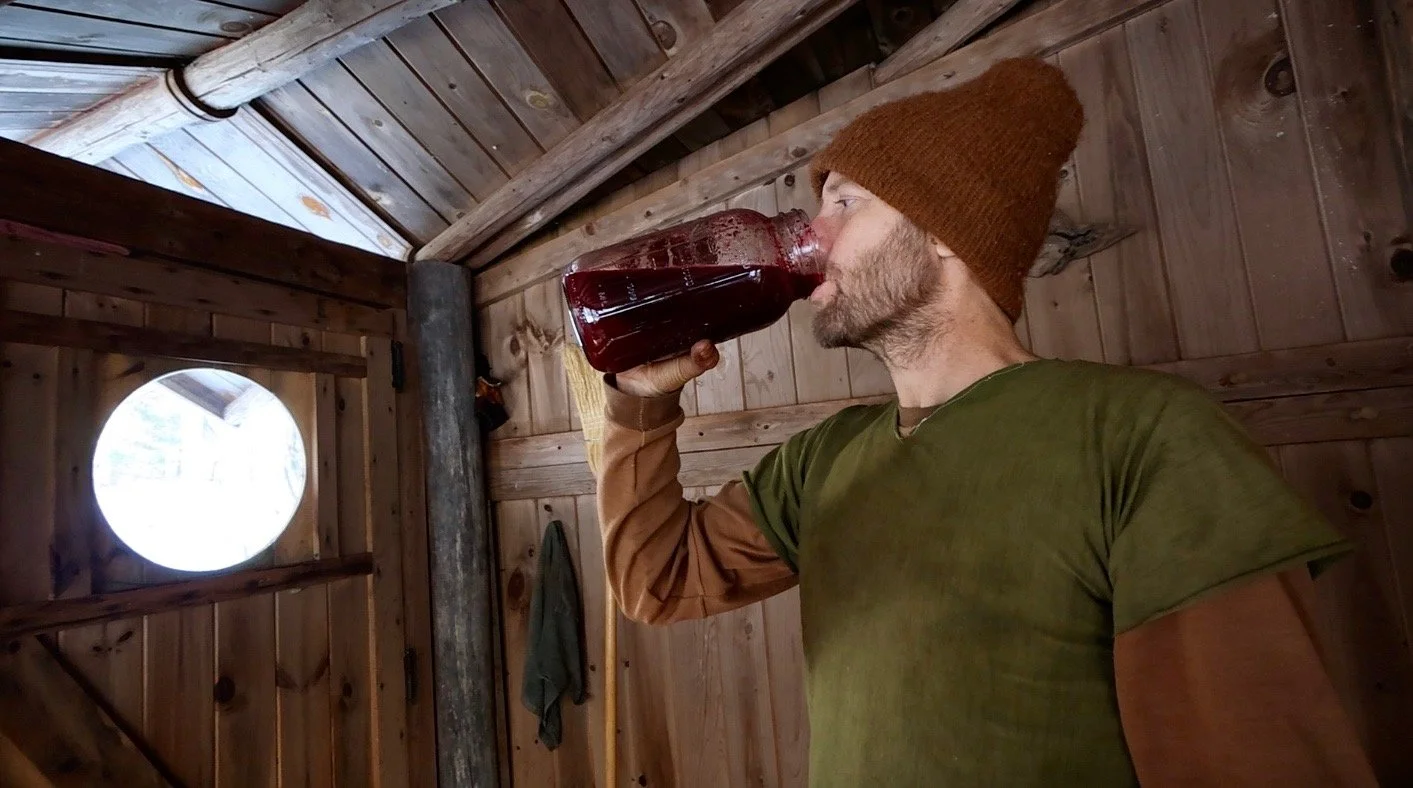
Photo: Robin drinking wild juice. Credit: Robin Greenfield.
What does it mean to live simply in a culture built on excess? In this episode of Nonviolence Radio, we speak with environmental activist Robin Greenfield, whose latest experiment is to forage 100% of his food and medicine for a year while traveling the country to help people rediscover their relationship with the Earth. Together we explore simplicity as a practice of nonviolence, the illusion of separateness, and how reconnecting with nature, community, and ourselves can become a profound act of resistance. As Greenfield reflects, "Connection is at the root of the solution to all of our problems, and disconnection is at the core of our societal woes." Drawing on influences including Gandhi, Peace Pilgrim, Thich Nhat Hanh, Marshall Rosenberg, and Robin Wall Kimmerer, he shares how a life of voluntary simplicity has become not one of sacrifice, but of greater freedom, joy, and connection.
Transcript with gratitude to Elizabeth High:
Stephanie Van Hook: Well, greetings and good morning, everybody. Welcome to another episode of Nonviolence Radio. I'm your host, Stephanie Van Hook, and I'm here in the studio with my co-host and news anchor of the Nonviolence Report, Michael Nagler, and we're from the Metta Center for Nonviolence in Petaluma, California.
On today's episode of Nonviolence Radio we hear from Robin Greenfield. Robin is a servant of the Earth, humanity, and plants and animals with whom we share this home. This year, Robin has immersed himself in quite an extraordinary experiment. He's foraging 100% of his food and medicine while traveling the country to share the message that Earth provides us with everything we need. He also launched the One Million Community Fruit Trees Initiative, a grassroots effort to plant one million fruit and nut trees through the collective work of thousands of people and communities.
We were happy to meet him in Sebastopol, California and happy to share this interview with you
Stephanie: I was really inspired by what I have seen of your presence with your year of foraging. I saw somebody who's experiencing deep purpose and meaning, and that in the kind of wild state of the excess in our world, to see somebody who's slowing down and being intentional and being in tune with nature, I just was really impressed with you and what your mission is and what you're doing. And I also really appreciated the video I saw of you in the industrial orchard where you were showing all of the different waste that's part of our food systems. And it really made me sit for a while and think about how deep the violence is to trees in that situation, when we treat them just as inanimate objects, just to give us food, we're harming them. We're in relationship with them, and we're just using them for fruit, and not honoring them in the way that we could be, and it feels really dirty. And so just having you and your lifestyle and consciousness in that space, I felt really helped to awaken that understanding in me, so thank you for that.
Robin Greenfield: The way that I live my life, I generally forget that I'm doing anything remotely unique and that I'm actually offering something to the world. And then I remember how far we've gone as a society, that what is considered the societal norms, what is the mainstream, is one of the most extreme societies that has ever existed on the face of this earth, potentially the most extreme society, and for me, that actually helps to remember that, because I can say, "All I have to do is genuinely care and live my life and put that into action, and that is meaningful." And so for people out in the world, I really love to be able to share that, that because of the state of the world, you don't have to do that much in order to walk in this society in a way that can really be a positive influence and can really enrich the life of others. And so although a lot of people look at what I do and think that it's quite something, in many ways it's pretty easy because it doesn't take that much in order to be a contributing member in that way
Stephanie: Well, I think there's a lot of inner work that you're doing that might go unnoticed, but we definitely notice it. And one of the things that I read is that when you were first getting started, that you had a list that you made. And you started there. I think that's super inspirational and very helpful for people who are asking, "How do I help to tip the balance in the other direction?" So can you tell us about your story of getting started in all this?
Robin: In 2011, I was living a fairly typical US American lifestyle. I was very focused on material possessions and financial wealth. I was 25, and I had set a goal of becoming a millionaire by the time I was 30. And I was running a marketing company, selling advertising, and I was happy, actually. Things were going well. I was on track to accomplish that millionaire status. I had a team of about 20 people selling advertising. I had love. I had friendship. I was traveling the world. I was a Wisconsin boy living now in San Diego, three blocks from the beach. So in every way, my young self would have been proud of myself, and I could have continued on that path for the decades ahead.
And then something happened, and I realized that I wanted to radically transform my life. And a lot of people, when they hear that, they imagine some sort of aha moment and, you know, a near-death experience. But what happened was I simply started to watch some documentaries and read some books, learn from different leaders and listen to organizations. And I learned that the way that I was living was causing incredible destruction to the Earth. I learned that what we call the American Dream is actually the world's nightmare for billions of people and for the millions of species of plants and animals we share this home with, and that I was basically wrapped up in this deep web of consumerism. And this web was tied to systems of oppression and exploitation and extraction, and this was happening through almost every daily action that I was taking. The food I was eating, the stuff I was buying, the trash I was creating, the money I was spending, the money I had invested. It was tied to the military industrial complex and to police brutality and to just such an incredible amount of suffering.
And as one would imagine, I felt some anxiety, overwhelm, disheartenment, frustration, and maybe even some anger when you realize that the US government has lied so much. You know, when you realize that this nation is founded upon the enslavement of seven million people stolen away from Africa and the genocide of hundreds of Indigenous cultures and that this stuff is baked into our constitutions, our corporations, and trickles down into our local laws even.
So there was strong feelings in that way, but at the same time, I felt even stronger feelings, and that was I felt empowered, excited, invigorated, motivated because these documentaries, books, people, organizations, they didn't just share the problems that existed in the world, they shared solutions. They shared alternative ways of existing, living sustainably, living simply, living in closer connection, opting out of the monetary system, localization, decentralization. And they shared many simple ways that I could start to transform my life.
And so I made a list of over 100 changes that I wanted to make and committed to making one positive change per week at least. And I put that list on my kitchen wall and made a commitment that I would every single week make one positive change. So after two years, one positive change, I had made over 100 changes in my life and relatively quickly, but also, slowly and quickly at the same time, transformed my life into more of the path that I was hoping for it to be on.
Stephanie: And as you were making these changes, I've heard you say that, wow, it's bringing you more joy, more happiness, more fulfillment, more satisfaction, and so it made the other changes a bit easier to make, or it kept you on the path because you started to sense that there's a deep connection to the path that you're taking?
Robin: Yeah. The way that I saw it was that I was building the foundation towards a more sustainable life. Step by step, that foundation was being built. And with the foundation growing stronger, it allowed me to take more steps. And I realized that everything is interconnected. As I made this change and that change, many other changes I had already started to make by doing those and that made for the steps to be less to get to some other areas. So eventually I'd wanted to get rid of my car, minimizing my involvement in the fossil fuel system and this really radical individualism. And I did. I got rid of my car. And I realized that one of the greatest benefits of getting rid of my car is that I got rid of my trunk. With no trunk, I couldn't fill it full of stuff to buy. If, now riding my bicycle, trips to Walmart no longer made sense, it was trips to nearby local stores that I could transport things on my bicycle. And that was huge. I never realized how not having a car would so deeply change my form of consumption. Now, of course, you could just then order everything online, but that wasn't my objective, and it was all interconnected. So, yeah.
Michael: Robin, I just want to point out, one of our big heroes is an Indian sage by the name of Swami Ramdas. And he set out to be completely materially simple. And he had nothing except a spare clothing. Of course, in India, there's a different ecology, you can do this. But what you have made me think about is that, here he is at being absolutely simple, stripped down to the bare necessities, and included about six books. So when we disengage from the material clutter, and we do it right, and I think you have done it right, it doesn't mean we disengage from human relationships and from the meaning of our individual life. Now, I'd like to hear your thoughts about that, as, you know, whether there was any spiritual practice involved or how this has helped you be paradoxically more in connection with others and through them the reality of life than when you were cluttered and distracted.
Robin: I love that. So a big part of my journey has been to simplify. And as you know, Mahatma Gandhi's been one of my biggest influences, and he said, "Live simply so others may simply live." And that was relevant then, and it's potentially more relevant today because the way we currently live is the less simple we live, the more we're tied to these systems of exploitation and oppression. The more we're dependent upon materialism that is coming out from far off places where we're completely disconnected from the source, the people, the plants, the animals, all of it, the more likely violence is being done on our behalf without our seeing it. And it allows us to do this violence because we don't see it. If the violence was happening at our doorstep, we would opt out. But it's so outsourced. And so for me to live simply is at the core. Since 2011 when I started on this journey, the answer was always, "What don't I need? What have I been sold on the belief that I need in order to be a loved member of society, in order to be successful and have meaning and purpose?" And so continuously, I've just questioned everything and let go. Some things it's like you got to find an alternative, replace it with something. But with most things, it's just letting go. And from the early stage, my focus was living sustainably at the core.
But it's all– peacefulness and justice, equity, all of these things are completely interconnected. The thing that at the beginning I was less focused on- there was always a focus, but, you know, a lot of the leaders that I learned from: it's whatever we create inside of us is what there will be outside of us. So Peace Pilgrim, for example, you know, sharing that if we have peace within, there'll be peace without us. And Thich Nhat Hanh has been a big influence of mine, and if we can exist in this state of mindfulness and joy and connection, then that will multiply around us. So my work more so of the last five years has moved away from, "sustainability," because what I've definitely realized is that if we can't find peace within ourselves, we will never create a peaceful world outside of ourselves, and that's been a very substantial practice of finding that wholeness and completeness within, is the way that I would describe it, is if we're whole and complete, no corporation can sell us anything that we don't need. No government can get us to do these things if we are whole and human beings. So it's one of the most powerful acts of resistance we can do, is to love ourselves just the way we are. That's where Mr. Rogers has been such a wonderful influence to be able to say, "I like you just the way you are." Imagine if everybody in the world liked each other just the way we are. We wouldn't have wars, which are the greatest environmental destructors and human destructors.
As far as early on in the realm of spirituality, was there any spirituality? The answer is pretty simply no. I've never had a god, and I've never had a religion. A lot of people look at what I do, and they see the spiritual element to it, and I can understand that. But for me, spirituality in one sense can be just a label, and I don't need a label. I'm just doing my best to be a human being who, in my daily actions, my interactions, I'm living in harmony with the world around me and using my life to enrich the life of those around me. Which I think is the basic tenets of a lot of spirituality. But do I need to put a name to it? I just do it. I just do it.
Michael: I wanted to point to the fact that it seems to me, Robin, that you're making the best use of what some people might regard as a sacrifice. I don't. But your example that, you know, there are people who have gone away from life and lived in complete obscurity. And I believe that they have some influence on the world in some Akashic or quantum field element, but it's also very good, especially in this day and age, to go beyond that and to strike that balance of letting it be known who you are and what you're doing without having it influence your choices. Do you know what I mean? Like, "I'm not going to do this because it'll look good. I'm going to do this because it feels authentic." And then let it spread. And, you know, by golly, when you're authentic, it tends to spread very nicely. Would you mind commenting on that?
Robin: I basically am, one of the things that Marshall Rosenberg teaches is, don't do anything that you don't want to do. Don't do anything from a place of have to or should or guilt or shame or duty or obligation. Do what is going to bring you alive. And being alive is the opposite of what this society is. We're basically the deadest human beings that have ever lived on this earth. And being alive is exactly what a dominator structure doesn't want. Human beings who are truly alive, that are critical thinking. So I would say that I am not…well, I think a lot of the people who spend time with me would say, you could say that I'm selfish. I'm not really giving things up. I'm still working towards my own desires of meaning and purpose and connection and belonging and love and success. I'm just not willing to accomplish those basic human needs at the expense of other people's basic human needs.
So I'm not selfless, and I haven't really sacrificed much, because instead, with everything that I'm letting go, I'm filling my life with exactly what I want. And part of that is that there is an element of me that has still not dissolved as much of the ego as I would like to, and I'm still living my own individualistic-centered life because I've been programmed for that for multiple decades. That's the society we live in, and I'm still a product of that society. But the way that I look at it is that if at the very least, if I'm still living ego-centered and I'm still focused on myself, at the very least, what I can do is make sure that any way in which I'm meeting those needs also enriches the life of others. So it's not a change of the needs that I have, it's a change of strategy of how I meet those needs, and so very little sacrifice on my part. Although I will say the further that I go, I'm getting to the point where I'm having to let go of some things that really are painful, you know, to not have those.
Michael: Robin, when you talk about using fulfillment as kind of a compass, almost everybody would say that that's what they're doing, but they don't have a good feedback mechanism. They don't really ask themselves, "Did that make me feel good or not?"
Robin: What I've found is that connection is at the root of solution to all of our problems, and disconnection is at the core of our societal woes all over. Over the last now 15 years of making the objective of my life being the solution, what I've really come to see is that one of our greatest threats as a humanity is the belief that we're separate. Because when we believe that we're separate, that's when we can exploit, that's when we can oppress, that's when we can extract. And when we know that we're interconnected, we can't do that so easily anymore. And even, so right now, we have the illusion that we're separate from the Earth, that we're separate from the plants and animals, that we're separate from our global neighbors, we're separate from our next door neighbors, and even we're separate from ourselves.
So I think one of the most powerful things that we can do today is dissolve that illusion of separateness, and to really deeply know inside of ourselves that we're connected. And from what I see, the cultures of human beings who really feel such a deep sense of connection with their place, with their culture, with their traditional ways, those are the people who will die for protecting that land; because this land is us, and those are the people who are the true stewards of these spaces and the true protectors of these spaces. Whereas when we're separate we can always just go somewhere else. You know, we can always find just another community to go to.
So my life is designed around connection. Although I do a lot of fairly individual-type living. Like bringing back to, in 2020, I got my life down to just 44 possessions, which one of them was a postcard of Mahatma Gandhi was one of the 44. Some people see that as a individualism of moving away, but the whole experiment was by having less, it forces me to have relationships. When we don't have a house full of all the material goods and all the money we need, we need to be out in the world, and being out in the world means having connections with each other, with the plants and animals, with the earth. And so I would say the core of my life design is to make it very hard to be doing things truly alone and design it so that the only way that I can exist is through a dependence upon others. And this society shuns that. It's like "dependent upon others, you're supposed to earn the dollar, you're supposed to earn everything that you need." And so my lifetime commitment to earning less than the federal poverty threshold and having very few material possessions is all designed to force me to live in a state of connection with other people and with the Earth.
Michael: A couple of things. One is this term selfish Who are we? Who is the self that we're serving? And it's perfectly okay to be selfish if you know who you really are. And we're completely convinced that to fulfill yourself cannot possibly be at the expense of others. It's fulfilling who society tells us we are that leads us astray. And that's a pretty important thing. And again, that's where feedback comes in, that if we do something where we think it's fulfilling, do we have the self-knowledge to acknowledge, to recognize that that was wrong? When I was a kid, under the influence of family and society, I harmed people sometimes and little animals, and I felt terrible about it. But I wasn't directed to notice that feeling and to classify it as legitimate. Whereas, you know, now I've got that thing pretty well tuned. So inwardly, I shrink back from hurting anything that lives.
The other part of what I'm so interested in here is how sometimes by pulling back, in a way, we get more connected. Because what we often say at Metta is we have to recognize that we are body, mind, and spirit. As bodies, we are inevitably separate. There's nothing you can do about it. As minds, we either are or we aren't. Here we are being very much on the same wavelength. Having the same values. Other people not. But as spirit, otherwise known as consciousness, there's nothing separate about us. You can't even introduce alienation or separateness. So one way of looking at what society has done to us is to plunge us downward toward that material level. And every advertisement does this. While it's trying to sell you product X, Y, or Z, it's also selling you an image of yourself as a physical entity without telling you that you will inevitably then be separate, and therefore inevitably at some point down the road, your separateness or your imagined separateness will conflict with somebody else's and will be on the road to violence.
Robin: I'm very grateful to be having this conversation. And I will, just because here we are in this presence of three like-minded human beings who have some very similar desires of the ways we explore, what comes to my mind is you mentioned Swami Ramdas who got his life down to
almost nothing but some books.
So I don't know if you saw, but last year I finished a walk from Canada to Los Angeles. I came right through Sebastopol, and when I arrived in Griffith Park after five or so months of walking, I gave away literally everything that I owned, and I sat naked in Griffith Park for five minutes before someone lent me a blanket and covered up with a blanket. And for the next four months, I existed owning not a single possession. The only few possessions that I had were just items that were borrowed, and I made the rule that I could only borrow an item for 10 days and then had to give it back. So it was true borrowing. So it's been a deep practice, and part of me wants to do that with my whole life, just travel this country with absolutely no material possessions or just a few material possessions. I've read that Mahatma Gandhi owned 11 items at the end of his life or something like that, I'm not sure exactly. But a lot of these people have really influenced me in just deeply ascending materialism and existing in this society in a way where just your presence helps people to question how much they really need, and to see, wow, look, this human being is so deeply happy and joyous, and they have close to nothing. And then realizing actually they have everything, because it's not materialism that provides us what we really want.
But right now I'm on this journey of a year of foraging all my food and medicine, and that brings us to connection, the question of my experience with connection. So right now it's no grocery stores, no restaurants, and in some ways I've separated myself from society because, if I go to people's houses, they can't make me dinner and even have me over in their garden. I'm literally harvesting all of my food and medicine from what the earth is freely and abundantly providing, and so there's some losses there. But the whole idea of this is that by having to go out and harvest my food and medicine, I am gaining such a deep level of connection with the plants, the animals, and the earth.
Whereas in the past, I could feel loneliness. How could I possibly feel alone when I'm surrounded by all of these plants? And one of my experiments is making the sky my best friend. If the sky is my best friend, I could never possibly be alone. And then my experience is, the more that we become connected and interconnected with the plants and animals and the more we're becoming whole and complete; that actually, for me, results in it being much more flowing to be connected with humans too. And it's been a really beautiful experience. I'm about eight months into the year, and definitely one of the ideas of this project, this experience, has been to dissolve that illusion of separateness. And I will say, in the last eight months, a good amount of it has dissolved away through this practice.
Stephanie: So tell us more about how did you start learning about foraging? Because we were also talking about Douglas Fry, who is a peace anthropologist, and he tells the story of humanity from a New Story perspective that there have been peaceful societies, we've lived peacefully with each other, amongst each other, with the Earth. And there's good evidence for that. And that our ancestors were foragers. So you're also tapping back into our deep connection to Earth. But foraging can be dangerous, and you can get sick and do the wrong things if you don't know what you're doing. I know you help educate about foraging along the way, so how did you get started with foraging in your life?
Robin: So right now I'm traveling across the country. That's what brings me to Sebastopol in Northern California, and as I'm immersed in the year of foraging, I'm leading foraging walks and foraging schools and giving talks. And the idea is to help people see this, that food and medicine is growing freely and abundantly all around us, and that human beings, we're home. You know, this is our home. And for me, the fact that everywhere I go, I'm finding my food and medicine and harvesting, it's just this deep sense of home and belonging, and that's what I want to instill in people, more of that.
And then there's also the practical aspect that human beings, basically as far as I can tell, need to eat. There may be some human beings who have cracked that code, but as far as I can tell, human beings need to eat. And so we need to find ways in which we can eat in harmony, where every bite that we take is not taking a bite out of the planet, but actually potentially regenerating the planet. So for me, the foraging journey began with the journey that I mentioned earlier. It was just questioning our global industrial food system and wanting to break free from that, and that's not something you can do overnight. We have been deeply programmed in this realm.
And so it started 15 years ago with just harvesting some nasturtium leaves and some lamb's quarter when I was living in San Diego, some guavas growing on the street, and just a little bit of foraging. Mostly though, I was buying my food in the bulk section of the co-op. We had People's Organic Market and the farmer's market supporting local farmers and such. And so little by little, I started to grow a little bit of food. I started to forage a little food. And then after six years of breaking free more and more from the global industrial food system, in 2017, I set out to do a year of growing and foraging 100% of my food. So I had front yard gardens and then harvested my food all around as well. And so that forced me to really, really start to forage. And that's really where I gained a lot of my knowledge, was from teachers, books, YouTube channels, schools and so on.
Michael: Yeah. That touches on the first of two questions that I wanted to ask you. And that would be, what connections have you had or what have you drawn from Indigenous wisdom? Because you know, here in California, we're close to the remnants of certain tribes, and we have learned here and there how, like for example, the Miwok lived on acorns basically, and what they made out of acorns, and that was just pretty much it.
Robin: As far as learning from Indigenous people, I'm fortunate I grew up in what's currently northern Wisconsin, in between the Bad River Reservation and the Red Cliff Reservation, so the Anishinaabe people.
And so my high school was 20% Anishinaabe. So for me, it was a normal way of life to interact with Indigenous people, whereas, the vast majority of white Americans have very little interaction. And today, that's one of the reasons I moved back to northern Wisconsin, is because it's such a deeply enriching experience to get to connect with many of my Anishinaabe friends and colleagues. They're the great stewards of the wild rice, mnomen, and that's one of the staple foods in my diet, and so that connects me to them. And so it's one of the most meaningful ways in which I get to exist, which is to interact and be a part of learning from people who have a long-term, unbroken relationship with the land and the plants and the animals. And so I think it's very deeply important to me. My book, Food Freedom, 100% of the profits are donated to Indigenous and Black-led food sovereignty initiatives. And the reason why is that I believe that this is one of the most powerful ways that we can heal our relationship with the Earth and with one another. So it's definitely really important to me. I haven't been there nearly as much as I would like to. There's so much more learning that I would like to do, and there's so much more collaboration that I would like to do in that regard.
But, I can say that, if we talk about spirituality, any spirituality that I've read that I'm most drawn to is usually Indigenous spirituality, and it's so in alignment because it's living in relative harmony with the Earth and all life. So the concept of we are all connected and that we're all related, you know, these are deep, deep areas that I'm drawn to. And then, you know, once you start to connect with some of these plants, there's no way around it. As I connect more deeply with the acorns, which I am now, you learn that in California, many of the Indigenous people, 50% of their caloric needs came from the acorns. And so I start to feel a stronger connection and love for these cultures as I start to love the acorns more and become an acorn human being myself. So it's been a nice journey in that regard and much more to come. And I will also say Robin Wall Kimmerer, the author of Braiding Sweetgrass, has been one of my biggest influences of late. And Winona LaDuke has been a very positive influence in my life. So very grateful for all of them.
Stephanie: One thing that I wanted to say as I've been thinking about the work that you're doing with your life and how you're influencing people using social media as well, and that people would say, "some people don't have the choice. They have to live this way, but you have the choice." And so they see that as you're carrying your privilege, and you are. We all are. But what I appreciate about your choice is that you're choosing something that's so humane and something so Earth-centered, and that you're showing that we can all make different choices. And I think that's what's really exciting about experimenting in nonviolence, is to understand that there are other ways of living, other relationships to cultivate, and that they don't happen unless we experiment with them. And in the same way, by not experimenting with how we live and to try to live more simply, we're also making a choice. Whether or not we want to call it a choice, it is.
Robin: Yes, I have a very substantial amount of privilege, and some people will use that as a way to try to bring me down. You see that on the internet quite a bit. But my message really is to the privileged people. Like, who am I speaking to the majority of the time? People with privilege. And what I'm trying to do is help people with privilege see that they do not need so much money and resources in order to be fulfilled, and that they'll be more fulfilled by distributing that. So my objective is to get the 1%, the 5%, the 10% to distribute those resources, and my message really is to the privileged people that we have the choice. You know, we have the choice. There's a lot of people who don't have nearly as much choice. I do believe every human being has some choice. But there's a lot of people who really, you know, they just need to work to survive. And for those that have privilege, we have the ability to enrich the life of the people that we interact with in the world through our daily actions, and I'm not going to go as far as to say that's our responsibility, because I don't know what even a human being is and who we are, but it's our choice. We get to choose, as people of privilege, if we're going to use our life in a way that extracts or enriches.
And that to me is, that's an effective thing to do with that privilege. Guilt for our privilege won't help, but instead using it as a tool.
Stephanie: Well, it just reminds me too of Gandhi. He was a lawyer. He was making good money. He didn't have to do what he did until he had his personal aha. He had an aha moment. He had an experience where then he started to become aware of how he could support a transition to a different kind of world. But he renounced his wealth, his attachments. Michael, I'm thinking about the term trusteeship, and I wonder if you want to talk about that a little bit.
Michael: Yeah, I'll get to that in a second. I was challenged once, decades ago, but very deeply, about privileges, and I was very unsettled by the challenge– does this mean I have to give up? And then what I came to feel was everything I possess, and I'm not just talking about physical objects, but talents, education, whatever, from that day forward, I have been deliberately looking upon it as a responsibility. So not something that I can use to benefit myself, but in very much the sense that you were talking about, to make sure that it is of benefit to the earth. And, you know, to give away everything would be to disempower myself. So of course, it's a fine line. And you have to be monitoring your emotions carefully.
The other thing that Stephanie wanted me to talk about was Gandhi's really profound concept of trusteeship. That he felt that he didn't own anything, but he was its trustee. Which is pretty much like what I was just saying, that he divested himself of everything that he could not use for the benefit of humanity, but he didn't feel the slightest twinge of guilt or anxiety about having tools. Fundraising, for example, to make his work successful. And I've come to feel there are, like, three grades of possession. The first, the basic level is food, clothing, and shelter needs. And society is responsible for making sure that everybody has that.The second level is the question of tools. What do we need to give our best contribution to society? And above that, everything is superfluous. And he famously said.. he, of course, there's always Gandhi in these conversations. He famously said, "There's enough in the world for everyone's need, there's not enough for anyone's greed." So that is the line that you're very creatively living.
Stephanie: So you are also only wearing clothes that are made from natural fibers and natural dye. And, did you make your clothing? Do you want to talk about it?
Robin: Well, yes. My clothing definitely brings us back to Gandhi. He, you know, him sitting at the spinning wheel is something that is very deeply influential. The Khadi movement, the idea of taking back power from the industrial corporations and putting that power back into our own hands, and that is a core for me with my commitment that I'm wearing 100% homemade, natural fiber, and naturally dyed clothes. So they're as far removed from industry, and logos and advertising that I can… actually, I can get further, I'm still on the journey, but pretty far from all of that.
And it's about building skills and also relationships. Again, this green that I'm wearing, this shirt is dyed with glossy buckthorn growing from the glossy buckthorn berries in Prentice Park, which is the park that made me who I am as a child, and I feel a deep connection. These shorts are dyed with black walnut, and this is black walnut from my mom's front yard. And I feel a connection to my mom, and I feel a connection to the black walnut tree, and the squirrels that eat those black walnuts as I wear them. So it's definitely, you know, making my own clothes is very much an act of liberation, very much an act of trying to clothe myself in a way that's in harmony with the life that we share this home with.
And also, it's a way of walking down the street, and people just seeing, like, "oh, there's something different going on there." You know, it's just not this constant subliminal programming because, for example, I could buy my clothes secondhand at the thrift store. But if I'm wearing a pair of Levi's jeans from the thrift store, nobody knows it's from the thrift store. It's still subliminal programming for those broken ways. So in my clothing, I want for there to be that element of just being able to see a difference, an alternative, a solution in it as well.
And then lastly, it's part of my practice of impermanence, which is that one of the most exciting things for me is that one day, if things go according to my hopes, I'll return to the Earth, be buried in the soil and return to the Earth. Yeah, my body. And I want to be ready for that, and when I'm in these clothes, I'm ready at any moment. If I fall down and die in the woods, I will not be littering. My clothes will return to the Earth as I would, just as a deer that dies or a bird's feather falling. That's my practice of impermanence and non-attachment.
Stephanie: You're at Nonviolence Radio, and you've been listening to an interview with Robin Greenfield. You can find out more about his year of foraging 100% of his food and medicine at his website, robingreenfield.org, and that would have all the links to his socials where you can find him and follow his work. Let's turn now to a brief Nonviolence Report with Michael Nagler.
Michael: Thank you, Stephanie. Yeah. Here we are. John Mearsheimer is a commentator that I like to follow, and he had an awfully encouraging opinion to share with us this week, and I'm just going to give you a direct quote. He said, "The whole notion of forward military bases in foreign countries is finished." Now that, friends, which I believe is true, is the end of an era, because this is the way the American empire imposed its will on, well, basically the entire world. I forget the number now, I'm not your number person. But it was well over 100 military bases that we had established in other countries. And someone who lived in one of those countries once shared with me that it felt to them like there was a loaded pistol pointed at their head. I mean, if they got out of line, the military was right there. So, there's a widespread sense developing in the world, this is what John Mearsheimer is referring to, that countries are not there merely to suit the convenience of the remaining superpower. They want to chart their own destiny. Above all, they want to develop their own relationships with their neighbors, which might not be exploitive and militaristic. So hats off to that development, and I hope what Mr. Mearsheimer said is exactly correct.
Now, reporting to you from Pace e Bene, this year, back in January, they started what they're calling a new leg of their nonviolence journey, namely a Year of Nonviolent Solutions, and this is a daily commitment. They're going to be naming, sharing, and building the world we know is possible. So since then, since January, their community has shared more than 150 nonviolent solutions, I mean, any one of which would be earth-changing. They're in the realm of restorative justice programs that keep young people out of prison, community safety teams that transform neighborhood safety, urban green corridors that lower city temperatures, as well as providing food for those who can use it, living wage campaigns that lift communities out of poverty, and the one that we always like to highlight here at the Metta Center, unarmed peacekeepers who do the transformative work that policing and punishment cannot do.
So these are real programs making real change, and I want just to share one of them: there was a conference held at the Vatican called Nonviolence and Just Peace, and it was co-sponsored by the Pontifical Council for Justice and Peace and Pax Christi International. Pax Christi International is very long-established and well established in the sense that they have a lot of well-trained people doing superb activities in various parts of the world. So in this conference back in April, they brought scores of different kinds of folk, reminding me of an event that I took part in in the University of California some years ago. We had academics like myself, theologians, and people in the weapons labs. It was really, it just felt so good to be talking to these people who otherwise you felt were, you know, in a different universe. You had no contact with them. So they brought in scores of theologians, scholars, church leaders. What was different this time, and is most significant actually, they brought in practitioners from war zones and other hotspots around the world. "Gathered in hope of seeing (I think referring to the Catholic Church now) this 2,000-year-old institution actively re-embrace the nonviolence proclaimed and lived by Jesus."
And of course, that reminds me of a book I like to share wherever I get a chance, and that is Geoffrey Nuttall, N-U-T-T-A-L-L, Christian Pacifism in History. It's such a fascinating story of how this fundamental commitment, you know, I'm not even in that faith, but I'm going to declare that nonviolence is a fundamental commitment of the religion of Jesus, and how because it's so inconvenient and misunderstood, it gets submerged. But it will not stay down. It reemerges, and there's been five major waves of this in history. So this conference was a dazzling, multi-layered conversation, and it is leading to a consensus-based document, is what I really wanted to emphasize. This document is entitled An Appeal to the Catholic Church to Recommit to the Centrality of Gospel Nonviolence.
So that is a reminder that every now and then, declarations can make an important difference in the campaigns for a nonviolent future. I'm thinking, way back in 1962, there was a Port Huron Statement that was compiled in Port Huron, Michigan, by a group called SDS, Students for a Nonviolent Society, which was a pretty radical, fringy little group, if I remember.
And one of the people who played a key role in the Port Huron Statement was Tom Hayden, who went on to become a congressperson in the state of California and to help us found peace studies there when the time came. There was also, later on, a statement of 70 intellectuals in Czechoslovakia that similarly had a compelling effect. I mean, it's worth highlighting this because statements oftentimes go nowhere. They're just, for example, we state our objection to something to people who don't care whether we object or not, and at worst, we can kind of let off steam that's needed for real concrete work. But in addition to those abuses, there are definite uses for documents that pull people together and state a position. You know, "this is where we stand." And so this appeal has the concrete goal of getting the church and getting this pope, who is very likely to be more sympathetic than others, to actually issue an encyclical which would be compelling on 1.4 billion Catholic people on this planet of ours. That could be earth-shaking. Even the campaign to try to get it done is helping a great deal. If it succeeds, and I don't know if you can see that, friends, but I have my fingers crossed right now, it will be historical.
So, on a lighter note, some years ago, I reported about a town in Germany called Wunsiedel, where there was a far-right group that held a march towards the cemetery in this little town where an infamous Nazi leader was interred. The people didn't like that very much, and one of the things they did was they drew stripes across the road. I think they were, like, maybe five meters apart or something, and they pledged to donate money to a group that helped people get out of right-wing organizations, and they pledged more money for the more the people marched. So it put them into... this is really called a dilemma action. It was a very funny example of it, that here are these people marching along, you know, fully conscious that every step that they take, they're putting more money into the groups that counteract what they're doing.
Well, there's now an equally funny, an equally successful event took place in a town called Ostritz in Germany. Not familiar with that town. I'm not sure where it is. But, again, there was a far-right group that planned a festival, and to deflate the crowd and prevent the violence and hate crimes that take place at these festivals, they took on a really unusual approach. Get this. They bought up all the beer in town, stocking their basements with hundreds of crates, and with nothing to drink, the far-right insurrectionists, shall we call them that, quickly left town. It would be kind of an interesting PhD dissertation via the role of beer in the rise of German fascism. If you remember the Beer Hall Putsch, which is the event that catapulted, Hitler into power. It must've been 1933.
Well, equally imaginative but much closer to home, and thank you Betsy Crites for sending us this news item. There is a Mennonite youth pastor in Colorado Springs. His name is Mike Martin. And after the Sandy Hook shooting in Connecticut in 2012, he launched something called Guns to Gardens. And, this was his way of... he was inspired actually by the famous biblical phrase, this is Isaiah 2:4, "Beating swords into plowshares." So he said, "It's really hard to get rid of a gun if you don't want to just sell it or pawn it off. There are not many options out there." So he learned blacksmithing, and he founded a group called Raw Tools, R-A-W. And what they do, and you can see pictures of this online, and it's kind of satisfying in a way. They take these big cutoff saws, radial arm saws, and they cut up weapons, hopefully unloaded, and then turn the metal parts into gardening tools. And Martin points out that "raw" is war spelled backwards. And this is exactly what it's doing. It's reversing the process that leads to war.
Stephanie: So Michael, thank you so much for all that news. For those of you just tuning in, you're here at Nonviolence Radio. That was Michael Nagler with his Nonviolence Report. We want to thank our mother station, KWMR, for making this show possible. Thanks to Robin Greenfield and his team for setting up the interview, to our friends at Waging Nonviolence, Elizabeth High for help with transcript. The show is archived at nonviolenceradio.org. Until the next time, everybody, please take care of one another. We'll be back in two weeks.