
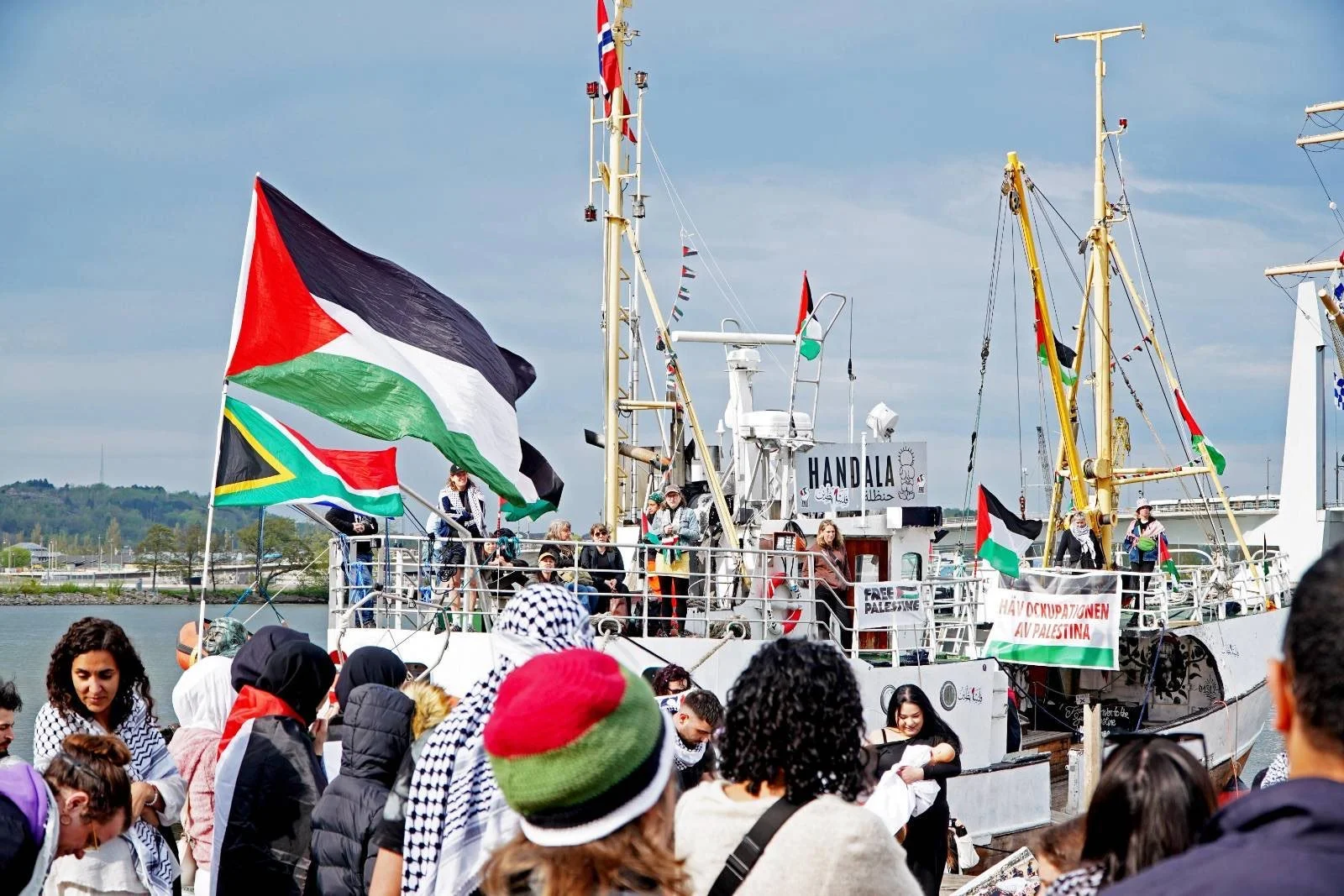
Image of the Handala from 2024 flotilla.
Retired Army Colonel and peace activist Ann Wright joins us to discuss the Freedom Flotilla movement and its efforts to challenge Israel’s naval blockade of Gaza. Ann shares what it takes to participate, why extensive nonviolence training matters, and how people can support Palestinian freedom both at sea and at home. She also reflects on bringing her military and diplomatic experience to the work of peace.
Following the interview, we reflect on the relationship between courage and fear, healing moral injury through action, and why nonviolence is a lifelong practice. The conversation is a reminder that, even though it might not seem that way sometimes, we are all on the same boat.
Transcript (with gratitude to Elizabeth High):
Stephanie Van Hook: Well, greetings everybody. Good morning. Welcome to another episode of Nonviolence Radio. I'm your host, Stephanie Van Hook, and I'm here in the studio with my co-host and news anchor of the Nonviolence Report, Michael Nagler, and we are from the Metta Center for Nonviolence in Petaluma, California, and we use this show to help tell the story of nonviolence that's not making the mainstream news.
This is really important to us because especially next month at the Metta Center, we'll be doing a deep dive into the study of media and the nonviolence in the media as well. So as you hear our interview today and our conversation, know that this is something that is a gift of local radio, of alternative ways of breaking into that mass media.
And today on our show, we speak with retired Army colonel and peace activist, Ann Wright, about the Freedom Flotilla movement and its efforts to challenge Israel's naval blockade of Gaza. We explore what it takes to participate, how activists prepare for the risks through nonviolence training, and the many ways people can act in solidarity with Palestinians at sea and at home.
Let's turn now to Ann Wright.
Stephanie: Any updates about the current flotilla, the Kate/Tenacity?
Ann Wright: Oh, yeah. Well, this is the 18th year that we've had citizen activists from around the world who have challenged the illegal Israeli naval blockade of Gaza, starting in 2008 with the Free Gaza Movement, and they moved five boats, were able to get five boats into Gaza, and then, the Israelis just said, "Nope, no more." And from 2009 on, and starting with really 2010 and a six-ship flotilla, and now we've sailed, gosh, now almost 150 boats. The last 18 months has been unbelievable because we were joined, our longtime Freedom Flotilla Coalition, which had been sailing the boats with regularity, about every year we'd have a few boats. But, in 2025, we were joined by the Global Sumud Flotilla, which was an outgrowth of citizen activism going to Egypt to try to get a land convoy into Gaza to break the land blockade.
And the Egyptian authorities were very brutal to the almost 4,000 men and women who came from all over the world, similar to what happened to us in 2009, when we had what was called the Gaza Freedom March, and we had 1,500 people who went to Cairo, and were unable to get outside the city limits of Cairo. The 4,000 in 2025 really got beaten up by a lot of thugs that were hired by the Egyptian government.
And, you know, you don't beat up activists and they lie down saying, "Oh, okay, beat me up again." No, they said, "Well, we'll come back, but this time we're going to come back in boats." And so they mobilized so many people, so much money, so many boats, that in 2025 they had 42 boats, and we had already sailed two boats by the time they came along, and then we had eight more that joined with them. And then in 2026, we had nearly 80 boats, 50 of them in the last movement toward Gaza, which was in early May. But 20 of them had been violently stopped off the island of Crete three weeks earlier. So that was another 20 added on to the 50 that we finally sailed. So, the flotillas are there.
And the Kate/Tenacity is the latest in the numbers that will be going. She sailed from England in August, and made eight, well, let's see, six port visits. And the port visits are so important because it helps mobilize the citizen activists in the ports around Northern Europe. So she stopped and she started out in Bristol, UK, then went to Ireland, then to France, and then three places in Spain. And then, we normally would have her stop in a few other places, but we needed to get her on to Sicily because the weather in the Mediterranean is starting to get so windy that the type of boat that the Kate is, which is a much shallower bottom boat with no real keel, it really suffers in big waves. And so we decided for the safety of those on board and for the use of the Kate, …27, that we would go ahead and move her quickly into Sicily to a port where we could have her safe and get her ready for 2027, where we will again, and joined by many other boats, including one that's up in Scandinavia that sailed around Scandinavia all summer. And they went to, I think it was like 25 different ports in Sweden, Norway, and Denmark. And then they had a little accident, ran into a pier, and had to go back to Denmark to get repairs. So she's being... this is called Handala II, and she's being repaired right now, and will winter over in Denmark. And then she will make a sail, stopping in various ports, to arrive in Sicily to meet up with the Kate in the late spring. And then we'll be joined by other boats that are being prepared right now.
So we will never stop our activism, and we use the vehicles of the boats, but of course there are so many other things that citizen activists for Palestine around the world are using. And in fact, on October 30th will be a very big mobilization in Europe, and we hope in ports around the world, where activists are challenging the shipping lines that take primarily US weapons, but of course Italy and Germany also send weapons, to Israel. So there will be big port actions all over Europe, and I think in both the East and West Coasts of the United States, to say, we as citizens are totally opposed to what our government is doing, in enabling the genocide to continue that the Israelis are conducting.
Stephanie: Mm. And with this, there's a constructive side to it, right? Because it's bringing aid and food, medicine.
Ann: Well, that's more symbolic. I mean, we do carry that on board, but what we're able to carry would be a tiny drop in the bucket, and because the Israelis are hell-bent to leather not to let these boats in. In fact, they had two prison ships out in the spring of 2026 where they took people off the ships in international waters hundreds and hundreds of miles away from anywhere close to Gaza or to Israel, and left the ships, our little boats, adrift as hazards to navigation. So they've been doing that since 2008. They've not let anything in. And we do carry symbolic aid, but the Israelis refuse. They just tear up the ships. They confiscate anything that's on it. They never deliver it to Gaza, even though they say they would. So we don't expend the money to take huge amounts of food or materials or medical supplies.
We urge all the supporters of Palestine to donate through well-established organizations that infrequently are able to get things into Gaza. That's not really what we do. We are moving the boats for political reasons, to break an illegal naval blockade.
Michael: And what this whole operation represents is a number of well-known principles in nonviolent action. And one of them, and I want to get your feedback on this, is called the paradox of repression, where you back your opponent into a corner where if they let you do what you want to do, you know, that's great for you, and you know, they've lost that much. If they stop you, they look so bad that it backfires on them. So that it seems to me is one of the elements that the whole movement is trying to engage here, to sort of show how bad what Israel is doing is, and force them to face it, and stop in some sense or other. Do people discuss this on the ship? Is this part of your strategy or?
Ann: Well, it's kind of an unspoken strategy in a way. Most of the time when you're on the ships, you're just trying not to be seasick, number one. And then if you can think of any other thing besides not being seasick, it's like, what are the Israelis going to do when they stop the vessel and attack us and assault us and things like that. But in the back of your mind, you know that they are going to end up losing face in the world by what they're going to do to us. And being willing to put your life on the line, so to speak, in a way is the physical manifestation of exactly what you're talking about, that it's putting the Israelis in a corner, and either they can act civilly and let the boats in. I mean, because what harm would that do? But no, they don't, and they show the violence to the world that they are willing to do on internationals, much less the even greater violence that they do to Palestinians. And of course, that's what our participants always underscore and emphasize, that anything that's done to us on the flotillas is just so minor compared to what they're doing to Palestinians every single day in the prisons, in the jails, on the roads, anywhere.
And when you see the ethnic violence that's going on, ethnic cleansing going on in the West Bank, and the settlers, many of whom are young New York City kids from Bronx and Brooklyn who have gone over there and are settlers supposedly, but they're just a bunch of little thugs that are beating up the Palestinians and they're beating up all the internationals that are coming in there. But that's not stopping the internationals from trying to get in, and every time a delegation, like with Sabeel a couple of weeks ago, a whole delegation was turned away at Ben Gurion Airport. Well, with the publicity on that, it certainly doesn't help the image of the State of Israel, and in fact the State of Israel's image is probably at the lowest point that it has ever been because of all of the horrible actions of the government and the military forces, and the lack of the ability of the good people of Israel, those that believe in peace, that want to work for peace, and their offices are being raided, they're getting beaten up on the streets by the thugs.
So it really is, the world has seen very, very well what is happening, even here in the United States of America, where every presidential administration since the creation of the State of Israel has been a violent supporter of the State of Israel. Even now the United States Congress is questioning that. Even the American public, the statistics are that there are a much greater number of Americans who say, "What Israel is doing is wrong, and the US should not support it anymore." So it's the suffering of the Palestinians and the genocide, and gosh, now what is it, like 76,000 Palestinian deaths, that it's taken to bring us to this point, which is an abomination that it takes a genocide to actually get the US to focus on that. The world has been focused on Israel for a long time, most other countries of the world except Western Europe. But the US and Western Europe have been the last to really acknowledge how violent the State of Israel is.
Stephanie: On our last episode, we spoke with an Israeli conscientious objector. He's 20 years old, part of this network called Mesarvot of supporting conscientious objectors from the Israeli military. He is thinking about leaving Israel, because his mother's American, and he said one thing is-- he's like, "When the aid to Israel, when the US stops supporting Israel, it's going to look very different here." And just that he had the capacity to imagine that the US would ever stop supporting Israel, really left me, interested in that. I've never imagined that the US could ever stop supporting Israel. It seems like our interests are just too deeply ingrained, and I wonder, do you think that could ever be a reality even if public opinion isn't on the side of Israel, that the government is just so deeply entrenched in the strategic location of it and-
Ann: Oh yeah, I think it certainly is possible, and this will be the closest we've ever come to actually having a realization of that. And the Trump administration, and really the Biden administration before it, have done exactly what Michael has mentioned. This paradox that they themselves have backed themselves into a corner that it's going to be very difficult for them to get out of, and they keep digging the hole deeper. They get the corner narrowed by the stupid pronouncements that they're making.
I mean, for them to acknowledge finally that the State of Israel is the security ally of the United States, well, we knew that. But that the administration is willing to hand over the secrets of the United States military, which we suspicion they knew a lot of anyway, but the proposed legislation at the Congress right now, which essentially says that the Israeli military will become a part of the US military, and we will provide all sorts of information, data, I mean, essentially giving away the farm to the State of Israel. And the outcry that you see, from even some more to the right Republicans, like, how can you possibly do that? I mean, there's a great cooperation between the US military and the Israeli military. But even the Republicans and the Democrats, which have been a part of giving away the farm, are saying, "Wait, this is a little too blatant. Maybe if you'd kept your mouth shut about what we were doing, we could get away with it."
But, now that the public knows, the public is outraged. And in fact, for anyone that can be in Washington DC November 11th, 12th, we're having a taxpayers revolt against genocide, a taxpayers revolt against everything, and we're trying to put real street pressure on the Congress to throw that amendment that's in the National Defense Authorization Act, to get that thing out of the legislation. Not to say that behind the scenes Department of Defense and all of them will continue to cooperate in virtually every aspect. But to have it written into a law is something we're saying, "No, no, you just can't do that."
And we're making some progress. We're getting a substantial... well, I wouldn't say substantial. We're getting some support. At least we've got some people that are willing to stand up in Congress to say, "No, you just can't give away everything to Israel." And of course, it's what the Israelis have done to their own relationship with the United States, and certainly, Trump being led by the nose by Netanyahu to attack Iran that hadn't done a damn thing to anybody. Well, they have supported Hezbollah, they supported Hamas, I mean that, for sure. But as far as a blatant attack on US interests, Israeli, no, they didn't do it.
But boy, everybody's getting their clock cleaned right now. If you look at how many US military bases in the Middle East have been now abandoned by the United States because their facilities, our facilities, have been destroyed by the missiles coming in from Iran. And if you look at Saudi Arabia right now, that's really taking a bit of hit from the Houthis, and the Houthis have been after Saudi Arabia for a decade and a half, two decades. There's been that war between the giant Saudi Arabia and the little Houthis. There's a lot of blowback that's now happened from the United States and Israel attacking Iran. So that all is playing into us trying to get the congressmen and women to stand up to the big Israeli and Christian Evangelical lobby in the US Congress.
MIchael: You know, there's a backstory here. I mean, just for full disclosure, I am from Brooklyn.
Ann: Oh. Well, at least you're not in the West Bank.
Michael: No, I'm not. And I like to think I'm not a thug.
Ann: Nope.
Michael: But I think there's a very deep issue that has not really been confronted, dealt with, and it could be very helpful to do it, and that is… I mean, let's look at the most obvious fact. The Jewish populations of Europe suffered the most extreme, humiliating and destructive trauma of almost any people that I can think of in the modern world. And what they're doing now is partly a result of that. I don't say it's rational, but it's a result. And I don't think any state-- I mean, the Germans have tried to give them stuff and make reparations, but I don't think any state has really dealt with that deep psychological trauma of those people, which Stephanie and I experienced it firsthand when we were over there. And it seems to me an overlooked option for people who want to bring justice and peace to the country is to find some way to somehow work with that trauma and relieve that existential anguish, if you will, that's in the hearts of many Israelis.
Ann: Mmm. Well, that would be a wonderful project, that's for sure. Because the trauma from the Holocaust, for the few survivors that there are. And most of the survivors, very interestingly, that I've ever run into here in the US are horrified about what the State of Israel is doing. And there's a 95-year-old woman, Miriam, who is in front of the White House every single day, and she's a Holocaust survivor, and she's there with her sign, saying, you know, "This is wrong, the US supporting Israel doing the same thing to the Palestinians that were done to us." And how you help those generations that know what happened to their parents and grandparents, and the few actual survivors themselves, it is a very worthy project. And now, we will have to include all of the families of the Palestinians who will have that same trauma for generations of what's happened to their loved ones. And the same in Sudan, and the same in Burundi and Rwanda. All of these places where these genocides have taken place, and the world has not done what it should have done to stop these things
Stephanie: When I think about the flotilla work and this kind of satyagraha, direct action, just keep keeping at it, keep showing up, it actually makes me think back to the Dharasana Salt Pan raids that the Indians did, and it's portrayed very dramatically in the Attenborough film, Gandhi. But it was illegal for them to process and harvest the salt, and then they showed up and just got beaten down, you know, person after person. They didn't succeed in getting in there, but they found their victory in that too. They knew that at that point India would be free because people had lost fear of the British government at that point. I see those parallels in the work of the flotilla, that you might not get in, but what it's doing is, besides changing public opinion, it's also changing people's sense about the power of Israel, when we understand that the only power that it has is violence.
Ann: Yes. I think you're exactly right. And when you multiply the numbers of people that have actually been on those flotillas, plus the numbers of people that have been at educational events to raise funds for people to go on the flotillas and to purchase boats, and then who attend the seminars when people come back, I mean, every one of these will influence thousands, if not tens of thousands of people. And then the international media publicity, which had been pretty sparse when you only have a couple of boats, but boy, when you get 10, 20, 30, 40, 50, 60, 70 boats, there is a world attention to it. And a lot of people around the world now are very, very familiar with the flotillas.
And with now the violence, the ever-increasing violence that the Israelis are using to try to get the internationals to stop this thing. I mean, for them to think that, okay, we don't want to catch these boats 50 miles off the shores of Gaza. We're going to take two big old prison boats all the way up to almost Crete in the Mediterranean, a seven days sail north, and we're going to put these big prison ships up there, and then we're going to have enough naval vessels that we can go out and individually stop the little boats and take the people off the boats, put them on our other boats, take them to the prison boats, and then keep them on the prison boats until- And we sail to, well, the first set of boats took the people to Crete and dumped them there. I think 170 people got just kind of dumped in Crete after getting beaten up, and then the second group of 430 people on the two prison ships, they sailed them all the way down to Israel, beat them up the whole way, then beat them up in the Ashdod processing center, and then beat them up in the prison.
While all this was going on, we were negotiating with the government of Turkey to see if we couldn't get the Turkish government to send three charter flights down to southern Israel in the Negev Desert to pick up all the 400 and… actually, 428, I believe, because two South Koreans got released from the Ashdod processing center because the South Korean president stepped into it and demanded from Netanyahu that his nationals be released right then and put on a commercial flight to South Korea. And that shows what government pressure can do. Those two young Koreans were put on a plane, and we were shocked. The first time we, as organizers, heard of this, these kids had already gotten to South Korea and were at a press conference. It was like, how in the world did you get there? And then all the publicity came out because the South Korean president said, "What Netanyahu and the State of Israel is doing is illegal, and I demand you release my people right now in the Ashdod processing center," which happened.
Of course, the governments of all the rest of the 55 countries that were represented, none of them took the time to do that. In fact, the US consul, never visited our folks in either the processing center or in the prison, nor had the US consul come to the US citizens in 2025, when we had many of them that were in the prison then. But it does show that things can happen when the governments step in.
To the credit of the Turkish government, they negotiated with the Israeli government, who quite honestly I'm sure was glad to get these 428 people out of their hair, because they'd already gotten so much bad publicity because one of their ministers, their minister of national security, Ben-Gvir, took photos of himself berating some of the participants who were on their knees. They were forced on their knees with their heads down, and then they were pulled up by their hair to look at Ben-Gvir. And one of the women that is in one of the videos, she said, "Oh, yeah. When they jerked me up like that and Ben-Gvir was right in my face, all I said was, 'Free Palestine.'" And that's when she got shoved to the ground again, but we had seen those photos by the time the plane loads got back into Istanbul. So I saw her as she was coming into the facility, and I went over to her and I said, "Did you know that you're kind of famous right now?" And she said, "Uh-uh, didn't know that." And I said, "Well, wait till you see the videos. And Free Palestine." She just started laughing like, "Yeah. It hurt a bit, but it was worth it."
So I mean, these are young men and women, and some old men and women, who are willing to take a big hit by challenging Israel. And we have no shortage of people who are volunteering to do this. Most of the people who have been on these flotillas, they want to go back. And we say, "Well, aren't you still traumatized from your previous time?" And they go, "Well, yes, but I'm not afraid of those Israelis. I'm not afraid of them. I've been beaten up, and I can handle it. If the Palestinians can handle it, I can handle it."
And, we have to be careful though because these are serious things that are happening to the people, and they end up with serious physical and, and emotional trauma, even though they won't acknowledge it. So we are very, very careful about how we handle that, and because we know there are plenty of other people that want to be a part of this. And it's part of our job as organizers to give these opportunities and to widen as far as we can the numbers of people who have taken direct nonviolent action against a genocide and ethnic cleansing.
Stephanie: Yeah, I want to get into this a little bit more about the participants. How do they prepare? Because there are so many risks and responsibilities involved, possibilities of injury and detention, deportation, trauma. So how do you prepare people for these actions,with the knowledge that they're going to be harmed in the process?
Ann: Well, first you start in the very initial part of their application. When they apply, we call people, we talk directly to them about the seriousness, the dangers, and all of that. And we also say, "Have you checked with your family?" because we've had plenty of instances of people will say "Well, I don't really need to do that." And we say, "Well, we want you to do that because it is important that your family knows about this. They may not agree with it, but at least they know what you're doing," because we have to stay in touch with your families, because if anything really bad happens to you, I mean, we as organizers... I mean, if people will not sign a release from liability, holding the flotilla organizers not responsible. But we make sure they know all of the ramifications during the application process.
And if they still want to apply, and if we select them, and then we say, "Okay, you need to be at a certain port on a certain date," then at that place, we give extensive, extensive nonviolence training. It's just not like one hour. It's like three days. Three days of it. We go through scenarios. We go through reenactments. We scare the bejesus out of people with some of the things that we do, and we have had cases where people have said, "Well, you know, I don't know that I can quite take this." And because one of the things we emphasize, if you can't take this, and if you have a mental breakdown right in the middle of it, then that means that other people that are on your boat or in your collective have to take care of you, and you are now a burden on the group.
And that's one of the reasons why I am no longer on the boats, is because first, I think I can take it psychologically, but physically, I'm so wobbly. I'm 80 years old now, and I wobble. I wobble on land that isn't moving. But you ought to see me on a boat. I mean, I'm crashing into everything, and on these boats, they're going in, a lot of times, very tough weather, and the things we don't want are people injuring themselves on the boat before we even get to the crisis point. On one of our boats, I did go from Rome to Naples on a boat that we purchased in Rome, and then we repaired it, took it on down to Naples, and were heading south. And on that voyage, we got into a big storm. There were only five of us on board, and I knew that if I got out of a bunk, that I would break something. So I was flat on my back for 24 hours. In the meantime, the captain and our senior crew person, who were doing most of the navigating and everything, both of them took severe falls as the boat was rocking and rolling. We had to even take the chief mate to the hospital once we got down to another part of Italy because he had such a huge hematoma on his leg.
Anyway, so the bottom line is, if you're wobbly, no, we don't need you. If you've got heart conditions, no, we don't need you. So we go through an extensive medical check. We ask people to be very honest about their mental state. If they've had psychotic episodes and things like that, we beg them to please let us know, because that will disqualify them. Because we just cannot have known issues and put them on boats, because it jeopardizes everybody else on the boat. And we know that because we've been through it before. It's not like we're being mean to people, but we've been through it, and we've had some things happen that we were all, everybody was disappointed in it.
And so we've got some pretty strict rules on some things. And people, some people don't like them, but they can organize their own boats. That's the way we feel about it. If you want to get involved in this, there's plenty of boats out there, and we ask you to go ahead and do it. But we've got some very strict guidelines, and within those guidelines is that everybody has to go through training. And if you miss training, then we just say, "Well, don't even come," because you have to know with your fellow boatmates what's going on and how you react to things. And if you come in at the last minute and you've not been trained with your crewmates, they're not going to be too happy about this, and you're not going to be happy, so just don't even think about showing up late.
And then, even when the boats get underway, things start happening and, sometimes it's family problems at home and people have to get off the boats. If we're at a place where we have multiple stops on the way, then we can accommodate things like that, but if we're on the direct line from, say, Sicily to offshore Gaza, that's an eight-day sail, and we don't stop anywhere. And so if anything happens then you just have to suffer through it. So if you've got potential family problems, we say this is not the time to do it. We've had one case where we were still stopping along the way, making visits, but we had one ship that had just come through the Straits of Gibraltar, and one of the people on board started having severe stomach pains. It's the first time we've ever landed a boat actually in North Africa. And we took him into Algeria, and he had appendicitis, and he had to have his appendix out in Algeria.
So there are things that happen, and we are very experienced in this. Not to say that there won't be surprises with every single voyage, but that's what makes it so very interesting and people have said, "Well, you're 80. You ought to give this thing up." It's like, no, it's too interesting. I'm going to do this until I can't remember where I am. And, because you meet so many fascinating, wonderful people from all walks of life, from all over the world. Oh my gosh. We had a National Geographic photographer from Bangladesh that was with us on the Conscience boat last fall. First time we'd had anyone from Bangladesh on our boats. We had three Koreans that were on boats. I mean, it's a wonderful array of people. We've had lots of people from South Africa that have been on boats, including the grandson of Nelson Mandela.
We've had Nobel Peace laureates who have been on the boats, Mairead Maguire. In fact, the last time I was on a boat with Mairead was in 2016 on the women's boat, and we had 12 women, a woman captain, women crew members. All participants were women. And when we were taken from the prison and then to the airport to be deported, and Mairead and I were being deported about the same time, so they put us into a holding area together, and she immediately raced toward one of these bunk beds that was in there, and she was looking up under it. And I was going, "Mairead, what's going on? Why are you looking under a bed?" And she said, "I'm looking for my name." Well, I said, "What do you mean your name?" She said, "Well, we always put our names, we scratch our names in here anytime we're in these cells, and oh, here's my name. This one was from 2010," or something like that.
So, it's just really quite remarkable. And the stories that you come out with are, you know, they give you such hope for humanity, that the majority of people in the world don't want genocides to go on, don't want their governments to waste all of our money on weapons, and wars, and things like that. So it's a real rewarding experience to be a part of the flotilla families. And we welcome you all, so please come and join us.
Stephanie: Well, and as I'm listening to you speak, I'm thinking about your background as a retired Army colonel and diplomat. I mean, this seems like the perfect space for you as what you're doing. I mean, when you're talking about the training, you sound like a real … you know? Like, you're-
Ann: Well, a couple of people will tell me at times, "Wait a minute, you're being too Army about this." That, sometimes the old training of 29 years in the military and 16 years as a diplomat, sometimes people go, "Now wait a minute, you're an activist now, and we don't do things quite that way." And so it's like you have to take a step back and recognize where you are. However, there are a few skills that you do learn in these governmental organizations that can be used for good, and that's what I'm trying to do. So I never killed anybody in the Army, thank God, and I hope policies I was with in the State Department didn't kill anybody, but I'm kind of doubtful about that. So this is an opportunity to pay back to the civilian community all the times I was working under eight different presidential administrations, most of whom didn't do much for peace in the world.
Stephanie: And you seem so, I mean, you're also so prepared in the way that, when you sign up for the military, you know you're signing up to get in harm's way, right?
Ann: Mm-hmm, that's true. Yeah. Although a lot of kids aren't. I mean, you're supposed to know it, but a lot of times it's like, "I just need a job. I need to get some money. I need a place to stay. I need to send some money home." or, "Life at home is way too difficult." "I'd love to go to college, but I don't have the money for that. If I hang in there, I can get the GI Bill and go to college." There are so many reasons that people join the military, and actually, the military should be saying to people who, "Oh, yeah,I want to go kill someone. That's why I want to join the military," then the military should say, "Well, thank you very much. We don't need you. We'll do our own training to make people decide they're going to kill people. But if you're already saying that, we don't really need you." Although I'm not too sure that's the way they're recruiting these days. Particularly for ICE and non-military, but militarized law enforcement agencies of our government now.
Michael: which are particularly dangerous. You know, Ann, I was friends with Kenneth Boulding, who's regarded as one of the founders of peace research, and one of the things he used to say, I mean, we had him to Berkeley years and years ago. One of the things he used to say is that we in the peace movement are neglecting a great opportunity, which is to recruit people from the military. Because they have, you know, the right courage, the right skills, and somewhere in there, the right values, which we just have to give them the opportunity to act on. So you are the only person I know who actually represents that.
Ann: Oh, well, I bet you know a lot more and you just don't remember them.
Michael: Probably.
Ann: Veterans for Peace is exactly that organization. I mean, most of us have gotten out of the military, but we do have some active duty members of the military that are in Veterans for Peace, as well as in About Face, and there's a new group that's called Veterans Against Fascism, and that's a coalition of about five different veterans groups that are really mobilizing people, particularly for these times where we are facing such a fascist government. And they've already organized one thing at the Capitol last summer, then the 4th of July parade in Philadelphia, in 180-degree weather on the 4th of July. And so that group is really doing well.
And I'll also mention that if anyone is available on November 5th, next week, particularly if you're in your 70s, 80s, and 90s and you happen to be a veteran, there we go, but you don't have to be a veteran, come join us in Washington, DC at the Memorial Circle, where we are saying, "Veterans and others say no to Trump's ego arch that he wants to build right there at Arlington Cemetery." And we've been having daily protests and sign waving on Memorial Circle, which is at the head of the bridge, the Memorial Bridge that goes across to the Lincoln Memorial, and you have Arlington that's on the south side of that circle. Well, anyway, so we've been having morning and afternoon vigils there for the last six weeks. I flew there five weeks ago. I was so, just frustrated with this idea that first it was the Kennedy Center, now he's going to build an arch, and then subsequently, now he wants to take over the biggest public golf course and park in Washington, and make his championship golf course. So I flew to be at the Memorial Circle to say no to the arch. And we have several banners that I brought from Hawaii. One of them has a background of the tombstones of Arlington Cemetery, and it says, "Veterans say no to the arch," and this is it, "Over our dead bodies." You know, bringing that into it. And then the other sign is, "Disobey unlawful orders." So we've got those banners, as well as, you know, "Stop the arch," all that, for the tens of thousands of commuters that come around that Memorial Circle every morning going into DC, and every afternoon going out.
So on November 5th is the testimony before the National Capital Planning Commission, which is accepting– it was supposed to be in-person testimony about the arch. Of course, now they are only going to have it online because I think they were deluged. They knew they were going to have a building full of people protesting that arch, and so they "We don't want them in here," so they're going to do it online. So we're going to ask people to come to the Memorial Circle, and do your testimony by phone from the circle, and help be holding up signs. It's the same thing. So we're asking 70, 80, 90-year-olds, veterans, non-veterans. Show up, and if you need a wheelchair or a walker with a little chair on it, bring that. And even if you don't, like I don't really need it because I've, even though I've got a hip replacement and a knee replacement, I'm doing fine, but I'm going to get my own wheelchair because the photographs of that, of all of these veterans, all of these elders out there saying no to this arch, to this guy's ego, hopefully we can prevent the the construction. And we anticipate that the planning commission, which is filled with Trump supporters, will after they hear the testimony, or perhaps in the middle of it, will authorize the ground destruction to begin on the Memorial Circle. So that's why we want to be on the circle itself. So there's lots of actions coming up, so if you can get to DC on November 5th, come join us.
Stephanie: Yeah. That sounds really great, Ann, and it's interesting to tie that into the work of the flotilla, that you're just, you're in part of this ecosystem of resistance. And so, as you mentioned, the people that are on the flotilla, there are certain qualifications, physical, mental, emotional, family situations. But for the vast majority of people who aren't on those flotillas, what kind of support do you need?
Ann: Well, to invite the people that come back from the flotillas to come and speak at your organization so that you learn more about what's happening. Fundraising is always a challenge because we don't get big donations. We rely on $10, $20 from people all over the country. We have our own national campaign here in the US called US Boats to Gaza, and we do fundraising here in the US. We have 18 national campaigns around the world, and each one of them does its own fundraising. And then, for example, sometimes we pool the money to buy a boat. Other times, for example, this year, in the spring, the US Boats bought a boat, and that's why I was in Rome and then Naples, because we were going to purchase a boat. And I joined the team that knows how to buy boats, that knows what to look for in a boat. I joined them, and we outfitted the sailboat that we purchased. So, to help us keep buying these boats is really important, and every $5 helps. And if you just go to usboatstogaza.org, or freedomflotilla.org, there are links to the things that we do, the trips we've taken, the voyages, and the people that have been on them.
Stephanie: Thanks so much for your time today, Ann. It's been great to have you.
Ann: Well, it's been a pleasure talking with you all. Thanks for all the good work on nonviolence. Let's keep it going.
Michael: I have to say that from our studies that we've done, I have to believe that the courage of you and all of the others has got to prevail- somewhere, somehow.
Ann: Thank you. Yeah, well, we believe that, too.
Stephanie: For those of you just tuning in, you're here at Nonviolence Radio. We were just sharing an interview with retired Army colonel, now peace activist, Ann Wright, about the Freedom Flotilla and its updates. And as said in the interview, she's part of an ecosystem of resistance, that not any one action is going to address all of the problems.
And so you find in activist circles quite a bit that people are involved in multiple angles of work, from direct action to personal work to constructive angles. Or some people just are completely dedicated to direct confrontation all the time. It's their thing. So it's always something interesting and educational to learn from those who are dedicated to nonviolence and to peace, to hear what they're doing, and then to really take on their enthusiasm.
Because look, Anne is the kind of person, she's charismatic in a way, where she's like, "Yeah, you're going to get harmed. You're going to get hurt." And she's sort of giggling underneath of that. And you're like, where does that come from? You know, you're going to experience some trauma, but boy, this gives me hope. And it's like you want to be part of that. You're like, "yeah, I'm definitely willing to get hurt or, or risk my life," because there's something, some experience that she's conveying that's deeper than the risks involved. You know what I mean, Michael?
Michael: I know what you mean, Stephanie. I've been thinking about that exact thing because I'm looking at an item that I was going to talk about today. Anne's not the only one. There's an Air Force major named Jason Watson, who's in solitary confinement now. Because he was standing in front of the US Capitol with a sign calling for the president's impeachment. And before he took the stand, this is the critical part here, he asked himself, "What's the highest price that I'm willing to pay?" And his answer was, "Whatever it takes." And that's what the bravery looks like. As you said, you're still afraid. You go anyway, knowing hell is coming.
And that reminds me of something that I associated a little bit with Dan Ellsberg when he was asked what enabled him to leak the Pentagon Papers, that he said, I'm not sure this is completely accurate, but, I think what happened was he had been saying to himself, "Oh gosh, if I do this, what will they do to me?" And that paralyzed him. But suddenly, in his mind, he switched and said to himself, "If I'm willing to go to jail, what does that enable me to do? And that enables me to release the papers." So it's a very interesting psychological shift and it's part of what we've been saying all along, that nonviolence is healthy even when you may be physically at serious risk.
Stephanie: Well, and you're also pointing to an important principle of nonviolence, which we often share, which is ask yourself what they're holding over you. And when you are able to see that you're being threatened, that they're holding something over you, then when you can address that. Maybe you can address that need in another way. Maybe you can renounce it altogether. But you realize that you're being controlled by someone else that's holding something over you, and you let that go. And then it opens up a space for more action.
Michael: Yeah, it's very similar to what I was just saying. While we're on the psychological angle, I was so struck by the whole conversation, especially listening to it again as we were broadcasting it, that there's a cure in there inherently for a plague that is affecting our world today, in this country, called moral injury. So many people in the military are injured psychologically by what they do, what they're called upon to do. And, often enough, Veterans for Peace is very good about this, they find ways of making reparations, atoning. And she's doing this in a spectacular degree.
Stephanie: Yeah, she said that. Yeah. She said that she didn't kill anybody in the military when she was an Army colonel, but she highly doubts that policies didn't lead to people losing their lives when she was working as diplomat. And I think that's interesting because she's talking about direct confrontation versus structural as well, right?
Michael: That's right. Yeah. You know, another very important point that I'm really glad that you raised, and she spoke to it so eloquently was the question of training.
Stephanie: Yay. I wanted to get to that, too. Absolutely. Wow.
Michael: You know, I was, I was remembering back in the early '90s, there was something called the Balkan Peace Teams. And they recruited people in bars out of Italy, put them on ships, willingly, and they went over to the Balkans to interfere, and what they did was they slowed down and interfered drastically with the peace movement. Because you then had to take care of these completely untrained people.
Stephanie: Yeah. And training is so important. And the way that she's like, "You know, this isn't going to be just a one-day training. It's a three-day training." Three days doesn't even seem like that much. I loved how she said, "We try to scare the bejesus out of people to really see what, you know, help them imagine how scary this actually is." Even though it's really good work, there are really high intense risks involved. So to scare yourself ahead of time and know how you're going to react to that is really helpful. But I'm also like, look, so many trainings out there now, it's like one hour. You know, you do a one-hour training. And that's not training. And even, you know, our nonviolence studies that we do, it's a month-long study, and we're still just scratching the surface. I think that nonviolence training really has to be understood as a long-term game. And the more experience you get, the better you get at it, the more awareness you have. But these half-hour, one-hour trainings, even two-day, weekend trainings are really nothing. They're a real drop in the bucket.
Michael: I was at a meeting with Narayan Desai once, and he was asked this question, how long of training do you think would be necessary? He said, "Oh, I think one lifetime should suffice."
Stephanie: At least a lifetime. But then you have someone with Anne's background who is part of the training, who knows what kind of training goes into militarism, and you understand what you're looking for in people. And she's like, "I'm sorry, we don't want to hurt people's feelings, but we have a certain kind of mental state, body state, everything, that we need for this campaign, and start your own if you have a different way." But, they're articulate about what they need.
Michael: I think the first time that peace movement action started to say, "We can't have you, you're not quite qualified," was with Peace Brigades International in Haiti a long time ago.
Stephanie: And it doesn't mean that there's not a way for everybody to get involved at some level.
Michael: Absolutely.
Stephanie: It's just not everybody can do everything. And I think that's an important part of what we help to share as well, is that not everybody is going to do the same thing. But everybody can be involved. Everybody has a gift. Think about where your gifts are, what your needs are. And don't say, "Just because I'm not on the boat, I can't support." We want to thank Ann Wright, our mother station, KWMR, to everyone who helps make this show possible, syndicates it, all the ones. Thank you. You know who you are. Until the next time, everybody, please take care of one another. We’re out of time.