
All violence is suicide.
by Michael Nagler
“When the same Self is seen in all, how can self strike at self?”
Bhagavad Gita, xiii:67
"And there is only one way of preparing the new age,
by living it even now in our hearts."
Etty Hillesum
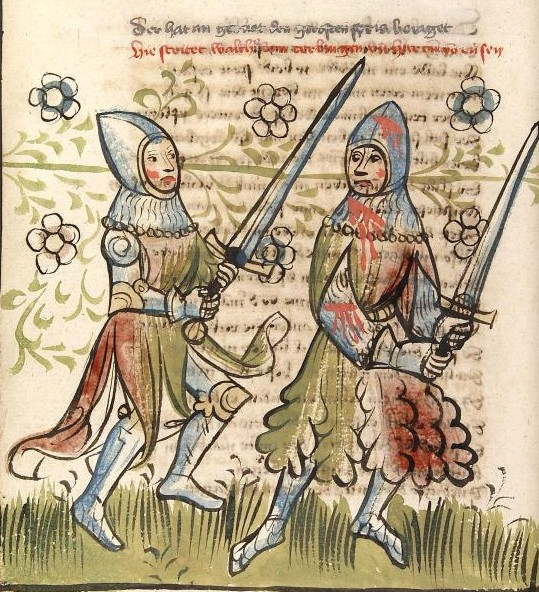
Walther fighting…
WHEN I WAS TEACHING literature at Berkeley I often used the 12th Century epic tradition about one Walther of Aquitaine. In most epics from that period, while they’re very important for the national literatures of what is now France and Germany, and very stirring poetry, you’re dealing pretty much with medieval action movies: lots of violence (apparently, for some people still, the basic meaning of “action”) and not much reflection. But with Walther there is what we call a “subtext” or implied meaning that appears between the lines. Walther looks at first to be your basic Ritter, or ‘knight,’ careering from one joust to the next; but something breaks the mold: adversary after adversary, when their helmet is knocked off, turns out to be a relative, a friend, or an ally whom he shouldn’t be fighting. Oops.
The profound subtext at some point begins to dawn on the sensitive reader: we are related; there is no one we can kill; no one against whom we should fight. Let that sink in. While Europe was nominally ‘Christian’ by that time, the real meaning of Jesus’ teachings had long since gone by the wayside. At this point the religion practiced in his name went exactly against his major teaching; Christianity could even serve as an excuse 𑁋 nay, an obligation 𑁋 to fight ‘others.’ Think of the refrain of the slightly earlier French epic, The Song of Roland: Les Chrestiens ont droict; les Païens ont tort, ‘Christians are right, Pagans are wrong.’
This logic is so primitive it would be at home in our own era! Indeed, there is a considerable set of people today for whom ‘Christianity’ is little more than a group identifier set over against ‘others,’ in fact, the same ‘others’ of the Chanson: the ‘pagans’ in that epic are Muslim, the conquerors of the Iberian Peninsula.
This sad sleight of hand is not limited to Christianity: all the major religions go through three stages I like to call revelation, accommodation, and, alas, cooption. From time to time in the long arc of history, a God-conscious human being appears 𑁋Jesus is the first to come to our minds in the west; then Buddha, Moses, the Prophet Mohammed, and of course the ‘serial avatars’ of India; Rama, Krishna, Buddha, . . . Their revelation renews the failing faith of humanity, begins a new cycle. Of course, in the West they run the real risk of being killed, but that’s another (and even sadder) story. The Revelation thrills some, or many and it seems that a new and better world has at last arrived 𑁋 as prophecies had promised. This stage can last for some time, in what’s called “primitive Christianity” about a century and a half.
There is truth to the assertion that when the Roman emperor Constantine adopted the new religion in 312 CE 𑁋 not to save his soul, but to win a battle 𑁋 he created a fatal confusion between “church” and “state” that creates tensions down to the present day; but it’s also true that it marked a major accommodation. Monks in the deserts of Egypt and Syria would still live in the extremely ascetic, radically simple mode of the desert fathers; they would still be gone to for advice and inspiration. But the rest of the world has got to move on. And the main thing they feel they have to move on from is the awkward injunction, ‘Thou shall not kill.’ The earliest Christians took it to heart; often they were martyred for not accepting military service 𑁋 and not just because if too many caught fire from their example (which wasn’t likely) the Empire would have a hard time filling its military ranks but also for a deeper reason: people who hold a higher moral vision than others are psychologically threatening to the self-image of those (often a vast majority) who do not. The patron saint of conscientious objectors is the North African St. Maximilianus who was martyred in 295 for declaring, Christianus sum; non possum malum facere, ‘I am a Christian; I cannot do (this) evil.’ The periodic rediscovery of this injunction (this truth, I would call it) has created five major stages in Christian history, as recounted in a brilliant little book by Geoffrey Nuttall, Christian Pacifism in History, and left some sects, like the Society of Friends, the Quakers that still flourish today. I would have had a much easier time getting CO status if I’d been a Quaker or Mennonite instead just a human being opposed to killing other human beings. (As it turns out, the birth of my daughter kept me going to Korea 𑁋or federal prison).
But the purity of the Revelation figure’s vision is a serious challenge for ordinary mortals; even some of their closest followers balk at taking them literally. So, the awkward teachings are toned down, made more “realistic,” more “practical:” this is what I’m calling accommodation. Peter Brock and others have told the story of how conscientious objection has been managed so as to allow for an individual’s abstention on one or another ground without unduly compromising the military ‘strength’ of given regimes. Yet for some, even these few can be an implied accusation 𑁋 think of the challenge posed by the Haredim in war-bent modern Israel. Soon it can become ‘against the religion’ and the state not to ‘serve.’ For those who take the original call literally and seriously, e.g. Thomas Merton, “what was once called ‘Christian society’ is purely and simply a materialistic neopaganism with a Christian veneer…” For some, a veneer that justifies behavior the reverse of the vision for which the Founder lived and died. Let me stress, for some. For some others, never; nor should any of this set detract (pace Merton) from the enormous support that Christianity has been down the ages for our entire civilization.
Ideally, one would want to do away with the rationalizations and accommodations; make non-killing the norm and rebuild society on that basis. For the state, that would mean no executions, no manufacturing weapons, no war. For the individual and her culture, an entirely different image of what it means to be a human being: one whose essence is to serve the well-being of others; in a word, nonviolence. This would be an enormous change; yet, as Kenneth Boulding used to say 𑁋 he called it “Boulding’s First Law” 𑁋 anything that has happened is possible; and this has happened, not just to individuals but societies. We know from Gandhi’s great experiments, among others, that a nonviolent group has other means of deterring and when deterrence has failed defending itself against aggression. On the other hand, we know now that violence even when it seems to “work” comes at the tremendous cost of “moral injury” to the perpetrator, not to mention the human and economic costs, the loss of meaning, the threat to democracy 𑁋 in a word, the clear evidence that it’s wrong.
Why can’t we get rid of it? Not only because it is so much a part of our economies, our politics, alas even our religion (cf. Lewis, The Report From Iron Mountain), but because it’s endemic to our prevailing culture. To quote Merton again, “We have to be aware of the poisonous effect of the mass media that keep violence, cruelty and sadism constantly present to the minds of unformed and irresponsible people.” I would add, that make sure they stay unformed and irresponsible.
But as the costs mount and the alternatives emerge from the shadows of history; as science step by step reveals more of our true nature and tiny hints of this make it through the media’s mental firewall and into the consciousness of the general public, the day will dawn 𑁋 it has to dawn 𑁋 when the recognition of the self in the ‘other’ prevails and the age of violence becomes what it always was: a bad dream.