Can a State be Nonviolent?
Some people argue that the State is inherently violent. According to political theorist Max Weber, the State is defined by its “monopoly of the legitimate use of physical force.” Yet others, like Dr. Nadee Dissanayake, suggest that states can evolve toward nonviolence—not as a moral ideal only, but as a practical strategy for governance and resilience.
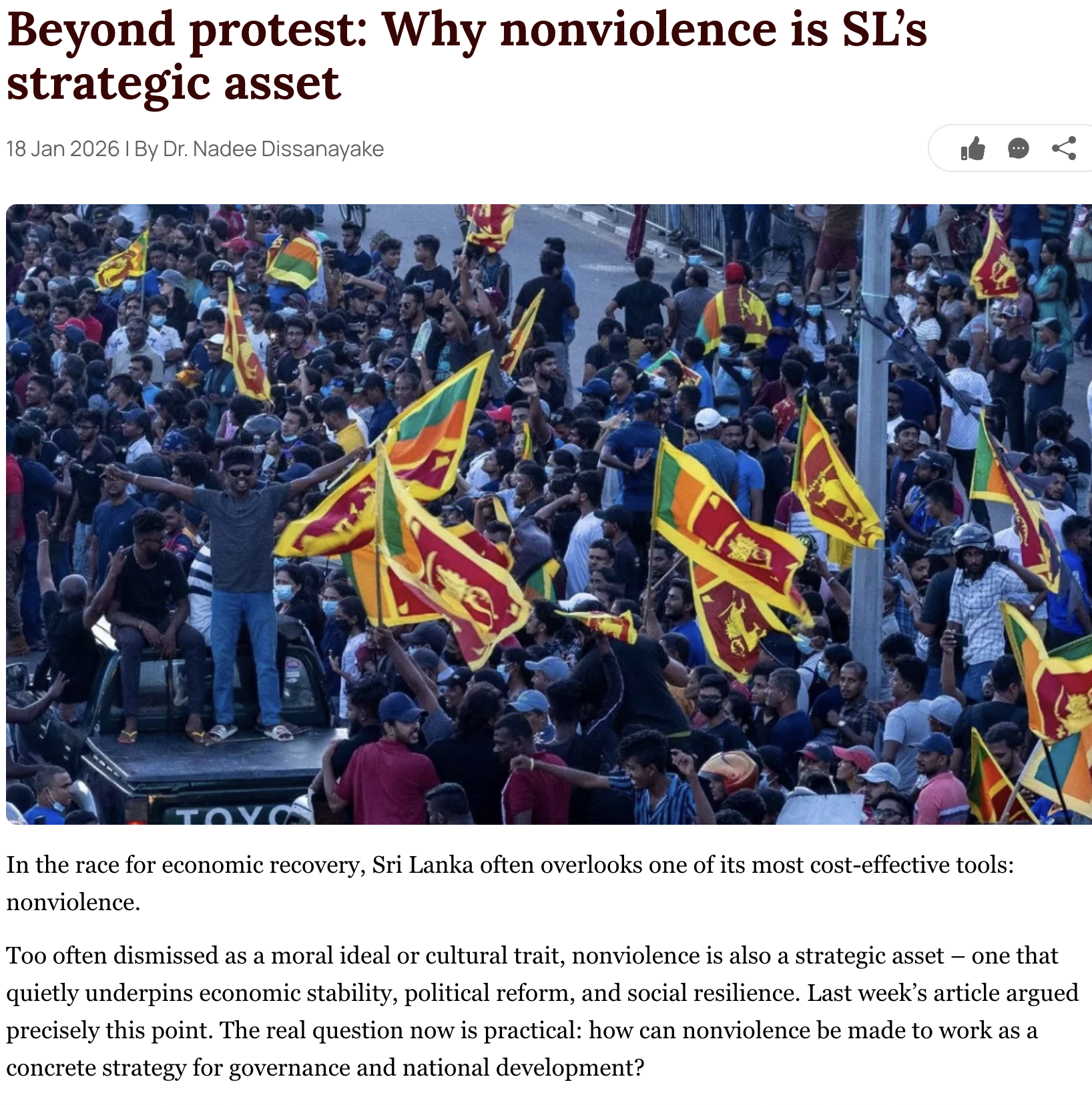
Dr. Dissanayake’s article “Beyond protest: Why nonviolence is SL’s strategic asset” offers a forward-looking discussion about how nonviolence can be embedded in public administration, politics, civic engagement, and institutional design. She frames nonviolence not as something only practiced in moments of protest, but as policy infrastructure that strengthens legitimacy, reduces escalation, and supports long-term stability.
For those of us working toward a more nonviolent world, this isn’t just inspiring—it’s urgent. It suggests that nonviolence can play a central role not only in civil movements, but in how governments and societies operate and flourish. Thinking beyond protest opens up new pathways for transforming conflict, rebuilding trust, and strengthening democratic life.
If you haven’t yet read Dr. Dissanayake’s piece, we highly recommend it—especially if you’re interested in how nonviolence can be more than a tactic: a strategic asset for collective life.