
Two Hands—Q and A with Amery
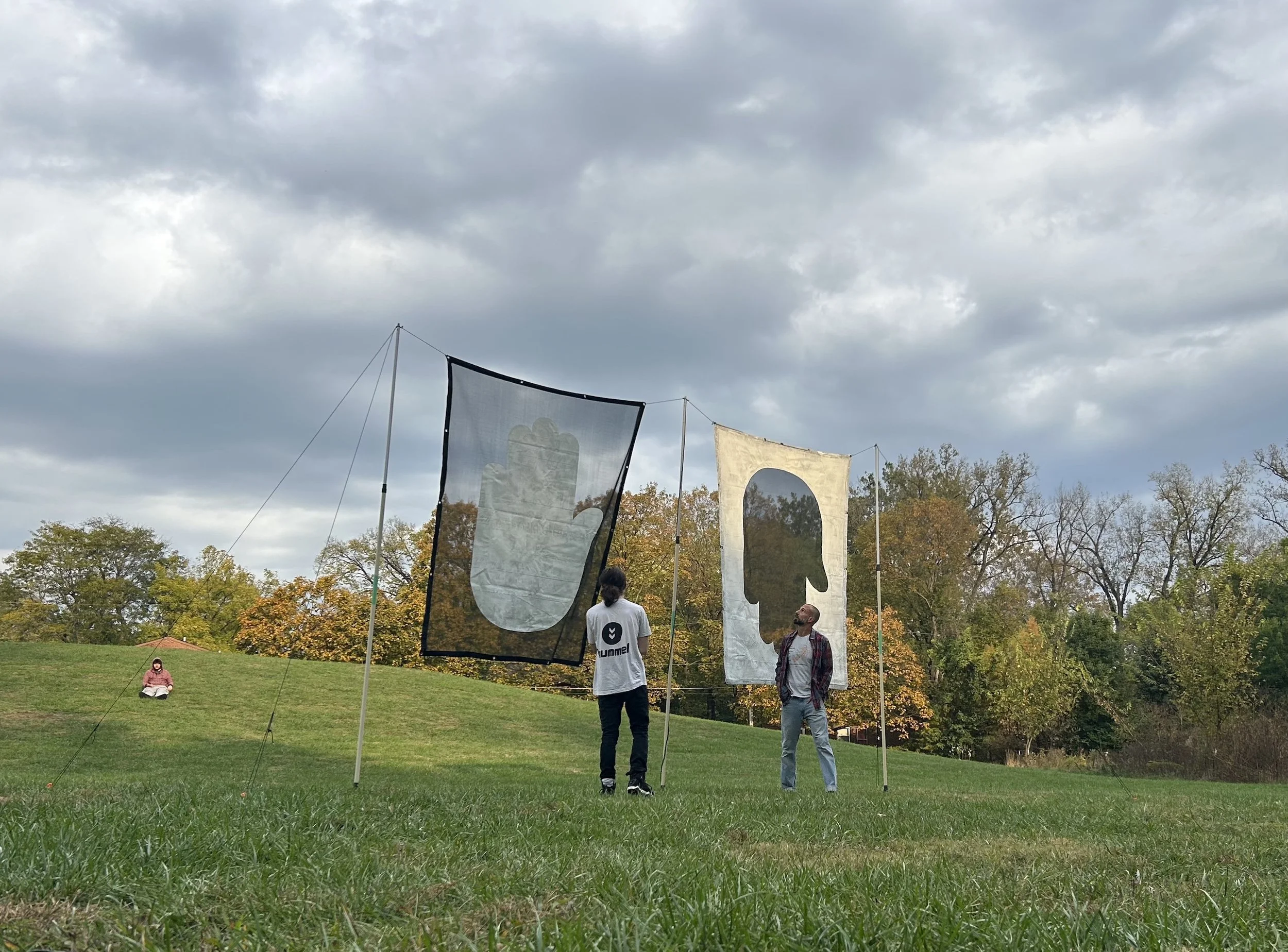
Amery Kessler, inspired by the Two Hands of Nonviolence, created an art installation to encourage reflection and conversation about the ambidextrous nature of nonviolence, “I am going to resist your injustice; but I’m open to you as a human being.” Below is a brief interview with him about his process and inspirations:
What inspired you to create this art installation?
The Two Hands installation was inspired by seeing people’s potential to love each other–even when, especially when, we are in a difficult conflict or disagreement. The metaphor coined by Barbara Deming, “the two hands of nonviolence,” reminds us of a transformative power that arises when we resist and do not cooperate with harmful and unjust actions and systems while also expressing care for our interconnected humanity. The banners are a symbol pointing to the concrete action, the courageous work that we are all invited to do–to say with one hand, “I will resist, I will refuse to cooperate with injustice” and with the other hand, “You are not only your actions–I see you as a part of me, we share the same home.”
What have you learned while creating/displaying this art?
I’ve loved experiencing the way these banners draw people in. They spark curiosity and conversation in public. They have allowed me to learn about other people’s stories, to learn of a place’s history or current events. And sometimes they simply allow a shared moment of silence.
The banners have a way of holding space for people to encounter each other. They also have a way of holding space for ideas to simmer, for contemplation, deeper understandings and ah-ha moments.
Lately, I’ve been curious about how the ‘two hands’ are one. With a deep understanding of love, both hands are from the same source. They may appear to be opposite or binary, but with time, looking and listening more deeply, we can see they are cut from the same cloth so to speak. I’ve been learning how liberating this approach and practice can be–to liberate ourselves, and see unity and nuance beyond the binary.
Earlier this year, the Two Hands has been installed at a public art series with Chapman Steamer Arts in Newburgh, New York, a contact improvisation dance intensive in Oberlin, Ohio, and most recently on a sunny Saturday afternoon near a post office in Tomales, Calilfornia. Throughout October and November I set them up in urban and rural locations throughout Ohio, Michigan, Pennsylvania and New York.
What do you hope to do with it/build upon it?
I’d like to experiment with locations, scenarios and collaborations. How could they be a meaningful presence at a retreat or conference, in a nonviolence training, in a performance, a dance, alongside a trail or at a park? I have simmering ideas of how they could be constructed with different materials, built in cooperation with the help of others, and then set to sail. They could travel to meet people and weave locations and stories together. A series could be sent out to different people and groups. They could be of larger scale to be seen from afar and smaller to be carried or worn with more ease. With all these possibilities, big, small, far-reaching and close to home–the real heart of the whole process, imagining and creating, is in the extent the objects as symbols can point to something, a way of being, that is greater than any piece of art or any one person.