
Restorative Justice as Relationship: A Conversation with Dominic Barter
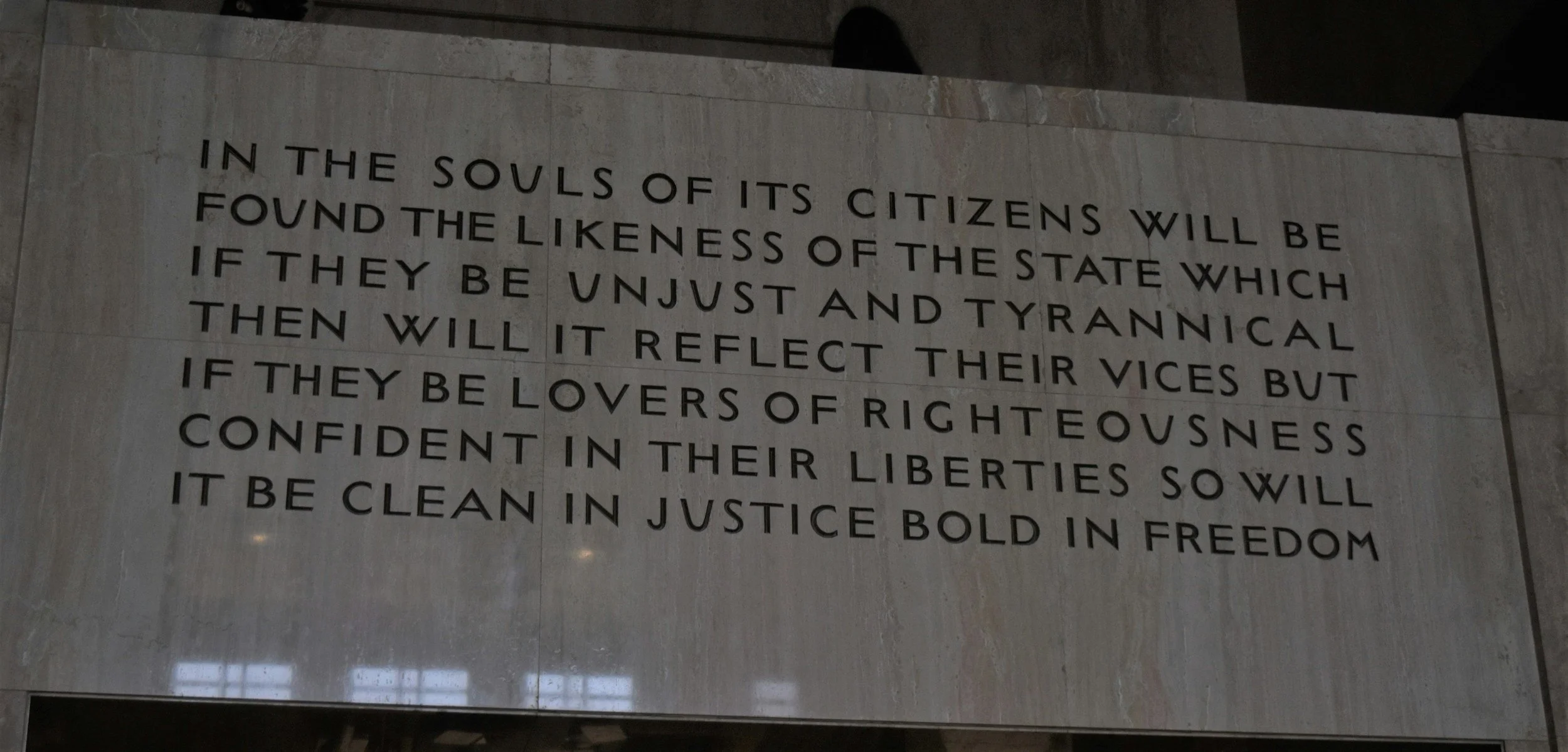
Quote attributed to Plato, inscribed in the Oregon State Capitol.
In this conversation, restorative justice practitioner Dominic Barter reflects on more than three decades of work at the intersection of community, justice, and nonviolence. Beginning with his early experiences in Rio de Janeiro, he describes how communities already hold a “dialogical” capacity to respond to harm—one rooted in listening, relationship, and shared needs.
From grassroots work in favelas to collaborations with courts, prisons, and governments, Barter traces how restorative justice has evolved across contexts while resisting reduction to a fixed method or technique. Instead, he emphasizes that this work must emerge from within each community’s own culture and lived experience.
At a time of deep polarization, the conversation explores how conflict itself can become a source of transformation rather than division. Barter invites us to move beyond retribution and toward rebuilding the relational foundations that make community—and a more humane vision of justice—possible.
Transcript (with gratitude to Elizabeth High for her support!)
Stephanie Van Hook: Welcome to another episode of Nonviolence Radio. I'm your host, Stephanie Van Hook, and I'm here in the studio with my co-host and news anchor of the Nonviolence Report, Michael Nagler, and it is May Day, May 1st, and we are here to talk about the power of nonviolence and nonviolence in institutions.
We interview activists and teachers and scientists and thought leaders about all of the different issues surrounding nonviolence, how it's applied, how it works, and how we can all get involved. And Michael, you have anything to say about May Day as we get started?
Michael Nagler: Yeah, May Day celebrates two things, one in the natural world, the onset of spring.
It's good to let the planet know that it's time to do that. And also, international labor work and international labor rights. And I was thinking, you know, those two things are in, in a way kind of resonant or related to one another because to recognize the value of one another and especially the value of human work and how when properly done, that work can enhance the bounty of nature and make it sustainable.
And that's something we've had to relearn, but we are relearning in many ways.
Stephanie: That's an interesting take on May Day, Michael. But it's also interesting the way that nonviolence is already in the systems of nature
Michael: Absolutely—
Stephanie: and of human societies as well, which ties us into today's theme, which is on restorative justice. You know, at the Metta Center where Michael and I are from, this month in May, starting today, we're going to do a month-long study of restorative justice and restorative practices. For those of you who are unfamiliar with that term, congratulations.
You just heard the most wild idea that's going to change your life forever, which is essentially that—have you ever noticed that our justice system doesn't actually provide justice? It just provides retribution. You broke a law, you have to do this thing, or you're punished, and then you get labeled, and then there's this whole school-to-prison pipeline and all of these problems about who gets arrested and why.
And it's, it's a, it's a mess, right? That we all know that the justice system is a mess. Let's not even get into the Supreme Court and the way that you can buy judges and so forth. Restorative justice is an ancient practice where before you go to lawgivers to find justice for you, you make it yourself, in ways that help support the well-being of everyone.
I'm not talking about like street justice, like we're gonna, like, you know, harm people. This is a way of going beyond harm and finding healing through justice. And often it includes encounters between people who have been harmed and who have done the harm. There's a lot of different terminology out there now where people don't necessarily like to say victims and offenders, and let's just say people in the conflict at this point.
So it's really an exciting field, and we're really lucky today because we're sharing an interview that we did with Dominic Barter. He is one of the key thought leaders and practitioners in the field of restorative justice that, in terms of trying to spread it into institutions like schools and governments and so forth.
People are really drawing from Dominic Barter's experiences as a witness to these practices to help implement them in structural ways, right? This is really an exciting time. And so let me tell you a little bit about Dominic. He collaborates in promoting sustainable, inclusive, adaptive responses to community needs.
Over the last 25 years, he's worked with marginalized communities, organizations, local and national governments, the UN, and international agencies promoting cooperation and change, primarily in the areas of justice, education, governance, collaborative community finance, and local self-determination. His innovations have inspired changes in 50 countries, from drug gangs to corporations and prisons, hospitals, churches, social movements, universities, police departments, militia, civil conflict and its aftermath, schools, and public policy.
That's a lot of stuff. In the mid '90s, he collaborated in the development of something called restorative circles, a community-based and owned practice for dynamic engagement with conflict that grew from conversations with residents in gang-controlled shantytown favelas in Rio de Janeiro.
He adapted the practice for the Brazilian Ministry of Justice's National Projects in Restorative Justice and supports its application around the world. In recent years, he supervised a mediation program for the police pacification units in Rio and served as an invited professor at the Standing Group for Consensual Methods of Conflict Resolution at the high court in Rio.
He's a longtime student and colleague of Dr. Marshall Rosenberg, and he served as the board president of the Center for Nonviolent Communication, and he spoke with us on Nonviolence Radio, so let's hear from Dominic Barter.
Dominic Barter: I've been exploring this area for just over 30 years now and at the same time that feels like a long time and it feels like I've just begun, I'm scratching the surface, because I think justice is one of those social systems that is profoundly ingrained within ourselves, within all our most important relationships, as well as politically and socially. And one of the reasons why a social system like justice is so strongly ingrained in our society is that it exists at the interface of these three, the inner, the relational and the political. And transforming a justice system requires us to do something similar. We're working politically, we're working relationally, we're also working personally. And that's, I think, one of the reasons why it feels like I've just begun.
I formally began because after teenage experiences of run-ins with the law and challenges in school, I moved to Rio de Janeiro, my adopted home, in 1992, and I found myself in the midst of a city which lived as if it was normal, a state of non-declared civil war. And in fact, at the time, I can remember meeting the head of the Red Cross and he explained that Rio was the ideal city for him because he could train, he could send doctors to be trained in normal public hospitals in Rio, and in a normal day, they would see the kind of injuries that you would otherwise only observe in an active war zone. And it meant that everybody was living in a mild degree of war trauma the whole time. And so I was thrust into this environment, wanting very much to be there, but finding myself very, very lost in knowing how to respond.
And the solution for me was to start crossing the tracks, as it were, to go into the areas of town where I was advised not to go, to start taking a bus to the end of the line and getting out and just spending time there with people and beginning to listen to them; and eventually to go into the favela shantytowns in Rio, which are off limits, many of them, to the forces of the state, and have their own internal government and therefore their own internal justice system, which is simultaneously often cruelly brutal and at the same time what I would call dialogical. That is, it functions by listening and through dialogue to try and work out how to meet people's shared needs in a way that works for everybody. And these two aspects of life in those communities shocked me and moved me. And eventually by spending time with young people, I learned about how they would resolve conflicts through dialogue. And I started to understand that this was present not just in those extreme marginalized areas of society, but in the cracks and the margins of everywhere. And that it was possible through observing that, what I call a restorative flame, a dialogical flame, through observing that, to encourage it, to invite it to get stronger, to name it, and therefore for it to go back to being not just a flame, but a fire in the center of our community life, which gives us light and warmth and orientation. And that's the work that I've been doing ever since.
Stephanie Van Hook: How has your trajectory gone since then? I mean, it's the work you've been doing ever since, but it seems you've worked in various areas around the world. You are consulting and supporting restorative justice efforts in schools and governments, I imagine, too. Tell us about your arc.
Dominic: Yeah, so I spent about nine years in the community field, mainly building restorative systems within the favela communities. And building really means noticing them and engaging with them and helping them become more politically aware of themselves. Networks emerge spontaneously following needs everywhere. But often networks are quite fragile. They tend to recede again when the immediate conditions that require them are no longer present. We saw that in the pandemic. That was the largest emergence, spontaneous emergence of networks of mutual aid probably that the planet has ever seen. And yet much of that is no longer visible just a few years later. And so what we were trying to learn is how can these networks become conscious of themselves and actually offer an alternative as a social system.
So after about nine years of doing that on the community field, the Federal Ministry of Justice knocked on the door and they said– they were very honest, they said, "we don't really want to be having this conversation with you. We like to have conversations internally, but we're stuck. We don't know what to do. We've heard about what you're doing. Maybe you have a clue." So I was invited to design practices and a system for bringing this methodology into the formal justice system. So that meant courtrooms, youth prisons, police stations, schools and social services all at once, which is one of those crazy offers that you only accept because you are visibly naive, completely unaware of what you're doing. I think that's an essential characteristic of some of us in the field of nonviolence. If we really knew a little bit better what we were taking on, we would probably shy from saying yes, but our naivety moves us forward. So I was one of those people at that time. And that was really a crash course on the justice system, how it works from the inside. The tragedy of so much of its results, but also the courage of people to show up every day and make really atrocious systems work, because they don't know of a better alternative and doing nothing is not an option.
And that had a very strong effect on me because I realized that I was doing my little thing over here and happily criticizing everybody else without really knowing what they were going through and why. And when I understood that there were people who said, "well, I don't like it either. I'm quite aware that punishment is ineffective, but I do it because where is the viable alternative?" I think that was the moment where I grew up, as it were, and realized I have to be part of at least trying to see if we can construct a viable alternative. And at that time, through the formality of that process, I started to find out that there was a world of restorative justice out there. It seems rather strange to think of it now, but at that time I had no computer, no internet, no cellphone, and I genuinely, innocently didn't know what else was out there. I had heard the term restorative justice, I knew that we were working roughly in that area. I had the guidance of Marshall Rosenberg and his research into nonviolence, which was extremely powerful and useful for me, not so much in telling me what to do, but in giving me language and concepts that helped me articulate it to myself and later to share it with others. But it was really that moment where I said, "OK, we need to think much more consciously about what we're doing and learn how to propose options for people."
So that's what we did, and that work spread, and it was very successful throughout Brazil and started to reach federal level and influence the culture as well. We appeared on soap operas, on television programs, in newspapers, and I started to realize the power of stories. And from then, the information started to spread to other countries. I'm speaking to you tonight from Italy, where we've been working in prisons and schools, and now beginning to develop a restorative process on a community level, because there's so much conflict in a city like the one I'm in at the moment, which the police don't know how to deal with, and the public don't want to go to the police. And yet it still needs a community space in which it can be expressed. And now I travel around the world and I do this work wherever I'm asked to.
Stephanie: What does your work consist of? Where do you start? I know that a lot of trainings for restorative justice include "I" statements or some of the kind of the soft skills that help build community. But where do you begin with how you teach people about this?
Dominic: I think it's really a response to circumstances. So 20 years ago, I would come to North America, for example, or to Europe and I would give short introductory workshops. And even though I was basing what I shared with other people on my experience in Brazil, fundamentally what I was doing was just introducing the concept that it was possible to think of justice in a different way. And at that time, for many of the people who came, that was new, not new as a dream, but new as an achievable reality.
That's no longer necessary. A lot of people now know the term restorative justice. They've heard a story or two, so they know roughly what's involved. and the field has spread hugely. There's been a great deal of research, which is very valuable, but there's also been somewhat inevitably a tendency to reduce restorative justice from a field of active research to a series of modules and trainings and manuals.
So now a lot of people will receive an introduction to this, perhaps at work or on a community level, presented as a fixed model that doesn't actually immediately seem to be particularly relevant to their culture and their reality. It doesn't look like them, it doesn't sound like them, it sounds like a technique. And so these days I do occasionally teach, but I tend to be more interested and spend most of my time actually building systems locally so that people can experience that fundamentally this work already belongs to them. There's no one to teach them because there's nothing to teach. There's just something to institute, something to support its existence. And we're not reading manuals. We're writing them for ourselves. We're not teaching other people. We're remembering our community inheritance, which is that fundamentally, we live together.
Conflict emerges because relationships are important. If the relationships aren't important, you're not going to fight about things. So where there's conflict, where there's painful conflict, where there's violent conflict, it's because people are doing important work and the connections between them are important. So it's fundamentally about community. It's about recognizing its prior existence, strengthening it, and recognizing that conflict is feedback on change that can strengthen social cohesion and make it even more powerful for us to live together and decide our own lives. And that I think can't be reduced to any fixed methodology; we need to rediscover that for ourselves from from the inside, and you know people should just read your book Michael because it's all there; it's just that this is a specific application of the same principles that you've been identifying and teaching for decades and that happily now are making work like the work that I do much easier for people to understand and relate to.
Stephanie: I spent some time in West Africa in my early 20s and what I learned in the village where I was in Benin was that there was a police bureau in the village, but people didn't go to the police. They went to local chiefs, mediators, women's groups, families; they had their own system set up. Only time they went to police was if there was something that was beyond the capacity of that network, which was rare. I think the time that I saw the police is somebody died in his house. Somebody came in, stole some money, there was a question of whether this person had killed this person. But even then, when the police got this guy at the border, they picked him up, brought him back to the village. The border was like 20 miles away. The whole village came in just to look at him, too, which was, I think, part of the more traditional system. It's interesting to rediscover those places in all cultures. Where do we go before we go to the police? Where do we feel safe? And how do we strengthen those? Is that sort of what you're looking at?
Dominic: Yes. There's a pre-colonial logic everywhere, even in the countries that are responsible for the most recent waves of colonialism, which were all developed internally before they were exported to the rest of the world. So there's a process of repression of something that was native and in the logic of that which was repressed is the dialogical flame that we're looking to feed and support and help grow again, and we've done a lot of work recently in recent decades on understanding how to reawaken that flame within ourselves, and some of us have done quite a lot of work on how to reawaken that flame relationally in the way that we interact with other people. But it seems that in recent decades, there's been a diminishing or a distrust of how to do that on a political or a systemic level. And it's really the point of intersection of these three, and acts at that point that diminish repression and increase partnership, that I understand as the point of intersection of nonviolence into the current world, where we are connecting to that pre-colonial spirit that you just identified, but not in a historical way, but rediscovering it right now in ways that make sense currently. And I think of restorative justice as simply being what happens to that particular intervention when it happens in the field of justice.
Michael: I was impressed by the parallel, what you were saying recently with what we were hearing from our friends in Nonviolent Peaceforce and in the field of unarmed civilian peacekeeping, as it's called, namely that it's a very bad practice to parachute in, solve somebody's problems, conflicts, and go away. Rather, it's a question of reawakening people to their own capacity to solve these conflicts. So it's quite parallel on these different levels. And that leads me to jump off to the biggest level of them all. How does this, I'm sure you've wrestled with this a lot, how does this scale up to the international field?
Dominic: Yeah. First of all, I think that the question is too valuable to be answered in a hurry. I invite us all to sit with the dilemma and the pain and the sorrow that comes with looking at the fact that we don't have an immediate answer to that question, as well as the urgency of finding one. And one of the things that restorative justice has really strengthened me in is the value of staying with the questions. Keep staying with the questions, keep staying with the questions. The rush to answer them, the rush to strategies, is very unhelpful when you're dealing with something as important as the question that you're raising.
On the second level, I think it's to recognize that there is a lot going on behind the scenes, surprising amount that's going on in terms of infiltration of these ideas into the spaces of international conflict. So I've received calls and emails and messages inviting me to the most unexpected meetings, and I'm absolutely sure that I'm not the only one. And that's happened on a national level, I was particularly astonished that even in the radical transition that we've had in the political orientation of governments in Brazil over the last 10 years, those 2 am phone calls have not stopped. I don't know how people find my number. They've never met me. They've just been handed a piece of paper. "This is someone you can talk to when you can't talk to anyone else. This is someone who might be able to listen to you and that other person when it's the last person you want to talk to, but you have to."
So there is increasing awareness, not necessarily of what it is that we do and how, but of the current limits of what's actually going on at this moment. And that reminds me of the justice system knocking on my door just over 20 years ago. They also didn't really understand what I was doing and fundamentally all they wanted was the results. The discomfort they felt was in recognizing that they currently didn't know what to do. So that's not a good situation. I don't actually celebrate the fact that current systems are breaking down, partially because I don't think we're ready with viable replacements for them yet. But the fact is that that's happening. And those of us who are on the leading edge of doing this work, however limited we're aware of our own solutions, however limited we are, we're the ones that they're going to call.
So I can remember many years ago thinking, "how on earth are we ever going to get known enough to be called to these meetings, for example, international conflicts?" And now my worry is almost the opposite. "How on earth are we going to get ready enough for the moment when the phone rings?" And a crucial aspect of that for me, and it's been crucial throughout my journey with restorative justice, is making sure that I'm amply nourished with support. So whether you find that through interpersonal connections, whether you find that through your spiritual practice, whether you find that through the collectives that you're part of, it's increasingly clear to me that going along as individual isolated mediators to these conferences, to these meetings, to these negotiation processes, as important as it is, is a very risky business. And we need to increasingly make sure that we're plugged in to systems of support that can enable us to stay true to our values when there are such enormous issues on the line as there currently are.
Michael: Again, that's exactly what we were hearing earlier from the UCP cross-border interventions, that it took a while for the people in the field, for the whole field in general, to recognize that they themselves needed to be grounded and nourished and in a good place in order to do this work. There's not a formula. I mean, there are some, but they're not going to work very well if you don't go into it with the right mental equipment.
Dominic: Yeah. A few years ago, I was invited to a country which has been in civil war for 30 years. And we were driving to meet one of the main rebel groups out in the area that they controlled. And my colleague had neglected to tell me that it was Ramadan. And it was my first Ramadan. So I was hungry and I was pretty thirsty as well. And it was pretty hot where we were driving and there were landmines buried everywhere. And, you know, I was feeling the tension. And my colleague mentioned that we could stop off at a house where there were some religious leaders who'd been supporting a process of mediation in that particular armed conflict for quite a long time. And I must admit that my motivation was definitely to meet these people and learn from them but it was also since they were not Muslims to find out if it might be possible in their company for me to take a drink of water so we stopped off and I was chatting to them and I said "look you've been here for so long you know these people so well what's it like to sit down with some of these rebel leaders and talk to them?" and the response was "oh we don't talk to them, they're terrorists."
And I think underneath that comment, fundamentally, is a lack of support. And I notice it in myself, every time I reach a conclusion, every time I put a full stop at the end of a sentence; and this can happen to me when I'm sitting in a restorative circle, when people have done really painful things to each other. We talk about neutrality and impartiality, and those are very important concepts. But when we sit down, I can tell you, I've never experienced that. I am clearly partial. I am touched, moved, angered, in pain by the stories I hear and the damage that I see on people's faces and bodies as a result of what they've done to each other. In a moment like that, it's easy for me to make a conclusion. It's easy for me to define the other person in terms of the verb "to be", to say this person is an offender. This person is a victim. Fixed concepts which limit my capacity to see the potential for change.
And support is what really allows me… it's not just support as in feeling better about the way things are in the world or compensating for the fact that I'm having a hard time. It's a very specific quality of support that removes the blocks to creative action when I'm stuck. And I noticed that when the person said, "we don't talk to terrorists," or when I think, "ah, they always say things like that," and I've created a category in my mind, and I put someone in front of me into that box, that basically, it's a way in which I'm stuck. And I need to find ways to nourish myself, so that I go back to curiosity, so that I go back to listening and so that I open up the possibility of a new creative response that comes from the particular conditions we're in and that hopefully touches into the endogenous wisdom, the wisdom of that place and those people. And I think that's really the key learning that I've had in the last few years is the vital importance of support in moments like that. And I think that's key to dealing with the international conflicts that we're in, because those of us who've been alive for a while will recognize that these are the same stories. We're just going round and round.
Stephanie: And I think that we've learned, at least from World War I, that there's no retributive answer to international conflict.
Dominic: No, I don't think there's a retributive answer. If we're talking about sustainable community and relationships on any level of conflict at all, it's simply pushing the issue further down the road, and it will come back in a more painful form, either internalized in the sense of depression and hopelessness, which we see spreading everywhere, or expressed through these attempts at redemptive violence, which just repeat the same cycle again. And human beings have known this for many thousands of years. It's recorded in all the great traditions. It's been offered us as a message. The challenge right now and also the huge opportunity is to find new contemporary ways to express that. And again, it's at the margins and in the cracks in the current system, in the places where it's breaking down, that we see the most creative, vibrant responses to this current crisis. And that's endlessly inspiring to me. And I'm increasingly interested in observing and supporting that to emerge and less interested in whatever it was that worked for me last week.
Stephanie: What I see you doing and hearing you say is you're holding that space for potential and somehow your being in the room helps people go to that place. You're literally just holding open a door.
Dominic: That's the extraordinary power of observation. I think most of us, we realize that witnessing is crucial. But it's a whole other thing when you actually see that something emerges in front of you and you have this weird sensation that it might not have occurred if you weren't there. And yet, apparently you did nothing. And again, where do we find an explanation of those dynamics? We find it in the field of nonviolence. That's where people have always known that this is the case.
Michael: I had three questions of which I can remember two. Maybe the third will pop up. But we have been interested of late in the concept of moral injury, partly because it is a concept and a label, and that makes it easier for people to do research in it, get funded, and so forth. And I was just, as you were talking, I was thinking about the opposite phenomenon in a way that in going into this field, and in helping conflicts to resolve creatively, we ourselves grow in a healthy way, that it is once again proof that this is what we're supposed to do and this is a human thing. And that leads me to ask, is there more hard science that has come along? You've mentioned a lot of growth, which is very inspiring. I'd like to know more about that. But is there more neuroscience or conflict theory that you have found actually useful in doing your work that has happened in the last 20 years?
Dominic: I think there's a lot of people. I mean, you and I will remember back in the early 90s, when academically, even the mention of emotions was radical and suspect. So if you think about how much we've traveled over the last 30, 40 years, it's absolutely extraordinary. And yet I think there's an awful lot more to understand. The recent research into vengeance and the way that the hunger for vengeance functions in the body in ways that are similar to hard drugs so that it has a certain addictive quality, I found that fascinating.
There are clear mental health benefits to leaving a restorative process. And in the words of a young man who I sat with a few years ago now, who'd been through a very traumatic experience. When he was interviewed by the university department that was researching our work at the time, he said, "the strongest benefit I received is that the monster has gone." And when he said the word monster and they questioned him on that, he said, "I associated the monster with that man who almost killed me. But now I understand that he was always someone else. The monster was a process of dehumanization. which my body had done to defend myself against the danger of what I'd been through and to help me process the emotion, but it got stuck. So it was no longer processing, I was stuck in a place." And what I've seen recently is that there's a lot of anger and a lot of hate, which in fact is mourning, is grief that has got stuck in the body.
So we've seen a lot of people interested in coming to restorative practices in sitting down with the people who they have harmed and who have been harmed by them, together with the community of people indirectly responsible for this having happened and indirectly impacted by it. And basically, everybody is trying to move through a stuck place. Everybody's trying to move beyond the labels that have attached to them as a consequence of this violent intervention in their lives, and to create a new act, a new moment of power, which creates a new relationship between them.
And the mental health benefits of this are really extraordinary. And I think they will increasingly be noticed and studied. And it will be seen as, I hope, increasingly a cost effective means of taking care of social cohesion, beyond the idea of it being fundamentally about conflict resolution. Because crime and painful conflict and the scars that they create walk around society, reproducing narratives that deny the possibility of human beings being able to live together. Restorative processes do the opposite. Everybody who participates in a transformative experience like that, especially when it finishes with a concrete act, not simply a moment of emotional catharsis, but actually a new act which creates restoration and reparation on the same level: restoration as the symbolic experience of a changed relationship to others and reparation as the material manifestation of that which is sometimes necessary in order for the story to be understood by other people. The more people are walking around with that concrete experience, the more society is being fed by reminders that it's possible for us to live together. It's possible not just to survive conflict, but actually to have stronger relationships after than we had before.
Michael: You are touching on a couple of things, Dominic, which it seems to me could be ways of leveraging, of shoehorning our way into public consciousness, which we maybe haven't had before or been so aware of before. One is the question of mental health because health is a big topic in everyone's mind and the mental aspect of it has become more prominent. And the other that goes along with that is the cost-effectiveness. And that, you know, we've known that in the field for years, that it's about 20 times more expensive to resolve– a friend of ours working in Colombia with farmers who had to grow cocaine to survive, they figured out that it would take one-twentieth of the amount that they paid to get them policed and send in the helicopter gunships, to pay the farmers so they wouldn't have to grow this stuff in the first place. And so it seems to me those two arguments are very telling, even for people who don't have, what should we call it, the moral sense that we're supposed to be together as a human family, that even if that doesn't appeal, we have these two concrete things to work with to get this better known. And I'm looking to you for some comment.
Dominic: Well, I think it comes back to your question of moral injury as well, which is the hugely damaging experience that we have on a soul level, on a sense of our shared humanity, when we are encouraged to act against other people and their attempts to meet their needs. So as we understand justice as a limited institution within society, kind of walled off from the rest of society, we don't count the costs accurately; but when we understand it on a fundamentally relational level as a political intervention which creates a ground for dialogue and democracy or creates a ground for fear and repression, then suddenly our way of measuring the costs becomes quite different and we start seeing huge flows of relationship which add up and add up and add up and you can count as you just described the people at Colombia doing you can count in a completely different way.
So I think that is beginning to happen. It's uncomfortable for many people within institutions to recognize because it's not just about a project that would work more effectively over here in a corner. It's really a change in the way that we understand ourselves. It's a change in our identity. And it's a challenge to the story that we've been telling each other about ourselves. So this is an invitation for us to reframe the way that we understand the function of our civilizations and the direction and where we've come up till now. And I found it very inspiring to read recently increasing numbers of people, largely through the concern about the collapse of our current societies, questioning the structure of these societies and to what extent are they really doing us well, taking care of us. So restorative justice can be seen in many ways. It can be very much co-opted into trying to diminish the pain of the current system so as to keep the current system going. But it seems to me far more powerful to look at it as an acupuncture point in the sick body of society, which actually strengthens our energy to be able to rebuild the social relationships in new ways based on our shared sense of ourselves, based on our commonality, our common ground; and that's hugely powerful and will end up being I think our way out of the current predicament that we're in.
Stephanie: I'm still thinking of people who may listen to this and say "yeah that's nice but I don't believe in it," or "it's not for me," or "it's not going to work," and so usually that has to do with concerns around accountability and having been harmed or even trauma. And so I wonder what your experience has been about the conditions that allow for a restorative process to really work? What has to be in place?
Dominic: Well, first of all, I just really appreciate that skepticism. I think that's very healthy. I personally don't work on faith in what I do. I work with a hypothesis to try and find out if it's really true in this case. Okay, it was true in whatever case I saw yesterday, but what about this case tomorrow? How is that going to work? And I think that approach of researching the subject rather than affirming it is a healthy one. It may not be for everybody, but it certainly works for me. And ideally, I think the response to those people is to be able to say "It's here. Let's try it. Go through it and see what happens. And at the moment, that's still not possible for most people. And that's one of the reasons I keep working, because I would like this to be available to everybody who needs it, including those people who are rightly skeptical of it because they haven't seen it happen yet.
The conditions that I think are valuable and necessary to function happen on three different levels. The one that we know is that there needs to be the dialogical conditions for a meeting between the people directly impacted by what's happened. And there are many different approaches to creating that context. And one of them seems to me to be essential, which is the notion of a circle. And when we spoke about the circle, we're not just talking about the way we arrange chairs. We're fundamentally talking about the way we distribute power. So something needs to happen as we move from normal society where everybody has roles and functions and there is an unequal distribution of power into a new relationship where there is, at least temporarily for now, a sense of shared power.
And for that to function, there needs to be a focus on meaning over language. So I've noticed some restorative processes beginning with a little text which says, so we're all going to speak respectfully to each other and no one's going to swear or raise their voice because this is a safe space. And I immediately think, "well, marginalized people speak marginalized language. So even if your intention is good, you've just excluded half the room." So spaces where meaning is allowed to flower seem to me to be absolutely crucial. That's on the relational level.
For that to happen, we need strong practices, strong ways of coming together that people look at and they say, "OK, that looks like us. That looks like where I come from." It's not something that feels like it came out of a textbook or was introduced in a project, which is literally the action of projecting something. Best practice, okay, but over there, not here. So I always think of the warning on a packet of cigarettes telling you that they're bad for you. How big can that warning get? People still smoke. You know, it's important to inform people of the dangers, but after you've done that, you need to do something else to work out the good reasons why people continue to do unhealthy things. Because there are good reasons there, otherwise it wouldn't keep happening. So the practice in which we come together, that needs to look like the communities or the organizations or the institutions that develop it. So rather than have a cookie cutter model where we reproduce the same practice again and again, we need to learn how to ground these practices, how to source them in the local wisdom of that community.
And then the third level is that justice is systemic. And if we're going to do justice with a different orientation, we need systems around our practices that are also aligned with the logic of these practices. And that system building is a little rare, it seems, in our experience of practical nonviolence. So I think of it as like a kitchen. There are a lot of hungry people in the world and some of us have devoted a lot of time and attention into learning the methodologies and the tools and the techniques and the approaches that make it possible for us to cook really nutritious meals for these hungry folk. But most of us are doing it in kitchens which were not designed by us nor for us. They don't give us the conditions to do that. You see a lot of people doing a lot of valuable work and putting massive effort into it and getting very, very tired because they don't have the systemic conditions to make it work.
A good restorative practice requires very little facilitation because the systemic conditions are already set up to enable people to focus on that which is most important and they are able to do that because they fundamentally trust that human beings know how to do this; we've just been fundamentally dissuaded and de-educated in doing it. So we don't need more facilitators, don't need more cooks, what we need is good kitchens. And what I'm interested in doing is learning how to build these restorative systems within which people can own their own practices and use them to connect and understand each other in their language, in the ways that make sense to them and produce the action agreements that give them the results that they're looking for. And when it doesn't work, they just go straight back and tinker with it until it does because it belongs to them. They're not calling me or anybody else up to ask for support because they own the widget. So for me good effective practices, restorative responses, have these three characteristics
Stephanie: As you were speaking it made me think about restorative justice, where it has been in my my own life, and I think of when I was a child in our household we had sometimes family meetings and that was our circle, like there was definitely punishment in the house, but there was every now and then a meeting.
Dominic Do you remember where they happened?
Stephanie: In a common space.
Dominic: Exactly. You had a dedicated space for food, a dedicated space for rest. Where are the dedicated space for coming together for those conversations? They probably already exist, we're just not using them.
Stephanie: You mentioned smoking and it just made me think of some research I saw recently that smoking is on the rise again, that it was going down and now I see people driving past with cigarettes out of their window and I find it a bit shocking because I thought cigarettes were on their way out. Same with retributive thinking. I think the United States in particular and our current administration is extraordinarily into the retributive push, retributive, separate, isolated, isolationist thinking, extremely cruel policies and liking our cruelty. I wonder if you've seen any kind of backsliding of the way that people engage with restorative processes due to permission from the U.S. to be retributive. So it feels like there's a backslide happening and that the U.S. is part of the reason why that's happening. Can you speak to that?
Dominic: I've been sitting with a group of prisoners, most of them with 15, 20 year sentences. So they've done serious things to get themselves in prison. And we've been designing together a restorative system for them internally within the prison so they can work on their own conflicts that happen in the prison. And doing that in Italy means that you're referring to certain histories and certain organizations which have a long and very violent past and reputation and very, very strong codes of honor between them. So it's a tricky business to negotiate any change in those codes. And after one session, one of the guys in there came up to me and he said, "I've understood something which I'd never seen before," he said "I've been here nine years already and not a day has gone by, partly because I can see the place that I was in from the window of my cell, not a day has gone by that I haven't thought about what I did that day." So he had been warned that another gang was looking for him. He'd gone out with a knife looking for them. He'd found two of them and he'd stabbed them and they'd died. He said, "not a day has gone by that I haven't thought of that. But today, for the first time, I remembered that when I found them and I started attacking them, there was a group of people around me cheering me on. There were people leaning out of their windows, calling at me, 'stab them more, stab them more.' " He said, "I never understood until that time that I had a support system for doing that. I always thought that I acted alone. And now I understand that I'm going to need a support system for acting differently. And I better start working on it now. Because when I leave, I know it's not going to be there waiting for me. I'm going to have to build it myself."
And I think a lot of what we're currently seeing is a support system of very lonely, very upset, very frightened people. And I'm not analyzing them so as to excuse their behavior. I just want to understand where this comes from. A lot of frozen grief in people's bodies, which is turning into hate and anger as a desperate attempt to feel powerful again, to have some sense of meaning. And when there's camaraderie added to it, when there's others looking for the same thing and I can join together with them, then what you get is a support system for this current behavior. So yes, it's all over the place. And at the same time, when you sit down with these folks, you hear how desperate they are.
So one of our projects in Brazil over the last few years has been to bring together in private meetings, large online influencers from different places on the political spectrum. And we treat them very well and we give them a wonderful breakfast and then we sit down. And we do some very basic dynamics, just inviting them. Would you share the first time you were really properly attacked online? What happened? What was it like? And some people start to understand, "oh, I was part of the attack of that person I'm listening to now." And we have long, long tea breaks and a long, long lunch break because it's not really about having coffee and having tea. It's about these little individual conversations that start to happen. And you realize a lot of these people are very, very lonely and very, very lost. And they're looking for some sense of purpose and action and meaning in their lives. And that's what they're being offered.
So this seems to me to be a real challenge to our way of understanding conflict, our way of understanding relationships. And I don't think we're going to deal with it by going back to what we've recently experienced. I think we have to recognize that a lot of what is apparently the extremism now is a result of the pseudo-liberalism of the last few years, which really invited us to consider the fact that it wasn't possible to dream of a better world. We had to be satisfied and happy with what we already have. So I think often of Walter Benjamin saying that all fascism is the result of failed revolution.
And I think many of us have experienced the same thing. We've been offered this dream, this promise of transformation. We voted for it or campaigned for it or invested in it or whatever it is. And actually what's happened is just a further ingraining of the same inequalities, the same imbalances that we've known from the past and they've just become intolerable. So I actually admire people who are willing to stand up and break those, even if I break those limitations, even if I fundamentally disagree with the direction they're moving in. I'm not interested in wasting my energy by dehumanizing them as much as I deplore the strategies that they're using. They are in fact experiencing moral injury themselves by doing these things. I want to provide a viable but also robust alternative for them, so that we can not simply say, "please don't do that," but invite them to do something which I think would be far more meaningful. And I think restorative justice has its role to play there, because if we simply respond to what's currently happening with more punishment, then we know what's going to happen next and it won't be pretty.
Stephanie:Thank you very much for your time today. We really appreciate speaking with you. It really is just kind of the tip of the iceberg, but it's been very enlightening. Thank you.
Dominic: Well, just to say you know how much I admire what you do, how grateful I am for the energy and creativity and persistence that you have in everything that you do. I think it's wonderful what you're doing and I'm delighted that people are signing up and joining you to learn with them and I hope that they'll feel free to reach out to me if they have any further questions on this subject.
Michael: And just on the human level, delightful to see you again, Dominic.
Dominic: As always, Michael. Very best wishes for all you do. Thank you. And who you are.