
Revolutionary Love: A Conversation with Valarie Kaur
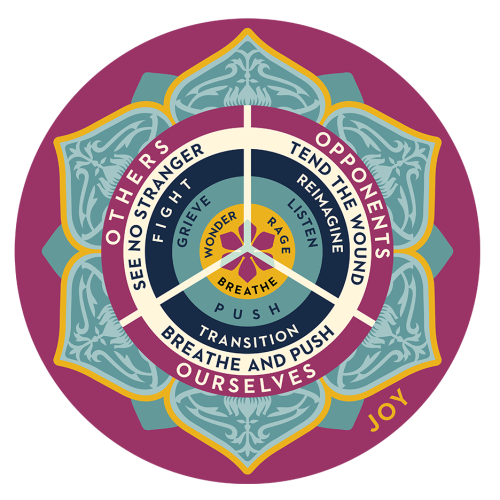
The Revolutionary Love Compass
In this episode of Nonviolence Radio, we speak with civil rights leader and Revolutionary Love Project founder Valarie Kaur about love as a force for transformation in our lives and movements. Kaur describes revolutionary love as “the choice to see no stranger… to risk ourselves for each other,” and shares stories from communities across the country where people are practicing courage, care, and solidarity in the face of violence and fear. These acts—whether on the front lines or in everyday life—offer glimpses of a world grounded in belonging and deep connection.
At the heart of the conversation is Kaur’s powerful framing of social change as a kind of labor. Drawing on the wisdom of the midwife, she invites us into a rhythm of “breathe and push,” tending both to our inner lives and to the work of justice in the world. “This is long labor, courageous labor,” she says, encouraging us to find ways to sustain ourselves while acting with purpose. The episode explores how choosing to see the humanity of others—even those who oppose us—can be a radical act of freedom, and how cultivating that inner strength allows us to remain present, brave, and connected in the midst of uncertainty.
Transcript, with thanks to Elizabeth High.
Stephanie Van Hook: Today's show is about love and the kind of love that nonviolence is made out of, the kind of love that comes from grit and sweat and work and not this sentimental feeling. And we often talk about love and nonviolence as a force, as a power, and that it's also a practice. The words for nonviolence often include love, like love in action. And Michael, I wonder if you have any thoughts about the work of love as part of the work of nonviolence.
Michael Nagler: I have a thought that's been coming up for me since you started discussing that, Stephanie, and that is love is one of the terms for the underlying creative force of the universe, that there are those who feel, and I confess I am among them, who feel that the universe is created by love. Not the sentiment, obviously, as you were just saying, not the sentimental kind of human affection that we feel for people and animals, hopefully as much as possible. But the cosmic Philotes is the same as Aphrodite, said one of the ancient Greek philosophers, meaning that the love that we feel is a universal creative force. That's why it's so powerful.
Stephanie: That's really lovely, Michael. Thank you so much. We're going to share an interview this morning with Valarie Kaur. She is a civil rights leader and author and lawyer and just incredible human being. And the book I have with me in my hands right now is called See No Stranger: A Memoir and Manifesto of Revolutionary Loveand let me read the back as as part of our connection to this conversation and love and it says
"Love is more than a feeling. Love is a form of sweet labor: fierce, bloody, imperfect, and life-giving—a choice we make over and over again. If love is sweet labor, love can be taught, modeled, and practiced. This labor engages all our emotions. Joy is the gift of love. Grief is the price of love. Anger protects that which is loved. And when we think we have reached our limit, wonder is the act that returns us to love. "
So our guest today is Valarie Kaur, a civil rights leader, lawyer and founder of The Revolutionary Love Project, and I think she'd also consider herself a co-collaborator, co-conspirator on that project. Her work has been shaped by decades of organizing, including her response to the surge of hate and violence in the aftermath of 9-11, when she began documenting stories of communities targeted by racism and fear. Through her writing, speaking, and movement-building, she has invited people across the country to see love not as something private or sentimental, but as a public ethic and a force for social transformation. Many will know her through her book, See No Stranger, where she offers a powerful framework for Revolutionary Love, a call to labor for others, to tend to our own inner lives, and to reimagine how we respond to conflict and injustice. And as she continues to develop this work, including her forthcoming book, Sage Warrior, her invitation remains both timely and challenging.
So at the Metta Center, we often say that the goal is not to put a different person in power, but to awaken a different kind of power in people. And in this conversation, we explore how her vision of Revolutionary Love speaks to that shift and what it asks in our lives and movements today. Let's turn to Valarie Kaur.
Stephanie Van Hook: You've been traveling and sharing the message of Revolutionary Love in communities across the U.S. And I'm wondering where you've seen its core values showing up in people's lives and where are those values being tested right now?
Valarie Kaur: Revolutionary Love is an invitation into a way of being, a way of seeing. It is the choice to see no stranger, to leave no one outside of our circle of care, to risk ourselves for each other. And I've been on the road, we've been to 65 cities. We were started on a bus and then we went to planes and trains. And so I've seen this country, I've seen communities show up to be brave with their love. And it looks all kinds of ways. From LA to Minneapolis, it looks like people showing up in the streets, showing up with whistles when they have guns. It looks like people bringing flowers to the front lines, laying them on the ground, not only for immigrant families who are being caged, but also for the men with machine guns, insisting that they are our brothers too. But it also looks like all the thousands of acts of care that are behind closed doors. People showing up to grieve with each other, to care for each other, to cook for each other, to care for each other's children, to the tender touch, the ability to lift each other into the light.
And it's those acts of care that make me believe that what we are seeing in this country is what I have never seen before in my lifetime. A movement, a network of people who are willing to practice the world we want in the space between us. The darker it gets, the more bold we are becoming, seeing our neighbors and our families and our friends and our communities as part of us; and every time people create a space of belonging and care and respect and deep listening, anytime it's a space where the love ethic is being practiced, I feel like I'm seeing glimpses of the world to come on the other side of all this ash. Our liberation experiments are not just like soap bubbles that pop and disappear, they are like sound waves that carry into the future. And just as I feel like I'm hearing the music of movements past, so too must we be able to lift our voices and be able to sing songs of love in such a way that future generations might hear it too. So that's where I'm seeing it alive and well in this country.
Michael: That is so wonderful to hear. You know, this morning I attended a webinar with Mel Duncan, who is the co-founder of something called Nonviolent Peaceforce, which now has 200 trained volunteers fanning out into conflict areas in the world. And one of the things that he kept repeating, you just also echoed, which is this moment is a movement. And he's based in Minneapolis, he's seeing it on the ground.
Valarie: That's right. Yes, I have just returned from Minnesota and I was on the ground with community leaders and it was astonishing that, you know Minneapolis is the new ground zero for the scale of brutality this administration is willing to inflict on immigrants, on people of color, on the neighbors who stand up to protect them. I mean Alex Pretti and Renée Good were murdered doing what tens of thousands of Minnesotans agreed to do, which was to witness. Witnessing is a shield. It says "you cannot do this to our neighbors in the dark. You cannot disappear our people and get away with it." And what their murders were about, where they were an extension of the kind of violence that people of color have long experienced on this soil. When they call you savage or illegal or criminal or terrorist or domestic terrorist, they are saying that "we can do anything to you. We can disappear you and call it your fault."
But that requires on the rest of the population being silent. And Minnesota decided not to be silent. They showed up and they created what I can only describe as an underground civil society, teaching kids in underground schools because schools were not safe, delivering groceries and supplies because stores were not safe, providing midwifery to mamas and babies because hospitals were not safe. There was a woman late to our convening because she was delivering breast milk to a three-month-old whose mother had just been taken. In the face of every act of brutality there are these hundreds of acts of care. And with every act of care it's as if the roots that connect us grow deeper and stronger and more fortified. It creates a web of what I like to think of as love in action. And that kind of love is what this regime cannot understand, cannot see, and can never defeat. And that's why I'm emerging hopeful. That's why I'm saying if we all take this blueprint in our hands where we are, we can begin to presage the world to come.
Michael: You know, this is exactly what happened in Palestine during especially, I think, the Second Intifada. And Mubarak Awad, who's a good friend of ours, said, every woman became every child's mother.
Valarie: Yes. That is the task, right? You know, we have never experienced the first livestream genocide before. When I began this work, my task was asking people to seek out the stories, to find the faces of people and say, "sister, brother, you are my child. You are a child like my child," and let that make them brave. But now people are telling me "I can't look. I can't look at my screen anymore. I cannot see any more children dead under the rubble because I get overwhelmed." And there is something called empathy fatigue when we are so overloaded by other people's emotions and suffering. And that's where I tell them like "I can't stare into the abyss like that either. I have to step away, I have to go outside and look at the sky and the sea and the trees and I have to breathe and I have to remember everything that is good and beautiful and worth fighting for; and then I return and look at the picture again." I see that child and I see my own and I let my body respond, right, you take that pain and you put it somewhere.
And this is where I believe the wisdom of the midwife is so useful. She says, "breathe, my love, and then push and then breathe again." It's an ancient formula, right? I think back to my ancestors in the Sikh tradition who called us to be sant sipahi, sage warriors. The sage sees through the eyes of love. The warrior puts that love into action. And so that means you must be able to give yourself permission to have time for both. To cultivate that wonder and rest and pleasure and that connection with everything and everyone alive. And then take that deep breath and then return to the front line and make that push, make that stand, do the one thing that matters.
And we care about outcomes, yes. We want to be able to birth a multiracial democracy, to end war and genocide, to see a planet that is sustainable. But we have to be sober about the fact that we might not live to see what we are laboring for. And this is where, just as our ancestors did not live to see us, I have to tend to the fact that just showing up is the sacred task. And when we are laboring with love, then there's enough space to let breath in and let joy in. And that's where I'm at now. I feel like laboring for a more just future with love is the most beautiful, meaningful, powerful, and pleasurable way to be alive. And I believe everyone can walk that path if we support each other and help each other breathe and push.
Stephanie: And I find this idea of the midwife and also of the mother quite helpful because in sitting with the pain of what's taking place that we feel and that I feel, that it helps to understand that that suffering has a role, that that has a purpose, that it's the pain of labor. And often in the conversations about nonviolence, understanding that suffering is part of nonviolence; this is something that's hard to talk about with people because it can be quite unexpected and very undeserved suffering. So I think it's just brilliant the way that you are providing a vision of what that suffering actually has a purpose. We're not suffering to die. We're suffering into birthing something new.
Valarie: That is what keeps me waking up every day and doing my work. I have asked myself this question for so long now. "The future is dark. Is this the darkness of the tomb or of the womb?" It is both. There is no denying the suffering. We have lost so much. We are going to be losing so much more. And so the task is to be able to taste the ash in our mouths, to feel the pain, to tend to our grief and our rage, and then to alchemize that into what we do next. And so my task is to lift my gaze on the darkest nights and see what I haven't seen before, what is emerging that is new, that is possible, that is good, that is redemptive.
And this is why from LA to Minneapolis, we're seeing stories of people being braver with their love than ever before, and that is where the metaphor of transition is very useful for me. Transition is the final stage in birthing labor. It is considered the most dangerous, the most painful. It feels like dying, from personal experience. It's when the voice in you says, "I can't, that I want to give up. I want to retreat." And it's counterintuitive, but exactly where you feel the pain, when you feel that current coursing through you is where you must decide to push to go with it, to go into it. The wound then becomes a womb. You can birth something new, and I feel like each of us are being called to birth new possibilities in ourselves to be more courageous than we've ever been.
And we can birth new possibilities in the world around us too. I don't know how many more turns to the cycle it's going to take before we birth the world to come, but I know that when I choose to labor and love, when I choose to do that alchemy of being proximate to the suffering, to alchemize grief and rage, to put it into one beautiful and good thing that I do next, then it creates moments where I see what is wanting to be born in the space between us. I can feel that freedom inside of me. I can feel that freedom between us. I get to taste it. I get to glimpse it. And that is enough to keep me in the labor. And may it be enough for all of us to realize that it can actually be the meaning of life to labor this way.
Michael: Whoa, first of all, I'm thinking constantly of Martin Luther King as you're speaking, because he actually said unearned suffering is redemptive. And on top of that, this is a psychological truth that human beings can take almost an unlimited amount of suffering if it has meaning. And it seems to me that what you're doing, Valarie, is providing meaning for the suffering that people go through. Because without meaning, it just goes down into despair. And then you start losing your faith in humanity, which is fatal. But to say, you know, this is something we have to go through, this is like a parturition, you know, to put that meaning on it, it's redemptive to think about it that way.
Valarie: You find the thing that saves your own life. This is the only way that I could find a way to last. Like, I really want to last. I want you to last. I want us to last. And I think for so much of my early life as an activist, I thought I had to make myself suffer in order to serve. I thought I had to ground my bones into the earth. I was always comparing my suffering to those I was serving. So, of course, the vicarious trauma, the pains that I survived in the face of police brutality or sexual violence, all of that I never tended to because I was always prioritizing their suffering. And it was my mother who taught me that you have to live the life within you and for you that you want for everyone, that it has to come from the inside out. And so finally learning that this rhythm of the breathe and the push is useful for any long labor has been the thing that makes it possible for me to find joy every day.
Stephanie: And what I love about your work is how your joy is so grounded into getting out there into the front lines and connecting with people. And I find it really inspiring and motivating and empowering to have your guidance in all of this.
Valarie: We make each other brave, right? We don't go to battle alone, we don't give birth alone. We need each other. There was a moment here on the front lines of Los Angeles when the surge was at its height, when we as faith leaders put our bodies between protesters and ICE agents and de-escalated, sang the old songs to de-escalate. We had flowers in our arms. And because I was not alone, right? Because there was a we, we left flowers on those steps for the families who were in detention. And then I looked up at those ICE agents and I thought, "okay, they are our brothers too, even if they've forgotten it." And so I set flowers at their feet too. And it was so difficult to make eye contact, right? That like insistence on humanity is labor, like the choice to labor. That's why I define love as sweet labor, to fierce, imperfect, demanding a choice we make. So I choose to look into their eyes and insist, lay the flowers down.
I'm done. I thought "I'm done." I leave the vigil and I hear "Ma'am" and I turn around and it's that first ICE agent calling me back. And I get scared. And he says, "thank you," and he puts out his hand. What do I do? In this spot, you pointed your rifle at me. This very spot, you held your baton over me. And now you're extending your hand to me. What do I do? And I thought about what I had just written in my book, Sage Warrior, right? You have to go back to the wisdom that anchors you. I wrote "Revolutionary Love is the choice to block your actions with one hand and extend the other with the hope that one day you will take it or your children will take it. For the brief high of domination is nothing compared to the infinite love and joy of true community." So I took his hand. I don't know if that man will stop hurting our people, but I want to be the one who believes in that possibility. That's who I want to be in the story. And I believe that our front line is not just in those streets. The front line is everywhere we are called to be brave, right? To see no stranger. It could be in our houses of worship, our classrooms, our homes, our kitchen tables, our own hearts. You know, what is your front line and what does it mean to show up to your front line with flowers.
Stephanie: and it's like taking your values and your practice and and doing them and showing them, sharing them, and so when I think of Revolutionary Love I think of it as both a movement and as like a transformer within a movement or a filter in some way, because movements against injustice can start to embody the kind of negativity that we're resisting. And I see Revolutionary Love as a filter for that. And I was really moved by a story that took place. I saw that you reported from Los Angeles, I think. You were standing by a protester and she was yelling at ICE agents. And you said something to her about them being afraid. I wonder if you remember the story that I'm pointing to.
Valarie: Oh, I remember.
Stephanie: Can you tell us?
Valarie: It was a terrifying moment. It was before we showed up with the flowers, right? It was when it was just righteous, raw rage in the streets. People were just in the streets, really hours after the raids began. And they came out in full force and the woman behind me yelled, "look at them, they're not even human!" And that's when I spun around and I didn't even know what I was saying before I said it, right? Because you have to practice the truths in your mind for moments like this. So without thinking, I said, "no, don't give them that power. There are no such thing as monsters in this world, only human beings who are wounded." She's like, "oh, they're scared." I'm like, "yeah, they're scared." And she says, "look at how scared they are." I'm like, "that's right." And then the flashbang grenade goes off and everyone scatters and it's terrifying. And I start to cry because it's been so long since I've been in the streets like that.
And so insisting on seeing the humanity of your opponents, insisting on seeing their wound doesn't make them any less dangerous. They lose their power over you. You become free. You're no longer reacting endlessly from your trauma, the hold they have over you. No, you're sitting in your sovereignty, in your deepest wisdom, and you are responding from there. What would love have me do? And sometimes it is the blocking the actions and other moments that you might find yourself in a position to extend the hand, but you won't know that unless you're seated in that deep wisdom and that love.
And I think that's what my ancestors taught me in the Sikh wisdom tradition and what this last book, Sage Warrior, is all about is I understood that they cultivated a space of freedom inside of them through music and poetry and song prayer. And then from there, they marched. From there, they fought. From there, they sang. From there, they acted. And that is so different from the activist playbook we've all been handed, where the loudest activism in the streets and pushing all the time is what's rewarded. I think there's a call for us to go deeper and you don't have to believe or belong to any religious or spiritual tradition to ask yourself, "what is the inner strength, the inner freedom I want to cultivate, the sovereignty I want to cultivate, that the hot winds cannot touch." My grandfather would say, the great, beautiful, Sikh shabad, "the hot winds cannot touch you. You are shielded by the infinite." Can we rest in that place? That's the sage. And then you can show up as the warrior.
Stephanie: I was listening to Ani DiFranco this weekend, also in honor of this interview. And I also saw something you posted a while ago about how Ani DiFranco wrote a song for you, it's like the whole album.
Valarie: That's right. I mean, the little girl in me was, you know, breaking down in disbelief. I would listen to her songs while driving to protests in college against the Iraq war. Her music is just the soundtrack of liberation in my life, and for then her to read my first book, you know, Stranger and then say, I want to take these words and make music out of them. So she wrote the song Revolutionary Love. She wrote more songs for us that we haven't released yet that will be coming out soon. And then she named her whole album that. And now she's my sister friend. Like we're really deeply close and I'm in disbelief of it. But I think that's what I mean about making each other brave. Just like Michael, you taught my advisor, Linda Hess, who was my first teacher in college who taught me nonviolence, right?
Stephanie: I just want to say in that song, my favorite lyric was, "I'll be the one to set myself free."
Valarie: That's it! It's like we unearth the deepest wisdom, we pass it on, it nourishes us, it fortifies us, it inspires us and this goes back to like you're asking about Revolutionary Love as a movement. I never set out to start a movement, I just wanted to seed the love ethic in all the existing campaigns for justice. But after listening to people and crossing the country I realized that this world makes people feel naive or unserious about power for believing in love, and what they wanted is to feel connected to a national movement which is really an ancient movement, it's King's revolution of values. So this is why we are calling this new iteration a Revolutionary Love movement that you can be part of however way it expresses itself through you.
Stephanie: We have just a couple minutes left with you, so you have a wonderful resource compass; that is extremely helpful tool, simplified, makes it easy, carry it in your hand, carry it in your heart throughout the day. But what are three recommendations you'd offer to somebody who wants to experiment with what you said, seeding love ethic in our movements and participating in experiments in Revolutionary Love?
Valarie: Number one, see no stranger. Can you move through your day and look at the faces of people on the street, on the screen, in the subway, and say to yourself, "sister, brother, cousin, beloved, you are a part of me I do not yet know." Simply retraining our eye to see all others as family is an anti-racist practice and an anti-fascist act. Demagogues succeed when they shut down our imaginations, our ability to imagine other people's lives as belonging to ours. And so just get curious about how that way of seeing no stranger, what that inspires in you, what you want to do from that, who you want to grieve with, who you want to fight for.
Number two, tend the wound. It might begin with tending your own wound to honoring your rage. Rage carries information and energy about what's important to you. You might need safe containers for your grief and for your rage. That might be where you are in the movement ecosystem right now. You might be someone who is in a position to tend the wound of those we see as our opponents. I don't use the word enemy. An enemy is a fixed and permanent identity. An opponent is anyone whose ideas, words, or actions oppose your own. They might stay your opponent this whole lifetime, but they might not. And just thinking that is a revolutionary act. Ask yourself, what is their story? And can you see their wound? How would they behave if they felt safe and free? And you can take that information, reimagining a solution, an outcome, a relationship, a future, a vision that leaves no one behind, not even them.
Number three, breathe and push. The wisdom of the midwife. This is long labor, courageous labor. This is the labor of a lifetime. And so how are you weaving breath into every day? Are you going outside, music, poetry, meditation? Are you looking at the sky and the sea and the stars? What are you doing to remember the magic and the mystery of being alive right here, right now? Breathing deep. And then what is your push? What is your particular push in this season in your life? And who will help you make that push with all of your bravery?
See no stranger, tend the wound, breathe and push. These are also points on the Revolutionary Love Compass. And if folks want to go real deep, you can go to revolutionarylove.org for all the tools. Everything that we put out is free. I've spent 20 years of my life organizing around hate. I will spend the rest of my life organizing around love. And I'm so excited to invite you all to organize with us.
Stephanie: Thank you so much for your time today.
Valarie: Thank you both. I've enjoyed this so much.
Stephanie: Yeah, we have too. And we are praying for you and holding all of your work and all of you in our hearts.
Michael: And in our meditation.
Valarie: I really appreciate that. I think the most challenging thing for me is like, I feel like I have two front lines and one is the frontline of the world, like showing up, playing this role, right? Calling people to love. And the other is the frontline in our home with my children. And it's the same work, actually. It's calling us to love, helping them become loving, resilient human beings. I find myself, you know, my post is standing at both front lines. And that feels to be an impossible task. But somehow every day we do the impossible, right? And there are many, many other women, especially who are mothering right now who feel the same way. And so I just want to tell them all what I tell myself, which is that "you are enough. You are more than enough to trust that our love outlasts life and that that love will make the people we love brave with their lives."
Michael: That reminds me so much of one of the most important things that we ever think about from Gandhi, where he said, "in the midst of death, life persists. In the midst of untruth, truth persists. In the midst of darkness, light persists."
Valarie: Yes
Michael: And then he says, and that for him becomes his definition of God: love, truth, and light.
Valarie: And then I would go further and say if we become it; we become the light, we become truth, we become love– oh that's the revolutionary invitation. I hope we get to keep talking because I feel like as things get darker in our country we're going to need to remind each other and fortify each other in these tools and this knowledge and you know, we're in the midst of authoritarian capture. And I don't know if we're going to take the blueprint that Minneapolis has given us and enact it in cities across the country in a way that reigns them in or whether they're going to get deadlier and more covert and more strategic. And so I feel like we keep checking in as long as we can still be speaking the way that we are now. We need to be speaking together and with each other. So let's keep checking in.
Stephanie: Okay, good. And you have a retreat coming up.
Valarie: That's right. So Sage Warrior, my book on ancestral wisdom in the Sikh tradition, how to become sant sipahi, how to become sage warriors; that book is coming out on paperback on April 14th. It comes with a musical album and a study guide. It's such a multi-sensory experience. And we're holding a retreat in April at Kripalu for folks who want to experience it with us, with me in person. We'll also have a virtual book club. So if you follow our work, you'll be able to take this wisdom into your life too.
Michael: Wonderful.
Stephanie: Are you heading to any other cities soon to be following what's happening? I saw that in Vermont, ICE is now cracking down in Vermont. I don't know where you're headed next.
Valarie: I usually go to where I'm invited and needed, so where we already have relationships. We had actually been to Minneapolis twice on the Revolutionary Love Tour. So the same faith leaders and artists and organizers who were in the trenches when I got there were the people we had developed relationships with over the years. We have been to Vermont. And I feel like my job, our job is to check in on each other and ask what you need. And if they need us on the ground, we'll be there. And I feel like that might be a good kind of invitation for all of us to check in on what our people need and let them tell us and then show up in that way so yeah so we'll see. Just keep following and we'll see.
Stephanie: That was civil rights leader and founder of The Revolutionary Love Project, Valarie Kaur. You can find all of her work and resources at revolutionarylove.org. Well, everybody, you're here at Nonviolence Radio, and as part of Revolutionary Love, music plays a big role. So I want to share this song that is from Nimo Patel and Empty Hands Music. And it's a song called Planting Seeds. And I thought it really tied in well with this idea of Revolutionary Love that Kaur was talking about. So let's hear this song.
Music: Planting Seeds by Nimo Patel, Empty Hands Music.
Stephanie: That was Planting Seeds. It's from Empty Hands Music. And I want to say a few words about Empty Hands Music because they offer this music with empty hands. So it's a 501c3 nonprofit based in the U.S., led by director Nimo Patel, and it's dedicated to serving and gifting communities across the world a positive and inspiring message through music and events, as well as its grassroots work with slum communities in India, providing opportunity empowerment to underprivileged children through the arts. And Empty Hands works in India; their work in India comprises of directing and supporting the heARTS program, and that's h-e with capital A-R-T-S, so heARTS, right? A platform of expression, education, and arts for over 2,000 underprivileged children in five different slum communities, as well as in the Gandhi Ashram in Ahmedabad, Gujarat. So, it's just really sweet and powerful to share that music, especially when so much music is under copyright and all that. So thank you very much, Nimo Patel and Empty Hands. So let's turn now to some more Revolutionary Love taking place throughout the world and with our Nonviolence Report, Michael Nagler. You are our Revolutionary Love reporter today, Michael.
Michael: What an honor. I hope I can live up to it. It was really good to hear that song of Nimo Patel's because Valarie Kaur is a rather difficult act to follow directly.
As we know, the country is technically at war. In other words, bombing Iran, destroying human life, destroying ancient, ancient treasures of human culture and setting back human progress by leaps and bounds. And there's a group called Crimson Winter, which is documenting the unrest in Iran that led up to, in a funny way, what we're now doing to the country. They found that there were protests that occurred in 682 locations across 203 cities, which occurred in all of the 31 provinces of Iran, which really showed that the demonstrations were of a national character. And as very often is the case, they may have begun with a particular grievance, but they quickly escalated into an insurrectionary movement aimed at regime change. What resonated in my mind was "remember the Bastille." Well, there's – now what is the response coming across the world?
Yesterday's Pace e Bene reported that coming up on March 28th, there will be the largest single-day protests in U.S. history and that will fill the streets with people. It looks like around 3,000 cities and towns will be holding – marches, rallies, and demonstrations. And Pace e Bene/Campaign Nonviolence are offering a website where you can find your protest. They also state, and I want to quote part of their words here, that "the list of reasons to speak out against the administration's abuses grows by the week." I read in another place yesterday that the takedown of democracy that's being carried out under the Trump administration is unprecedented in its speed and destructiveness. So here's the question that they raise and I raise. Will it accomplish anything to protest? They say yes. "Mass protests have lots of impacts," I'm quoting them, "they build a sense of connectedness within the movement," that I totally agree with, "they are a show of strength and unity. They are energizing. They can sway perspectives in bystanders and fence-sitters," what we sometimes call the reference public, "and they can send a warning to power holders," which may or may not be a good idea strategically. "They can bring people into the movement and offer an on-ramp into other kinds of nonviolent action." And that's where it gets real. They say, and I endorse, "mass protests are most powerful when paired with a sustained campaign that includes nonviolent acts of noncooperation or intervention," and I, of course, would always add: and constructive program: building the institutions, the networks that we want. So nonviolent protests "are rarely powerful enough on their own to resolve an injustice," especially the ferocity of the one that we're facing. However, they say "No King's Protests are not happening in a vacuum. They are part of an immense anti-authoritarian movement that has spent 15 months mobilizing some of the largest nonviolent campaigns in U.S. history."
And they look at some successful examples of nonviolent protest and I want to share two of them with you. Back in 1983 in Chile, there was what they call the caceroleo or the pots and pans banging protest in Chile that led up to the flight from the country and resignation of one of the worst dictators in South America: Augusto Pinochet, who had to flee to Spain. And they also, six years later, talk about the Baltic Way chain, which is something that I like very much. There are three Baltic states, Latvia, Lithuania, and Estonia. At that time, they were still part of the Soviet Union. So, people held hands in a long line to show that they were free and they were not part of the Soviet Union. This line was nearly 500 miles long. Just imagine that, 500 miles of people. And that led indeed to the independence of the Baltic states. Now, I was almost tempted to say the other United States.
I'm going to talk now for a bit about Israel. A clinical psychologist, Ohad Moran, M-O-R-A-N, has described today's Israeli society as, "living in a sort of mass psychosis characterized by widespread despair." In other words, this is what happens when people don't have or don't see that they have a positive way to resist, to fight back. This is the great danger, they fall into despair. And between 2022 and 2024, according to a recently published Israeli parliamentary report, 125,000 people emigrated, they left the country. And remember, this is a country of some 9 million people. And so 125,000 makes an impact. I'm going to comment on that in a second. I want to quote one of them who said, "I can't wait to leave. There will never be peace here. We can't even make peace between us. Israel is a divided nation. Our strength was that we were one nation. However, Netanyahu has destroyed that. Enough is enough." the person said. That was quoted in the Jerusalem Post.
Yeah, leaving has been a form of nonviolent protest forever. In India, it was called sitting dharna, where you just, you know, you walked out of the regime, out of your home, rather than pay the taxes or whatever the regime was demanding of you. Unfortunately, it has the effect of draining the country of the most resistant and most effective people. Now, it is possible that they can gather together in forces outside the country in diaspora. I'm not seeing any terrific evidence of that so far, but that often has been the way that regimes that are very oppressive have been brought down by the diaspora communities gathering their forces outside the country and coming in. I mean, in a funny way, after all, that's what happened in 1979 that brought the present regime into power in Iran.
So Iran, Israel, and now this is something that really has memories, evokes not very pleasant memories for me, and that is that we're doing it once again to Cuba. The crisis on the island has escalated this week and our president threatened to just take it. He said, this is a quote, "I can do anything I want with it," which is like a classic definition of malignant narcissism. That's a technical term that's been applied by psychologists. Okay, there will always be people who have a certain amount of narcissism. particularly of this malignant variety, though narcissism is inherently malignant. But this is a really bad form of it. But the difference is that this is the leader of the militarily most powerful country in the world. It was up until recently, as we're seeing now with the attack on Iran and the attempt to reopen the Strait of Hormuz, that our former allies are not going along with us. So that is a beginning of a takedown of a very violent regime, very violent system.
As we know, protests of one kind or another is going on in Ukraine and I want to talk about the other kind. There are pacifists in that country, even when there is a war to defend against outside invaders, pacifism can stay true to its principles. And recently there was a quote of three members of what's called the Ukrainian Pacifist Movement in English, and this now is beginning its fifth year. One of the people involved, Finbar Tosland, has said, and this is quoted in The Progressive back on the 25th of February, he was quoted in a freezing cold afternoon in the capital, Kiev, temperatures dipping as low as five degrees Fahrenheit. That's even lower than Minnesota. The reporter sat with three members of the Ukrainian pacifist movement who are speaking out about what they see as the immense danger caused by militarism. As I say, this is a dramatic position to take when your country is being invaded and it doesn't seem that there's anything but a military resistance that can protect it. So, their names are Yurii Sheliazhenko, he's the executive secretary, and then a pacifist Quaker by the name of Sergei Vedmediev. And a CO, conscientious objector named Artem Denisov. I wanted to give a shout out to those three brave young people. And one of the quotes that Sheliazhenko has recently shared, which you can not have any trouble understanding why I liked it. So much, and this is the quote, "war is contrary to human nature and the sanctity of human life," he says. He goes on to say "everyone feels good in peace and everyone can see what a bad thing war is." Yeah, and though we can see it, we don't always know how to respond to it. Now, here's the part that I really, really liked. He said, "if the country were better prepared for nonviolent resistance, no occupation would be possible." And that can happen. even after the country has been invaded, after it's been taken over, as we have a lot of documentation from Prague Spring and other events in the Cold War that shows that. Of course, it's much easier and causes much less death and suffering if you do what the military terminology calls shallow intervention. That is, you prevent them from coming in. But often you cannot do that without using violence. But what you can always do is refuse to cooperate with the invaders so that what they end up having is an enormous problem on their hands.
So to turn to some good events, and there are many of them, I've mentioned before the town of Caicedo in Colombia. I love quoting him again because of the name Caicedo was resonant with me because he was a Chilean psychiatrist who studied all the, quoting him, "the great yogis of India." He went to India and he said, I don't want to fool around. I want to see all the great yogis. So they took him to the heavy hitters. Now, Pace e Bene has a project that they work with called the Nonviolent Cities Project. It works with communities around the world that are exploring what it means to make nonviolence not just a value but a shared civic commitment. resonating with what Valarie Kaur was sharing with us. And very often the work begins with community dialogue and education and grows into collective efforts for nonviolent conflict resolution, restorative practices, and a culture of dignity in public life.
I'm again being very encouraged by the sophistication and not just the volume of protest that is rising up. It really does seem, when I look back, you know, when I started this work so many years ago, but who's counting, I cannot help but be thrilled at the growth in awareness and sophistication that is partly brought on by things like Gene Sharp's work at Harvard and many others. So I want to talk again about some organizations that have cropped up and that are, again, they were new to me. One is called Peace Through Action, and USA News for February reported on this. And then another rich source is the Nonviolence Project, which has a website, nonviolence.com/news, suspiciously similar to other famous programs. But they've recently teamed up with a group in Sweden called Det Rekker. I hope my pronunciation isn't too bad. And that means "that's enough," which sounds to me very much like Yesh Gvul, which was the Israeli anti-war protest movement of recent years, and Yesh Gvul means "there's a limit." And a Swedish artist, Carl Fredrik Reuterswärd, who was a friend of John Lennon's, as it turns out, created the symbol of the twisted gun, the pistol that is now made into a big statue and put in front of the UN plaza. And, you know, I have this ambiguous relationship to symbols, I give very good people a lot of trouble over this. But one of their quotes was, "from a piece of art to a global movement." In other words, this symbol managed to galvanize people, provide a place for them to rally around. And then another organization or source I was not familiar with is called The Conversation. And their motto is "Academic rigor, journalistic flair." It sounds a lot like the medicine, if you ask me.
When I was in Germany some years ago speaking at a Catholic university and then around southeastern Germany, what I kept hearing was a phrase, die Jugendlichen, die Jugendlichen, the youth, the youth. There was so much hope reposed on them. And now I think some of that hope is being realized. Gen Z movements around the globe are sharing tactics and challenges. And that was one of the big things that was said about the Jugendlichen, that they are a global culture, not a national culture. It goes, you know, youth culture that somehow transcends language and other kinds of artificial separation. And that reminds me what they're doing now of something that grew out of the Balkan protests in the 90s, a group called CANVAS, that's their acronym, Campaign for Nonviolent Actions and Strategies, started by a student by the name of Srđa Popović. And this is a leaderless movement, and I'm going to comment more on that in our next program.
Stephanie: Thanks so much, Michael. It's been so nice to hear this Nonviolence Report. So thank you so much. We want to thank our mother station, KWMR, to our guest today, Valarie Kaur of Revolutionary Love. And to everyone who helps make this show possible, Elizabeth High, who helps transcribe the show, to our friends at Waging Nonviolence, thanks so much, Eric and your team. To the Pacifica Network, who helps syndicate the show. And then to you, all of our listeners. We're grateful you're here. If you want to learn more, visit us at nonviolenceradio.org where you'll find archives of the show and lots more information about nonviolence. And until the next time, everybody, please take care of one another. We'll be back in two weeks with an excellent episode. We're interviewing Emily Yellin, who did a memoir with Reverend Lawson called Nonviolent. So, really excited.