
The Discipline of Nonviolence: Emily Yellin on James Lawson’s life and the making of a movement
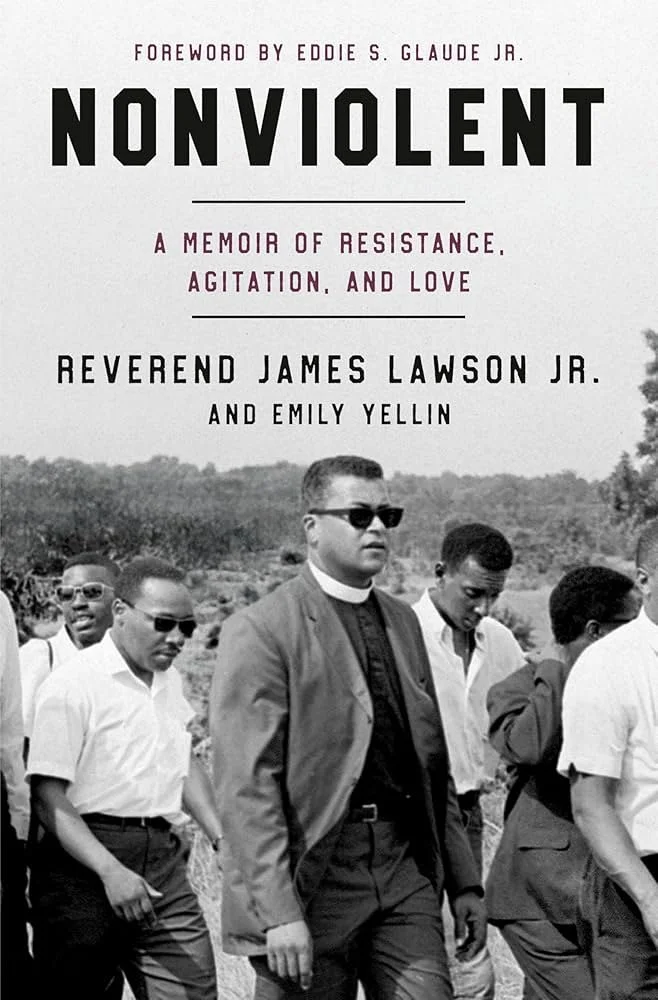
In this episode of Nonviolence Radio, we speak with journalist Emily Yellin about her collaboration on Nonviolent: A Memoir of Resistance, Agitation, and Love, offering a rare and deeply personal window into the life and thought of Reverend James Lawson—one of the most important yet often overlooked architects of the U.S. nonviolent movement. Drawing from years of conversations and archival research, Yellin illuminates Lawson’s spiritual grounding, strategic brilliance, and lifelong commitment to nonviolent direct action. The conversation highlights how nonviolence is not a spontaneous tactic but a disciplined, relational, and deeply strategic practice rooted in listening, training, and long-term vision—offering powerful lessons for movements today.
Transcript, with gratitude to Elizabeth High.
Stephanie: Well, greetings and good morning, everybody. Welcome to another episode of Nonviolence Radio. I'm your host, Stephanie Van Hook, and I'm here in the studio with my co-host and news anchor of the Nonviolence Report, Michael Nagler. We have a very special guest today, Emily Yellin. She co-wrote James Lawson's memoir, Nonviolent: A Memoir of Resistance, Agitation, and Love. And Michael, this has been one of your favorite books recently, so I'd love to hear your perspective on why you read every page of 600 pages of this book.
Michael: Yeah. Thank you, Stephanie. And how rare is that? You know, I just kept thinking, well, I'll skim, I'll skim—but no, it was so well written. Emily was perfect for the job. She's a journalist, and of course, we all knew that Reverend Jim Lawson was the person, with a little bit of help from Glenn Smiley, who really introduced Martin Luther King to nonviolence.
So just imagine what a consequential player he was in the Civil Rights Movement. And I love the tone of Reverend Lawson's writing. He is just so even-tempered, describing the most horrific episodes without bitterness, without panic. And I came away with the feeling that he was, in fact, the best, most insightful interpreter of Gandhi's nonviolence that we had in the West.
Stephanie: Well, let's turn now to our interview with Emily Yellin.
Emily Yellin: I have known Reverend Lawson since I was five years old. He and his wife and my parents were friends and worked together in the movement in Memphis. So he's been someone in my life my whole life, pretty much. So working with him was kind of like working with your father in a great way. And, you know, I also, though, as a journalist, it was just so rewarding because he could remember everything. And what he didn't remember, I was able to use my journalistic skills to fill in and amplify. So it was just a wonderful experience. And I feel really honored that he trusted me and lucky to have gotten to sit with him and talk to him. And we started this in 2020.
And I had called him up during the pandemic and said, "have you ever thought about doing a memoir?" And he said, "my family's been trying to get me to do this for years." And I said, "well, I would love to work with you on it if you want." And he went away, talked to his family; and his wife, Dorothy Lawson, approved, and that was the main thing. And he came back and then we started working and I got to talk to him during the pandemic, after the pandemic, a couple of times a week for almost three years.
Stephanie Van Hook: And what did that responsibility feel like to you?
Emily: Yeah, so it felt really natural to me. It felt like I was just talking to someone I had known, but also someone who had a story to tell. And that's what I do. This isn't exactly about me, but it's more just to establish the relationship I had with him and help you see. So my parents were both journalists and we moved to Memphis from New York in 1964. And I was a very little girl, toddler. And my father started the film and television department at the University of Memphis. And so that was our background. My mother was an editor at Reader's Digest.
And so, four years later, when the sanitation strike and the assassination happened, my mother, who was a history major and a journalism master's degree from Northwestern, said, "there's history happening here. And 100 years from now, if anybody wants to know what was happening in Memphis and all they have is the newspapers, they're not going to know." Because what I grew up with is the idea that, I mean, not the idea, the truth that the papers in Memphis were not covering this, were not covering the story. There were two papers owned by Scripps Howard and people working there were all white men, it was the 60s. And during the 65 day strike in your city where your sanitation workers are on strike, all 1300 Black men, they never interviewed a sanitation worker or a family member of a sanitation worker. And my parents understood that the story wasn't being told. And so they set out within a month and started interviewing people for an oral history that was done pretty much contemporaneously. So for four years, they interviewed 150 people involved in the sanitation strike. And the person they interviewed the most was Reverend James Lawson. So there are actually sentences in this book where half of it is his answer to my father in 1968 and the other half is his answer to the same question from me in 2022. So that's just sort of, as I said, it felt very natural. I sort of feel like I was set up, you know, in first grade, to do this. And so, you know, I think that that relationship made it, I'm not going to say easier, but it made it flow so easily between us.
Michael Nagler: I want to say, Emily, my background was in comparative literature. Yeah, that was my day job back in the days when I was working for an honest living. And I am just so happy with the beautiful way the book is written. You know, a book that length, I hardly ever read from cover to cover anymore. And I kept saying, "well, I'll skip this, I'll skip that." But I haven't skipped a thing. I've read every sentence; and I'm particularly impressed that some of those sentences were hybrids because I never would have known.
Emily: Well, and I want to emphasize in this that this is not a biography, this is his memoir. People sometimes mistake that I wrote his biography and had his cooperation. This is his memoir, so it's his words; so it really was a matter of taking his words, crafting it into a book, and working with him on it, you know, asking him a lot of questions around certain things and making sure that the details are right and then checking it out. You know, if he said something happened on a Thursday, I would make sure it did, you know, and it pretty much always did. That's the other thing that was amazing about him. You know, just being able to do that. And there are, as I'm sure you both know, there are a lot of interviews with Reverend Lawson floating around. He would talk to everyone because he was so open. But bringing it all together and getting the stories straight, you know, there's a couple of stories he always told. And, you know, like all of us, they would be a little different. And as a journalist, I had to make sure we got every single detail correct. Like, were you in fourth grade? How old were you? You know, that kind of thing. And do the math from his birthday, that sort of thing. So I tried to do that. I'm sure, you know, there might be some lapses and those are mine, not his. So, you know, there's that. But it is a memoir. And I thought that was really important. He thought that was important. His family thought that was important. And the publisher thought that was important, because this is one of the great leaders of our time.
And one of the reasons we don't know so much about him is that his nature and his tactic actually was to stay sort of behind the scenes. He was responsible for bringing nonviolence and the practice of nonviolence, and I know I'm speaking to the choir here, but that he was responsible for bringing that more than almost anyone, and John Lewis would say, more than anyone, to the Civil Rights Movement. He organized the Nashville sit-ins. And as part of that long, year-long process before the sit-in actually happened, but I'm sure you both know the whole process, but it's in the book, he recruited people like John Lewis, Bernard Lafayette, Diane Nash, who were students in Nashville at the time and then went on to become leaders of the Civil Rights movement themselves. And so he recruited and trained them in nonviolent direct action in Nashville in 1959 in a basement of a church near Fisk University.
And so that's really a very important point in his life, but also in the story of freedom and fighting for freedom in America. That moment and those moments of the movement obviously were pivotal, but his life is a trajectory; you can see a through-line from Jim Crow through the Civil Rights Movement to now because he only died a year and a half ago. Sadly, he died when we were finishing the book. And I was just so glad that we had gotten it, you know, but he represents, in my mind, the best sort of through-line by which to tell the story of that progress.
And what he realized at about 90 is that he wasn't going to see the finish. We might not see the finish. And obviously in Dr. King's last speech, he said that, "I might not get there with you," right? So that also is a model, I think, for us who have to carry this, who want to and are committed to carrying on the work, right? Is that we're a chapter maybe, you know, but the fact that they made progress, I mean, that's the other piece. They made progress in the movement and then beyond. He lived 56 more years after Dr. King was killed and they were the same age. And so I like to see his life and the rest of his life as what Dr. King would have been doing because he was carrying on the same work. He was working at police brutality, he was working at education equity and increasingly economic empowerment. So he worked with unions in Los Angeles and he worked with undocumented students and people on the West Coast in particular, but all over the country. So all of that work, though, he saw as part of nonviolence,and nonviolent direct action was his way, really.
Michael: You know, Emily, our field, if you will, is nonviolence. And what is it exactly? How does it work? And I had heard many times of Jim Lawson's pivotal role. You know, there were a number of Black people from the south who went to India, not just Jim, starting with Howard Thurman. And there were a number of Indians who came here, but I was blown away reading how penetrating and accurate was Jim Lawson's knowledge of nonviolence, exactly what it is and how it works. I don't know, Steph, I can't think of anybody else that we've come across that was so eloquent and so accurate in his understanding.
Stephanie: Could you say more about Lawson's deep understanding of nonviolence and maybe what you learned in this process about nonviolence?
Emily: We decided to do this book in chronological order. You don't always do that, but we thought, "oh, maybe we'll start with King's assassination and he was there in Memphis and all of that." But we said, "let's just get the chronological thing and then we can rearrange if we want." And when we finished, we said, "no, this is it."
The book starts, the first line in the book is, "I smacked a white kid in his face when I was four years old." And it's because this kid who was his playmate called him the N-word. And we thought that was a great way to start a book called Nonviolent, because I asked Reverend Lawson at the beginning of the process, I said, "what do you want this book to do?" There were a couple of things, but the one that stood out and I think he said most eloquently and strongly was, "I want this to show that a person, a community, a nation, the world can transform." And he believed that the transformative power of nonviolence was the way to do that. And as I'm sure you all know, there's science and research to back that up, but this was way before that was even happening.
And he said that he first really came to it on a personal level through his mother, but also on a more global level, there were always Black newspapers in his house growing up. He was born in 1928 and he grew up in the 30s and 40s. And he said that the Black newspapers were covering Gandhi and were covering the movements that were starting to bud in Africa. And Howard Thurman, they were covering that. So he actually knew about this. And then he said the minute that Gandhi's autobiography was published, he read it. He was in college. It was his first year of college. And he just happened to be at Baldwin Wallace College, a small college in Ohio, when A.J. Muste came to speak. And he was enthralled. He said, "I realized that there were other people in the world thinking like I was." But he talks about his mother and how her impact on him was sort of the organic way and the spiritual way that he came to this.
When he was eight, after the four year old incident, it happened a couple more times. And when he was eight, he was walking and he did it again. A kid yelled out a window from the car in the street and he went over and slapped him. And then he went home and he told his mother. He hadn't told his parents before that. And he told his mother and his mother said, in this long sort of soliloquy, she ended by saying, "Jimmy, what good did that do? There has to be a better way." And he said that he had a numinous experience, a spiritual experience. He felt something within himself and he heard a voice that was not his own within him. And he calls it later, he realized it was for him, he would call it the voice of God, calling him and saying, "this is your quest." He said that when he slapped the kid when he was four, he said he would never, ever stand for any kind of bigotry, basically. And then the eight-year-old experience is when he had a spiritual, I guess, awakening, where he realized that he would never hit anyone again. And he never did. And he said that he would find other ways. And that's sort of both of those things together combined to make this man.
And I think he was a humble person, but not humble as in, "oh, I'm not that big a deal," or anything like that. He was humble in the sense that he truly, and I've never met anybody who truly believed that we are all equal, that no one is better than anyone else. And when he was 18, he was supposed to register for the draft, and he sent back his draft card because he said, "I'm not participating in the selective service." He could have probably gotten a ministerial excusal or been a conscientious objector, but he chose not to do that. He said, "I'm not even, that's still participating in the system." So on principle, he sent back his draft card.
And when the Korean War began and the draft was in earnest he was supposed to report he didn't. And he knew that by doing that he was violating the law, but he was doing it on principle, and actually his mentor because he had been working in the Fellowship of Reconciliation, was Bayard Rustin, who's maybe another person who's as equally committed and he learned from him, and Bayard Rustin resisted the draft in World War II. And Reverend Lawson ended up getting arrested his senior year and serving time in prison. And it was the same prison, ultimately, that Bayard Rustin had served in.
And so there's a real trajectory again. It didn't just start when he met Martin Luther King. And then he was in prison, and the amazing thing is we found his journals. He kept diaries. One of his disciplines when he was in prison was he kept diaries and journals. And so they were handwritten and we transcribed them and and that's, the chapter on the prison is really from him, his diaries. And there's a letter that we found in in all of that, his papers are at Vanderbilt which is a whole nother story, but his papers and it was a letter to a friend and it was in 1951 and I'm paraphrasing but he basically said, "I don't understand why there can't be a movement in the south where segregation is the worst, where racism is the most evident, that Black people would come together in a nonviolent way and rise up against segregation. And it probably is going to happen, I just believe it will. And I think there's going to be a very charismatic leader, whose sort of the face of it. But I know I'm going to be part of it." And he said that in 1951 and it's written down. And then he keeps saying it and he says it in his journals and he says it.
And then he was paroled early. He was supposed to serve three years, but he was paroled early. And the Methodist Church, where he already had his preacher's license, they promised the federal government that they would send him out of the country. And so they released him, and the available spot was in India. He actually wanted to go to Africa, but there was a spot available in India, so he went. And just, again, there's so many serendipitous moments, which he would call providential in his descriptions. But he ended up in India, and within the first month, he met with nonviolent leaders who had worked with Gandhi and he met Nehru, the first head of India. And so he was in that mix right away. And he spent three years in India.
And then a really significant part, in the summer of 1956, he traveled to Africa and met with independence leaders like Patrice Lumumba, who the CIA later killed, and others who were working on nonviolent, not all of them were nonviolent, but many were nonviolently standing up and gaining independence from colonial European nations. And so there's an amazing, that's an amazing part of his story.
But he encountered, when he was in India, one day he came in from football practice. He was a coach. He was also quite an athlete and he was a coach in India. And he came in and he saw The Nagpur Times, the paper of the town he was in, an article about the Montgomery bus boycott and this man named Martin Luther King. And he started whooping and yelling and jumping up and down. And his office mate came in and said, "what's going on?" And he says, "I've been talking about this. It's happening. It's happening!" So when you ask him when he met Martin Luther King, he said, "I met him on the front page of the Nagpur Times."
And so it's just this amazing story of how he came to be the person he is. And then he ends up at Oberlin. And this is, I mean, both of these, Baldwin Wallace and at Oberlin, just coincidentally, Martin Luther King appears to do a speech about Montgomery at Oberlin, which makes sense if you know Oberlin, but still. And he was a divinity student there, a graduate student. And they ended up at a lunch together. And they were the first two in there and started talking.
And my sort of hidden agenda was I wanted readers at that point to say, "wow, Martin Luther King sure was lucky to meet Jim Lawson." Instead of the other way around, which you sort of would think. But he met Reverend Lawson and they started talking and Martin Luther King was fascinated because Reverend Lawson had already been to India. He had studied with the people who, you know, worked with Gandhi. He had been to Africa and been to the nations that were gaining independence or the independence movement. And he was so versed in all of this and had so much experience. He had done workshops in India on nonviolence already. And so Martin Luther King said to him, "you have to come south now." And Reverend Lawson said, "well, I'm going to when I finish my degree. I plan on it because I want to go to the belly of the beast." And he goes, "no, no, no, you need to come now. We need you now."
And so he dropped out of Oberlin. And he moved to Nashville. And that's how he became part of the Civil Rights Movement. In 1958, he moved to Nashville. And it's just an incredible story. I don't want to give it all away, you've got to buy the book, but it's a story people don't know, but it's also a pure story of conviction, well, the subtitle of the book, "A Memoir of Resistance, Agitation and Love." And that's what his life was.
Stephanie: I love how enthusiastically you're just sort of bubbling up and spilling over with so much of this. And that's really wonderful to see this happen to you.
Emily: Well, I've spent five years doing this. And so, yeah, I've got a lot of enthusiasm for sure.
Michael: Let me start by echoing something you said, Emily, which is, buy the book. Get out there and read the book. I can't recommend that strongly enough. I had a question I wanted to ask you. It goes back to those numinous moments or providential moments. Both King and Gandhi had those and described them very vividly. And I was very impressed with the couple that I've read so far in the book. But were there others that maybe didn't make it into the book? Or did he say more about them that haven't quite been captured?
Emily: You'll read if you keep going. Certainly during the movement, there were a couple of more moments like that, particularly, I guess, during Dr. King's speeches in Memphis during the sanitation strike in 1968, he talks about sitting and listening and sort of having that kind of experience again, which you can imagine. You know, everyone was moved by Dr King but the two of them were so kindred they both had such a similar background and they both had that commitment to nonviolence. I would say, and journalists never make all-out claims because we always are open to the idea that we might be wrong. But I would say more than anyone else in King's inner circle, Reverend Lawson had the same commitment to nonviolence as Dr. King. And his son, we've been traveling, talking about the book recently, it came out in February, and his son said they were spiritual brothers. And I think that's a great description. So yes, there are other moments like that. And then I think there are moments where you see other people in some ways being influenced by Reverend Lawson in the same way.
And that's a kind of amazing thing because he went on, I mean, we're sort of skipping ahead, but he went on for 56 more years and he lived in Los Angeles for 50 years until he died, and there are movements in L.A. where he was doing the same thing he did in the south and it's amazing you know. And so I think that spiritual part of it is so important and it's instructive to all of us that there are political aspects to this, there are moral aspects to this, but part of the spiritual aspect is the community and also the internal part.
I mean, one of the fascinating pieces, I think, is when he first gets to the south and he's in Nashville and he's working for the Fellowship of Reconciliation, A.J. Muste, and he's sort of the field representative in the south. And he's going around, and one of the first places he goes with Glenn Smiley is to Little Rock in 1958 in the winter, which was the second semester of the Little Rock Nine at Central High School in Little Rock. And he's in Daisy Bates' living room talking to the Little Rock Nine, and they told him about all the horrors and all of the harassment and all of the terrible things that they had to go through. But they told him that their parents and other other organizers had told them not to fight back. And he actually got really mad. And he said, you know, I didn't say anything to the people directly organizing this, but I said to the students, "I don't think your parents or other adults are telling you not to fight back. You have to fight back. Because if you don't fight back, it will hurt your spirit and your soul for some time. It could damage it for the rest of your life. Because what you're going through, the abuse you're going through is wrong. And you have every right to feel angry and you have to fight back. But what you have to do is fight back in a way that doesn't imitate the people who are harassing you and oppressing you." And that was one of his big lessons was that you still are angry. He was just as angry as Malcolm X or Kwame Ture about racism. And so was Dr. King. But the choice of how to fight back against that and how to stand up to it was nonviolence in their cases. And they saw that as the way to do it effectively. And as we've said, there's evidence now, but that was their real idea.
And Reverend Lawson was also really clear that he didn't criticize people who didn't embrace nonviolence, who were in the same fight, publicly. They would have discussions. You know, the idea that there was this big, huge rift in the movement between nonviolence and Black power and Stokely Carmichael. And actually the cover of the book is the Meredith March in 1966. The cover of the book is Reverend Lawson standing tall. And on one side is Martin Luther King. On the other side is Stokely Carmichael. And they were friends. He knew, Stokely Carmichael was his name then, then he became Kwame Ture. But we used the names of the time that we were writing about, and then we changed it as time went on. But so in 1966, it was Stokely Carmichael. But he met Stokely Carmichael when he was a student at Howard in 1960, and they were forming SNCC together.
And Reverend Lawson was the reason that the word nonviolence is in SNCC. He was there at the first meeting. He was the keynote speaker. He inspired everybody. And they recruited him to write the mission statement of the Student Nonviolent Coordinating Committee. And so the reason that it says nonviolent is because of Reverend Lawson. So, you know, again, John Lewis, who Reverend Lawson was his mentor. John Lewis said that Reverend Lawson was the chief architect of the Nonviolent Movement of America. That's what he said. And Reverend Lawson did like to quote that. He didn't like the term Civil Rights Movement. He thought that that was not really, that didn't embrace the whole point of the movement. He sometimes called it the Rosa Parks - Martin Luther King Movement, or he called it the Nonviolent Movement of America. And as a writer, I was like,"well, you know, Reverend Lawson, that's kind of long. So every once in a while, we might call it the Civil Rights Movement, just for short, you know, shortening it." And we laughed about that a little bit. But yeah, so I think that his influence is so much deeper and farther reaching than we understand, than we have understood, and than I understood. I mean, Stephanie asked me, what did I learn? That was one of the things. He and Dr. King in Birmingham, for instance, during the Birmingham campaign in 1963, they agreed that he would not march. He would not go to jail. He would stay out in their headquarters at the Gaston Motel in Birmingham and strategize because he was the chief strategist in many of these campaigns or one of the chief strategists. And he was so brilliant at that. And in the Memphis sanitation strike, he was the head of the strategy committee. So there's that.
Michael: You know, we keep saying Gandhi and King, Gandhi and King, but we should be saying Gandhi and Lawson and King.
Emily: And Rustin, and Thurman, and Diane Nash, and Dolores Huerta, let's say. And there were so many women also. And Reverend Lawson was very, very aware of that, and he regretted the sexism that was in the movement. But he also, I think, didn't as much participate. I'm not apologizing in any way, and neither did he. But he said, you know, he pushed Diane Nash to be a leader in Nashville. He didn't go out in front of the cameras. He would make Diane Nash. They had different leaders each day because they didn't believe in one leader. That was one of the Gandhian techniques, you know, and Diane Nash, Ella Baker, they worked with Reverend Lawson and later a woman named Maria Elena Durazo in L.A., who's now a senator, and there were others, and he had five older sisters. And I asked him, I said, "why were you sort of so open to women?" He said, "I had five older sisters, so I was used to women leading." And he very strongly believed that.
I think you might have heard, he coined a term a little bit later in life called plantation capitalism. And he would use that to describe the state we're in now. I mean, there's the next to last chapter is called that. And it's all about the things he was saying about our time now and our current president and all of that. But he called it plantation capitalism and he got the term. partly from the Memphis sanitation workers, who were 1,300 Black men, and they and their wives had grown up on plantations and been sharecroppers, and they left in Mississippi, Arkansas, Tennessee, and they left to come to Memphis, the nearest big city, and they got a job with the city, which seemed good, but they weren't actual employees. They were contract workers, and their pay was horrible, and their working conditions were unsafe, and toxic. And just the treatment was like the plantation. And so the sanitation workers called the public works department in Memphis, "the plantation," and they called the place where the trucks came and left every day to pick up the garbage, "the barn." And that really struck him. And so I think it's a really accurate term to use to describe the American system. And, you know, that's an important piece.
Stephanie: I want to go into that a little bit as we, maybe just a few more questions for you, Emily, is that okay?
Emily: Sure.
Stephanie: Let's bring it to the present moment that we're in. What does this memoir bring to movements today that people should learn?
Emily: Yeah, I mean, we thought a lot about that. And again, I think when you learn about the way that the Civil Rights Movement operated from a strategic point of view, there's the moral aspect, there's the political aspect, I'd say the political aspect was the least in this book, the biggest thing I think that the the chapters of up to 1968 which is really two-thirds of the book, or more, three-fourths of the book; they show the tactics, they show the strategies, and it is uncanny the way it parallels to today and the words that Reverend Lawson used about police brutality, the words he used about income inequality, the words that he used about immigration.
And, you know, in 2003, he and Maria Elena Durazo, who I mentioned, and a man named Kent Wong in L.A., they organized an immigrant freedom ride. Reverend Lawson had been on the freedom ride in the 60s and was one of the organizers and was on the first bus into Mississippi and gone to Parchman Prison and trained people in nonviolence at Parchman Prison in Mississippi. And so they brought him in, and he worked with immigrant workers, service workers, janitors, hotel workers, forming unions, and people who were trying to get the same kind of rights as the sanitation workers in these areas as Latino, mostly, immigrants. But not just that. They were from lots of countries. And they did a freedom ride. They had 11 buses that went to Washington, D.C. from the West Coast and the Midwest and the South. And then they went to New York. And in 2003 in New York at the big rally, Reverend Lawson stands up and says, "no human being is illegal."
So this man was way ahead of his time and therefore his life and the instructions, the instructiveness in his life directly applies to today. And I remember when the insurrection happened, in Washington, D.C., let's just call it that. And Reverend Lawson, we were talking then. We were working on the book. And he had a long thing about how it reminded him of Birmingham in 1963, right before Martin Luther King left, the morning before he left to go get arrested. And that's the time he was in jail and wrote Letter from a Birmingham Jail. And if you read Letter from a Birmingham Jail, it's also very directly pertinent.
So I understand that we sort of want to say, "well, what about now and how do we apply it to now?" And it's not, you know, that those are lessons from the past. But the thing is, and this is one of my favorite quotes, is that history rhymes, right? People say history repeats itself. It rhymes. And everything that's going on now, you can draw parallels and you'll see it; it's just we didn't have to point it out, you'll see it as you read the book, how there's so many parallels.
And this is one of the things I want to say really clearly is: they won in Nashville, they won in Birmingham, they won in Montgomery, they won in Memphis, they even won on the Freedom Ride. They got their goal accomplished. And it was not quick. It took 13 months in Montgomery. It took a couple of months in Nashville. It took 65 days in Memphis. The Freedom Ride was an extended thing. And so, I think now there are a lot of people who say, "well, we did a nonviolent march and it didn't work." Or "what's this nonviolent thing? I mean, people are heavily armed." Well, the idea that one action is going to solve it is not nonviolence. That's maybe helpful, but it's not nonviolence.
I think one of the things that I found so instructive is Reverend Lawson never called any of the actions "protests." He used the word "demonstration." Because in the steps of nonviolence, one of the steps is demonstrations. And what they're there for is to educate the public about the issue. So why did they sit in? It's not because they wanted a cup of coffee at a lunch counter. It's because not being able to get a cup of coffee at a lunch counter is such a basic right of any human being. And they were showing how violently the white supremacist resistance to humanity and morality was acting. And so they were demonstrating that. Emmett Till, the reason his mother had an open casket was to demonstrate the horror, right? And so as a journalist, I would hope that journalists, instead of calling people who are marching protesters, they would call them demonstrators. And it's maybe a small thing, but I would do that. Because I think that's really important to say they were demonstrating.
And Nashville is a great example of the steps of nonviolence. What they did is Reverend Lawson had traveled around the South in '58, '59, and they were trying to find another city that was primed to be the next Montgomery, because Montgomery was successful. And so they wanted to have another campaign. And, you know, Montgomery didn't happen because Rosa Parks was tired. That was planned. And it was planned long in advance. And she was picked. And, same in Nashville, and in all the sit-ins, it wasn't just that people wanted to sit at a lunch counter. It was, this is a way to show, to demonstrate, what the problem is. And if we do it nonviolently and it provokes the people who are white terrorists even more, then it will show. And it did. It didn't always do it right away. And those people still had power.
And Reverend Lawson got expelled. He ended up at Vanderbilt Divinity School. He got expelled from Vanderbilt Divinity School as one of their first Black students at Vanderbilt because the newspaper, the second newspaper, The Banner in Nashville, the publisher was a trustee at Vanderbilt and was a white supremacist. And he wrote all these editorials about how horrible Reverend Lawson was and got him expelled from Vanderbilt. So the power structure was exposed for all its ugliness. And I'll tell you, Vanderbilt is still making up for it. They recognized their wrong. He became a distinguished alumni in the 90s. They brought him back for three years to teach. There is a James Lawson Institute for the Study of Nonviolence at Vanderbilt. And Reverend Lawson, because of the kind of human he was, he actually donated, gave his papers to Vanderbilt.
And that was an act of reconciliation, which was sort of the last part, the last step in nonviolence, which is reconciliation. And that's something we have never done in this country. There was attempt at it in South Africa, for instance, but not here.
And so the steps were in Nashville. They first said, "OK, Nashville is the place, because there's four Black colleges and universities, we have a lot of students, we have a great leadership here." Kelly Miller Smith was another Black minister in Nashville who was very active, they had a branch of the SCLC there and Reverend Lawson was there. And so they set out and they spent almost six months just talking to the people who experienced segregation. And they said, you know, "what do you go through?" And that was one of the first steps was just identifying the problem, finding out the issues. And it was Black women, Reverend Lawson said this very clearly, the Black women of Nashville said, "you preachers, you leaders, you men don't understand what we go through." And they described how they would take their three-year-old son to a store to buy shoes and they picked some shoes, but they weren't allowed to try them on. So they had to take a bus home, try them on. And if they didn't fit, they had to come back on the bus, get another pair, do the same thing. And then they're walking in a department store and there's a place where there's a play area for the children and the mothers or parents can sit at a counter and drink coffee while their kids are playing. And they had to explain to their kids why you can't play and we can't sit at that counter.
And that struck them, and they said, "that's it, that's our target." And then the next step was to recruit. And they recruited at all the universities, and they got John Lewis, Diane Nash, and so many other leaders of the movement. And they took them to this basement, and they started training them in nonviolent direct action. And then they went and tested and said, where is this happening? And so they would go in groups and sit at a lunch counter and be told you can't sit there. And they'd say, OK, and get up and walk away. But at least they knew now, OK, this is a good target because it happens. It happened to us. And then after all of that, which took about a year, they had the first sit-in. And then when they finally won a couple of months later, they went and tested it again. And they didn't even have to, and it worked, and they had desegregated a major southern city for the first time using nonviolent direct action.
Stephanie: And one thing that Lawson, he experienced the consequences of resisting nonviolently over and over again, from imprisonment to getting beat up, and people that maybe think about nonviolence or choose to go to a demonstration, might not be fully aware that there's pushback when you're doing nonviolence at the kind of threshold of power, you know, that you will be, it will be repression. And with his emphasis on training, I imagine this is he helped train people to become aware of that, too, which I just really feel like that's missing today when people look at a nonviolent movement and say, "well, look, they're getting beat up, it didn't work." You're like, "no, this is part of the story." Can you help flesh out that part of the story for us?
Emily: Yeah, I think what he understood was that there were going to be people, and he and Dr. King and John Lewis and Diane Nash were committed to nonviolence as a way of life. But he also understood that not everybody was going to make that commitment. So there were sort of different levels, but the people who were driving it, I'm not going to say leading, and organizing it had that commitment. So at an action, they would have rules. And if you were going to participate, you had to be nonviolent. And if you didn't, you were out. So that would be a level where somebody could come and just do it. And one of the things was "you will be arrested. You will be, you know, if someone hits you, you know, there's training for that, how to manage that," right? And so there was a commitment in that moment of the people doing a demonstration.
But on a larger scale, what Reverend Lawson's commitment was and some of the other people who really drove this, it was their lives. And he said, "I am willing to die for my country. I'm not willing to kill for my country." And that was sort of a driving thing for him. And he said that Dr. King, he, a lot of other people, didn't believe they were going to live till 40. And Dr. King was killed at 39. And Reverend Lawson was 39 when Dr. King was killed. And he thought that he was going to go next. And, you know, that was reasonable because the FBI had been trailing him his whole life. And, you know, there were lots of people, he was getting hate and death threats almost every day, if not multiple times a day at work. And his wife and his assistants at the church and people would get those calls as well. And he talked to his son, John, when he was eight and said, you know, "I might die for this and here's why I'm doing it." And so that kind of commitment was part of it. The Nashville student movement group did their last will and testaments before they went to join the Freedom Ride. And, you know, they were willing to do that because, he would say that commitment to nonviolence is just as intense and serious as joining the U.S. Army. So it's the training. It's the willingness to die for your country. It's the willingness to be committed to a cause bigger than yourself and work with others within that and establish a sort of protocol and the training. And so it's a lot.
It's not a passive thing. I think a lot of people think "nonviolence is just turning the other cheek." And that is part of it. But that is a deep, deep part of it that isn't about not doing anything, it's actually harder than sort of a stock response of violence. And Reverend Lawson said many times to me, and in this book he says it, that he believed that the United States of America is the most violent country in the history of the world. And my sort of evidence of that would be, we were the only country that has dropped an atomic bomb and we have more guns than humans in this country. So just that alone.
He also, and I think this is really pertinent, he talked about the three original sins of this country. And I think you can probably guess two of them. But he said that the first one was stealing land from Native Americans, and the colonialism and, you know, that. The second was stealing human beings, kidnapping human beings from Africa and 250 years of slavery and another 200 years of Jim Crow and the prison pipeline, right? And then he said the third was a spirituality that justifies burning women at the stake and that that was the third original sin of this country and that you can trace everything to those three things that established this country and I don't know how much we want to be timely, but we just got the revelations from Dolores Huerta about Cesar Chavez, who Reverend Lawson worked with both of them. And I can see directly. that third sin in that story of the way whenever we were taught about witches it was kind of like a little novelty story you know it was a side side story but Reverend Lawson saw it as central to this country and how it was established, and most of those women were women who stood up against the established powers and the oppression against women.
And so there's a bottom line that is often said, and I believe, and one of my greatest heroes from the Civil Rights Movement is Fannie Lou Hamer from Mississippi. And she said, "nobody's free till everybody's free." And I think the way we've translated that now, in my opinion, is I'm sure you've heard that; it's only when you work for the freedom of Black women that you're working for the freedom of us all, and that Black women leading is the way to freedom. And I believe that strongly, very strongly. And as a white person, I have to work really hard to overcome a sort of disease that all of us have in our DNA if we have white blood in us or if it's the dominant blood in us, let's say. And that is the sort of inherent racism of this country and recognizing when it's time to not be the leader and to step back and to follow or support.
And that's something that I think is really important in the work of nonviolence, because a lot of the sort of pushback against nonviolence is that it's a very privileged position. But Reverend Lawson would say, I mean, I think he understood that argument, but he would say, when you are being harmed, and you are up against a state with an arsenal like the American government, you cannot fight back equally. And so you can get guns, and you can do that, and it might make you feel better in the moment. But you have to figure out another way and you have to rely on your wits, on your imagination and on your creativity. And I think, Stephanie, to get to your point about now, I think we're seeing a lot of creativity in the way that people are pushing back. And that, I think, would be really encouraging to Reverend Lawson. But I also think he would say it's not enough.
Stephanie: I'm thinking about when he had passed away that so much of the work that he has been fighting for and working toward is getting rolled back, pushed back, kind of brought back up. And it makes me think too of like when Gandhi passed away, he was deeply depressed because of the partition. You know, not the vision that he had been working toward. And I was wondering what was, where was he at in the last year of his life?
Emily: It's interesting because I certainly asked him some of those as the current president was in his first term and a lot of other things. I will say this, he said our current president had a hole down the middle of his soul, which I think is a good way to think of it. And there's a whole thing in the book about that. But one of the interesting angles that Reverend Lawson had on now is, this is actually healthy because all of this hatred, all of this bigotry and white supremacy and economic plantation capitalism has always been there. It's been hidden. People have been able to operate. Many people have been able to operate without seeing it. And he said, what's so uncomfortable for so many people who maybe don't believe in tyranny and that sort of thing is that it's being exposed, but it's always been there. And so he said, in a way, this is a healthy thing that is out now and that there's no denying it, right? And when you talk about, when I would hear people in the last election say, "we're trying to save our democracy," Reverend Lawson and others would say, "we've never had a democracy. For Black people in America, we've never had a democracy."
So the Constitution and the Declaration of Independence were sacred documents to Reverend Lawson. He would talk about them as that. He said they were sacred documents. And he said that, I think Martin Luther King has said that too, that we're trying to live up to the promises of our original documents. He's not, he wasn't a Pollyanna, he wasn't a, you know, "no negativity," but he very much believed that this is part of the whole cycle and the "I might not get there with you, but you can't give up." He spent 95 years, no matter what happened, going on. So you can get discouraged, you can get angry, you need to take breaks, you need rest, you need joy, you need laughter, but you can't use any of that as an excuse to stop.
Stephanie: You are here at Nonviolence Radio, and that was an interview with Emily Yellin. She helped to write Reverend James Lawson's memoir, Nonviolent: A Memoir of Resistance, Agitation, and Love, which you can find at booksellers and bookstores today. She's just an incredible researcher and writer, and this connection to the life of Reverend Lawson really shines through and comes out in this interview and also in the book. So we're really lucky to speak with Emily and thank her for her time.
I'm really struck by the strategic angle toward the end of the interview, as she's talking about the desegregation of lunch counters and what Lawson was doing. And I just wanted to kind of go through those steps again as I wrote them down as I was listening.
And the first thing that they did is they listened to the stories of people. They just went and talked to people and did deep listening practice of what's happening for you. And that makes that real human connection, and also kind of identifies what's working, what's not working.
And then from there, they sort of found their target, which were the lunch counters, right? So they collected and they trained people in the basement, those sort of famous stories. And they also tested in a target area. They went to a lunch counter and decided, you know, okay, am I getting served? I'm not getting served. Okay, so this is definitely our target.
And then they organized the larger action with the people who were trained, based on those listening conversations, that we're gonna go in and we're gonna stay there not for the cup of coffee, but for the right to be able to sit at a lunch counter.
And they won. Through nonviolence, they were able to achieve their end. And then after that, they waited a little while and they went back through and they tested it. Did it work?
I think that's his emphasis so much on strategy and training and preparation and organizing. I mean, this is sort of—you can unpack every single action and see how much of that went in. It's not just showing up on a day. It's a long-term exploration.
Michael: Yeah. And there's a lot of that consciousness developing now with regard to the very large numbers of people who turn out, for sure, for protests and demonstrations for the first time. Demonstrations—for demonstrations, sorry, scratch that—demonstrations.
But I am really encouraged that people are widely recognizing that this is a starter. This opens a conversation, but then the rest is the long-term training, the strategy, and so forth. So it's a growth in sophistication in our awareness of nonviolence, and that's a big thing.
Stephanie: Yeah. And so, buy the book. So we want to thank our guest today, Emily Yellin. And if you want to learn more about our work, you can find it at mettacenter.org. That's Metta with two t’s, nonviolenceradio.org.
And until the next time, everybody, please take care of one another. We'll be back in two weeks.